
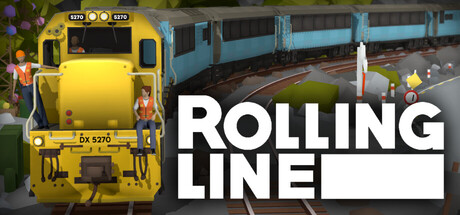
Rolling Line
A solo dev's model railway sandbox that quietly became one of Steam's most-loved sim titles, with a Workshop ecosystem so deep it could consume your entire weekend.
GamerScout Verdict
Best for sandbox and sim fans who want a meditative builder with a thriving mod community, VR optional but welcome.
Compare Prices(3 stores)
Every store in this table quotes us in euros, so the EUR figure is the price the seller actually set, not our arithmetic — which is why EUR is also the currency we rank in. We only list an offer here when the store gives us its price in euros, so nothing in this table is a number we invented.
Pick USD, PLN, GBP, CAD or AUD in the header and we convert from EUR at the European Central Bank reference rate — converted amounts are prefixed with ~. Your bank or the store may apply a different rate at checkout. We never hide offers based on where you are: everyone sees this whole table.
We may earn a commission when you buy games through links on this page — at no extra cost to you. It never affects our rankings or verdicts.
Price History
Screenshots & Media
About Rolling Line
I'll be straight with you: I came into Rolling Line expecting a niche toy for train hobbyists and left having reorganised my entire free evening around a switchboard and a hand-held DCC controller. This is not a grand-strategy sim, but the systems thinking it rewards is very much in my wheelhouse, and the sheer organisational depth of building and operating a working model railway layout surprised me more than I expected from something filed under Casual. At its core, the game gives you two distinct modes of interacting with your railway. In room-scale human mode, you stand over the layout like a giant, pulling rolling stock out of drawers, assembling consists, and throwing switches on a physical control board. Then you shrink down to miniature scale, step inside the cab, and suddenly those little diesel and steam locomotives have a driver's-eye view, dynamic weather, and a skybox that extends convincingly beyond the tabletop edge. That scale-switching mechanic is where Rolling Line earns its reputation. It is genuinely clever design, not a gimmick, and it makes even a modest layout feel twice as large and alive. The Workshop situation is remarkable for a title built by a single developer. Over 7,000 layouts and more than 20,000 mods and liveries are available to subscribe and load in-game with one click. Community members have shipped historically-inspired locomotives covering Pennsylvania Railroad steam engines, Amtrak diesels, New Zealand narrow-gauge prototypes, and much more. The in-game modding pipeline is accessible enough that you mostly need a 3D mesh and a texture, with the rest handled inside the game itself. Regular community map jams keep the Workshop active years after launch. The official built-in layouts span New Zealand, the United States, Brazil, and several other regions, so there is content to explore on day one without touching the Workshop at all. Multiplayer works across a public server browser or private LAN sessions, and Workshop content is supported in co-op as long as all players have the relevant mods downloaded. Where it falls short: the VR control scheme is genuinely finicky in places. Because your virtual hands are solid objects that interact physically with the layout, it is easy to accidentally nudge a train off a siding when you were trying to select it. Non-VR play on keyboard and mouse is smoother in practice, and the interface appears to have been designed with the flat-screen mode as the baseline. Graphically the aesthetic is deliberate low-poly, which holds up as a style choice but will not impress anyone looking for photorealistic scenery. The lack of structured scenarios or challenge objectives also means players who need external motivation to engage with sandboxes may find themselves at sea early on. For newcomers wondering whether there is a learning curve: the game is genuinely approachable on PC. The official layouts give you something working to explore and drive immediately. The in-game magazine series, readable directly from within your virtual room, covers layout building guides and community content at a pace that respects the player's intelligence without overwhelming them. If you are a sim builder who typically needs fifty hours before a game opens up, Rolling Line hands you a functioning railway in the first twenty minutes and trusts you to take it from there. For a solo-developed, sub-20-dollar indie that has been consistently updated since 2018, the depth-to-price ratio is hard to argue with.

Strategy & simulation
Tags
System Requirements
Minimum
- OS
- Windows 7/8/10
- Memory
- 8 GB RAM
- Storage
- 2 GB available space
- Graphics
- GTX 980 or similar (VR) Any low-end graphics card (PC)
- Processor
- Intel i5 range or similar
- Sound Card
- N/A
- VR Support
- SteamVR
Recommended
- OS
- Windows 7/8/10
- Memory
- 8 GB RAM
- Storage
- 2 GB available space
- Graphics
- GTX 1070 or similar (VR) GTX 660 or similar (PC)
- Processor
- Intel i7 range or similar
- Sound Card
- N/A
Keep exploring
Community Discussion
Be the first to comment on Rolling Line.
Reviews & Ratings
No ratings available
Game Info
- Developer
- Gaugepunk Games
- Publisher
- Gaugepunk Games
- Release Date
- Apr 27, 2018