
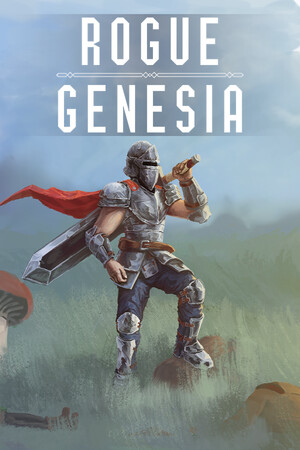
Rogue: Genesia
Vampire Survivors with a strategy spine: branching paths, 60-plus weapons, and a corruption system that will eat your evening if you let it.
GamerScout Verdict
Best for players who want a bullet heaven with a real strategy layer and don't mind imbalanced late-game power curves.
Compare Prices(4 stores)
Every store in this table quotes us in euros, so the EUR figure is the price the seller actually set, not our arithmetic — which is why EUR is also the currency we rank in. We only list an offer here when the store gives us its price in euros, so nothing in this table is a number we invented.
Pick USD, PLN, GBP, CAD or AUD in the header and we convert from EUR at the European Central Bank reference rate — converted amounts are prefixed with ~. Your bank or the store may apply a different rate at checkout. We never hide offers based on where you are: everyone sees this whole table.
We may earn a commission when you buy games through links on this page — at no extra cost to you. It never affects our rankings or verdicts.
Price History
Screenshots & Media
About Rogue: Genesia
I've spent more time than I'd like to admit mapping out weapon evolutions on a notepad while playing Rogue: Genesia, which tells you everything about who this game is actually for. It launched out of Early Access on March 7, 2025 under the 1.0 "Void Descent" update, and the solo developer Ouadi Huard shipped something that goes considerably deeper than the genre's surface appearance suggests. The bullet heaven foundation is exactly what you'd expect: your character auto-attacks, enemies swarm by the hundreds and eventually thousands, and you pick upgrade cards on level-up. Where Genesia separates itself is the structural layer sitting on top of that loop. Instead of surviving a single continuous map until a timer runs out, you navigate a branching path between stages, choosing at each node whether to push into an elite fight for better loot, rest at a shop to spend gold, or take an optional challenge for bonus rewards. It's a decision tree that sits closer to Slay the Spire's run architecture than to Vampire Survivors, and it genuinely changes how you think about resource allocation mid-run. The two primary modes, Rog Mode with its structured path toward a final boss and Survival Mode as a pure endurance gauntlet, give you different contexts to test the same build theories. The build depth is where a strategy-minded player will get stuck for a long time. Over 200 passive upgrades and 60-plus weapons are available, and weapons evolve when combined with specific passive items, so knowing that a Katana plus Fire Spirit produces a stronger evolution is information that actually matters. The six distinct build archetypes, including Pure Power for newcomers, the Zealot negative-defense build, and Metal Transmutation, each demand a different card-selection philosophy during a run. The avatar system layers onto this: the Duelist favors aggressive melee and limited weapon slots with high per-weapon scaling, the Summoner delegates damage to minions, the Corrupted avatar removes the movement-speed cap and introduces shrine events that can dramatically reshape a run, and the Gunslinger opens up weapons like the Railgun, which has damage potential several orders of magnitude above standard choices. Equipment crafting, which lets you forge gear with modifiers between runs, starts optional and quietly becomes essential once you're pushing higher corruption levels. The honest weaknesses are worth naming. Balance is loose in the late game. Many builds reach a point where the corruption difficulty system and exponential stat stacking make bosses melt in milliseconds, and the tension a good roguelite relies on disappears once you've solved even one reliable synergy. Some weapons, the Kunai and Magic Wisp among them, dominate in ways that make less-popular choices feel undertuned by comparison. There's also a community note that the stage-kill-count format, clearing a required number of enemies before the path progresses, can feel abrupt when you're just hitting your momentum. The mod ecosystem exists and Steam Workshop support is present, though the library of community mods is still growing rather than mature. For a newcomer to the genre, the tutorial is functional and the early difficulty curve is manageable. The permanent soul-upgrade shop means every failed run deposits something useful, so there's no dead-end progression. The controller support is reportedly weak, so keyboard-and-mouse is the safer choice. If you're someone who reads tooltips, sketches build orders, and wants to understand why the Zealot archetype pairs negative defense with the Humility card for a damage conversion, this is the kind of game that rewards exactly that investment for well over a hundred hours.

Strategy & simulation
Tags
System Requirements
Minimum
- OS
- Windows 10
- Memory
- 8 GB RAM
- Storage
- 500 MB available space
- Graphics
- GTX 770 / Radeon 8950 HD
- Processor
- Intel i5-7200U @ 2.50GHz
Recommended
- OS
- Windows 11
- Memory
- 16 GB RAM
- Storage
- 1 GB available space
- Graphics
- GTX 1070/RTX 3050
- Processor
- Intel I5 9500 / AMD Ryzen 5 3600
Keep exploring
Community Discussion
Be the first to comment on Rogue: Genesia.
Reviews & Ratings
No ratings available
Game Info
- Developer
- Ouadi Huard
- Publisher
- Ouadi Huard
- Release Date
- Mar 7, 2025