
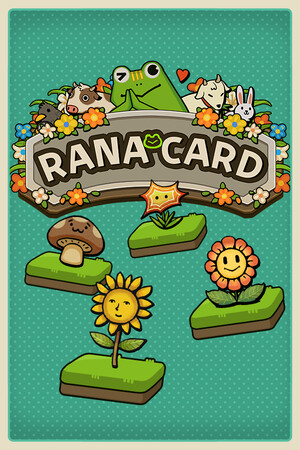
Rana Card
Farm-themed deck-builder with a genuinely tense time-management twist - over 300 cards, multiple playable classes, and an ascension system that keeps theorycrafters busy long after the first win.
GamerScout Verdict
Strong pick for deck-builder fans who want build variety and an active mod scene - weaker at the highest difficulty tiers if you favour plant-explosion archetypes.
Compare Prices(6 stores)
Every store in this table quotes us in euros, so the EUR figure is the price the seller actually set, not our arithmetic — which is why EUR is also the currency we rank in. We only list an offer here when the store gives us its price in euros, so nothing in this table is a number we invented.
Pick USD, PLN, GBP, CAD or AUD in the header and we convert from EUR at the European Central Bank reference rate — converted amounts are prefixed with ~. Your bank or the store may apply a different rate at checkout. We never hide offers based on where you are: everyone sees this whole table.
We may earn a commission when you buy games through links on this page — at no extra cost to you. It never affects our rankings or verdicts.
Price History
Screenshots & Media
About Rana Card
My first hours with Rana Card felt like someone stapled a corporate KPI dashboard onto a Slay the Spire clone, and I mean that as a compliment. The framing - you are a farm manager answering to TimeTech Corporation - sounds absurd, but it gives every run a clear scoring spine: hit your targets, survive the year, and don't let a badly timed Time Explosion blow up the deck math you spent twenty turns building. That single resource, the Time cap you burn each turn by drawing cards, is where the game's real decisions live. Push too hard chasing one more harvest and you trigger a Time Explosion; play too conservatively and your KPI output stalls. That tension is more interesting than it looks on paper. On the strategy side, the card pool is deep enough to matter. With over 300 cards spread across plants, animals, spells, and production cards, plus more than 200 pendant trinkets, the combination space is wide. The broad class archetypes pull in genuinely different directions: plant-growth builds that actively want to generate Time Explosions and convert them into value, animal-management lines that mostly ignore the time gauge once they hit a critical mass, and health-manipulation strategies centered on the orange faction that can absorb punishment and recover. Each of these has its own internal logic and its own ceiling. The community discussions make clear that players are still optimizing high-difficulty runs well past launch, which is a decent proxy for build-space health. The cataclysm and harsh-year systems add a layer that moves Rana Card past basic run-to-run repetition. There are over twenty harsh years and more than ten named cataclysms, each with mechanics specific enough to punish mismatched deck composition - Miasma, Sticky Slime, Parasitic Monolith, and others all operate differently. The branching map events give you agency in routing, and the reward side covers card packs, supply crates, gold, and scratch cards, so there are multiple upgrade vectors to manage per run rather than a single shop. The ascension system layers in difficulty tiers with additional penalties, though the community has noted that certain builds, particularly Time Explosion-reliant plant archetypes, interact awkwardly with higher-difficulty modifiers that limit your free shields. That is a legitimate balance wrinkle worth knowing before you commit to a specific strategy at the top end. The mod ecosystem is already active. VisionRana has shipped a mod editor and Workshop support, with patches addressing modded class compatibility and upload tooling. For a small indie this is a strong signal: the developer is treating the Workshop as a first-class feature, not an afterthought. The hand-drawn art is clean and the tone sits comfortably in the cute-but-crunchy corner of the genre. Newcomers who have never touched a deck-builder may find the tutorial functional but not particularly hand-holding, so arriving with a basic understanding of card synergies helps. That said, the lower difficulty tiers are forgiving enough to learn on, and the class variety means you are not locked into a single learning curve.

Strategy & simulation
Tags
System Requirements
Minimum
- OS
- Windows 10 (64-bit)
- Memory
- 4 GB RAM
- Storage
- 3 GB available space
- Graphics
- NVIDIA GTX 750 Ti
- Processor
- Intel Core i5
Keep exploring
Community Discussion
Be the first to comment on Rana Card.
Reviews & Ratings
No ratings available
Game Info
- Developer
- VisionRana
- Publisher
- IndieArk
- Release Date
- Sep 15, 2025