
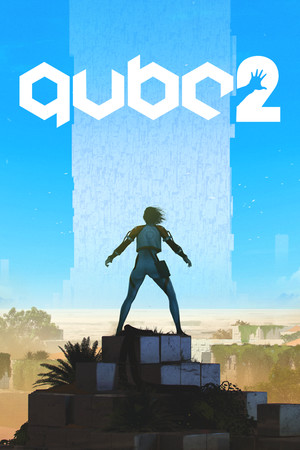
Compare Q.U.B.E. 2 prices across 50+ stores and find the best deal. Developed by Toxic Games. Published by Trapped Nerve Games. Released on 3/13/2018. Available on PC. Genres: Action, Adventure, Indie, Simulation. Metacritic score: 76/100.

If you burned through Portal and want more physics puzzling without the wit, Q.U.B.E. 2 delivers 80+ hand-crafted rooms and a clean difficulty curve, but clocks out in under six hours with almost no reason to return.

My instinct when reviewing a first-person puzzler with sterile white environments and a radio-companion narrator is to reach for a well-worn comparison, and Q.U.B.E. 2 makes that reflex nearly impossible to resist. Toxic Games built something structurally familiar, but let me put the decision-system lens on it anyway, because under the surface there is genuine mechanical craft worth examining before you spend money. The core loop works like this: you wear a suit with manipulation gloves that can imprint three functions onto marked wall panels. Red panels extrude retractable platforms and columns. Blue panels become bounce pads for launching yourself or objects across gaps. Green panels spawn a detachable physical cube you can drag, drop, and redirect. That sounds like a small toolkit, but Toxic Games layers secondary systems on top with real discipline. Oil nozzles coat blocks and reduce friction, and anything oiled can be set alight to burn down specific barriers. Industrial fans redirect momentum. Metal balls roll and smash through targets. Magnets pull green cubes and balls with noticeably better reliability than the original game managed. By the late chapters, a single room asks you to combine four or five of these elements in sequence, and the resulting Rube Goldberg chain is genuinely satisfying when it clicks. The difficulty curve is calibrated well: each mechanic gets isolated practice time before being folded into the compound problems. There is no sprint button and movement is sluggish, which is a minor but real irritant when you are backtracking to reset a failed chain. The structure across eleven chapters and over 80 puzzles is linear by design. There is exactly one intended solution per room, and while that limits the kind of emergent problem-solving you get from something like The Talos Principle, it also means the game can be read, methodically, like a logic problem with a guaranteed answer. For players who bounce off open-ended puzzle sandboxes, that single-solution focus is actually a feature. The tutorial respects your intelligence: new powers are introduced through short, isolated chambers that communicate function through geometry rather than text dumps, and by the time the final yellow glove power arrives, unlocking the ability to spawn any block type freely, the accumulated complexity lands with appropriate weight. Where the game stumbles is on the narrative side and on replay value. Commander Emma Sutcliffe communicates via comlink between rooms, and the mystery the story tries to build never pays off with the kind of punch the setup promises. The voice acting quality is debated across reviews: some found it effective, others found the script wooden. Either way, the story functions mainly as connective tissue rather than as a reason to engage. Critically, a first playthrough runs five to seven hours depending on pace, and once you have seen the two binary endings, there is almost no mechanical incentive to return. No time trials, no score attack, no community puzzle tools. The achievement list is completable in two playthroughs, which is about as deep as the replayability gets. For a puzzle fan, that short runtime might be fine at a low price point but sits awkwardly at full retail. As a pure decision-systems exercise, Q.U.B.E. 2 is a tight, well-paced single session. The physics are reliable enough that when a solution fails, you know the fault is in your reasoning rather than the engine cheating you. Occasional framerate stutters in specific chapters break concentration at the worst moments, and some users have reported puzzle states that required a save reload to resolve, but neither issue is consistent enough to be a dealbreaker. If you have played and loved the original, this is a clear improvement in scope, visual fidelity via Unreal Engine 4, and puzzle complexity. If you are new to the series, the lack of a Portal-style sprint and the thin story are the main friction points. Approach it as a focused logic workout across a single evening and it delivers exactly that. Diego, Scout Team

Q.U.B.E. 2
ActionAdventureIndieSimulation

Q.U.B.E. 2

Mar 13, 2018Toxic GamesTrapped Nerve Games
GamerScout Says

If you burned through Portal and want more physics puzzling without the wit, Q.U.B.E. 2 delivers 80+ hand-crafted rooms and a clean difficulty curve, but clocks out in under six hours with almost no reason to return.

PC
Best Price Available
0.00
at N/A
Historical low: $2.66

Compare Prices(0 stores)

Loading prices...

We may earn a commission when you buy games through links on this page — at no extra cost to you. It never affects our rankings or verdicts.

Screenshots & Media

Screenshot

About Q.U.B.E. 2

My instinct when reviewing a first-person puzzler with sterile white environments and a radio-companion narrator is to reach for a well-worn comparison, and Q.U.B.E. 2 makes that reflex nearly impossible to resist. Toxic Games built something structurally familiar, but let me put the decision-system lens on it anyway, because under the surface there is genuine mechanical craft worth examining before you spend money. The core loop works like this: you wear a suit with manipulation gloves that can imprint three functions onto marked wall panels. Red panels extrude retractable platforms and columns. Blue panels become bounce pads for launching yourself or objects across gaps. Green panels spawn a detachable physical cube you can drag, drop, and redirect. That sounds like a small toolkit, but Toxic Games layers secondary systems on top with real discipline. Oil nozzles coat blocks and reduce friction, and anything oiled can be set alight to burn down specific barriers. Industrial fans redirect momentum. Metal balls roll and smash through targets. Magnets pull green cubes and balls with noticeably better reliability than the original game managed. By the late chapters, a single room asks you to combine four or five of these elements in sequence, and the resulting Rube Goldberg chain is genuinely satisfying when it clicks. The difficulty curve is calibrated well: each mechanic gets isolated practice time before being folded into the compound problems. There is no sprint button and movement is sluggish, which is a minor but real irritant when you are backtracking to reset a failed chain. The structure across eleven chapters and over 80 puzzles is linear by design. There is exactly one intended solution per room, and while that limits the kind of emergent problem-solving you get from something like The Talos Principle, it also means the game can be read, methodically, like a logic problem with a guaranteed answer. For players who bounce off open-ended puzzle sandboxes, that single-solution focus is actually a feature. The tutorial respects your intelligence: new powers are introduced through short, isolated chambers that communicate function through geometry rather than text dumps, and by the time the final yellow glove power arrives, unlocking the ability to spawn any block type freely, the accumulated complexity lands with appropriate weight. Where the game stumbles is on the narrative side and on replay value. Commander Emma Sutcliffe communicates via comlink between rooms, and the mystery the story tries to build never pays off with the kind of punch the setup promises. The voice acting quality is debated across reviews: some found it effective, others found the script wooden. Either way, the story functions mainly as connective tissue rather than as a reason to engage. Critically, a first playthrough runs five to seven hours depending on pace, and once you have seen the two binary endings, there is almost no mechanical incentive to return. No time trials, no score attack, no community puzzle tools. The achievement list is completable in two playthroughs, which is about as deep as the replayability gets. For a puzzle fan, that short runtime might be fine at a low price point but sits awkwardly at full retail. As a pure decision-systems exercise, Q.U.B.E. 2 is a tight, well-paced single session. The physics are reliable enough that when a solution fails, you know the fault is in your reasoning rather than the engine cheating you. Occasional framerate stutters in specific chapters break concentration at the worst moments, and some users have reported puzzle states that required a save reload to resolve, but neither issue is consistent enough to be a dealbreaker. If you have played and loved the original, this is a clear improvement in scope, visual fidelity via Unreal Engine 4, and puzzle complexity. If you are new to the series, the lack of a Portal-style sprint and the thin story are the main friction points. Approach it as a focused logic workout across a single evening and it delivers exactly that. Diego, Scout Team

Tags

singleplayerachievementscontroller-supporttrading-cardscloud-savestier:aaaFirst-Person PuzzlerPhysics-BasedLinear ProgressionSingle-Solution DesignShort RuntimeRube Goldberg MechanicsGlove AbilitiesAlternate Endings

Steam Deck & Linux

Steam Deck PlayableProtonDB Platinum

Valve rates this game Steam Deck Playable. Runs flawlessly on Linux out of the box. Based on 37 ProtonDB community reports.

System Requirements

Minimum

OS
Windows 7 64-bit
Memory
4 GB RAM
DirectX
Version 11
Storage
4 GB available space
Graphics
NVIDIA GeForce GTX 470 or AMD Radeon 6870 HD series card
Processor
Quad-core Intel or AMD processor, 2.5 GHz

Recommended

OS
Windows 7 64-bit or later
Memory
8 GB RAM
DirectX
Version 11
Storage
4 GB available space
Graphics
GeForce 2060 or greater
Processor
Quad-core Intel or AMD processor, 2.5 GHz or faster

Community Discussion

Be the first to comment on Q.U.B.E. 2.

Reviews & Ratings

Metacritic
76

Game Info

Developer
Toxic Games
Publisher
Trapped Nerve Games
Release Date
Mar 13, 2018

Price Alert

Get notified when the price drops below your target!

Create Alert

Price History

2026-06-102.66(lowest)

More from Toxic Games

Buy smarter: helpful guides

Looking for more? See games like Q.U.B.E. 2

Frequently asked questions about Q.U.B.E. 2

How much does Q.U.B.E. 2 cost?

Q.U.B.E. 2 pricing changes often and varies by store, edition and region. The live price table on this page compares the cheapest in-stock key and store offers across 50+ verified shops, so you always see the current lowest price before you buy.

Where can I buy Q.U.B.E. 2 cheapest?

Compare Q.U.B.E. 2 prices across every verified store in the price table on this page. We list the cheapest in-stock key and store offers, updated regularly, so you always see the best current deal before you buy.

What platforms is Q.U.B.E. 2 available on?

Q.U.B.E. 2 is available on PC.

When was Q.U.B.E. 2 released?

Q.U.B.E. 2 was released on 13 March 2018.

Who developed Q.U.B.E. 2?

Q.U.B.E. 2 was developed by Toxic Games and published by Trapped Nerve Games.

Is Q.U.B.E. 2 worth buying?

Q.U.B.E. 2 holds a Metacritic score of 76/100, making it one of the standout Action titles. See the full reviews, ratings and how-long-to-beat times on this page to decide.