
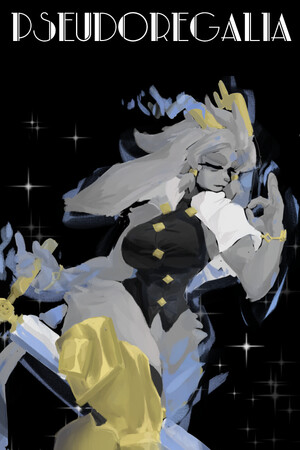
Pseudoregalia
A solo-developer's love letter to N64-era movement that somehow out-feels most big-budget 3D platformers. Short, strange, and deeply satisfying once it clicks.
GamerScout Verdict
Built for players who want to feel every jump, a tight, strange, movement-obsessed gem that rewards patience and punishes combat tourists.
Compare Prices(7 stores)
Every store in this table quotes us in euros, so the EUR figure is the price the seller actually set, not our arithmetic — which is why EUR is also the currency we rank in. We only list an offer here when the store gives us its price in euros, so nothing in this table is a number we invented.
Pick USD, PLN, GBP, CAD or AUD in the header and we convert from EUR at the European Central Bank reference rate — converted amounts are prefixed with ~. Your bank or the store may apply a different rate at checkout. We never hide offers based on where you are: everyone sees this whole table.
We may earn a commission when you buy games through links on this page — at no extra cost to you. It never affects our rankings or verdicts.
Price History
Screenshots & Media
About Pseudoregalia
My first hour with Pseudoregalia felt like being handed a language I didn't quite speak yet. Sybil drops into the dungeon of Castle Sansa with almost nothing, and the game offers no map, no waypoint, no gentle tutorial hand to hold. That opener could read as a warning. Treat it instead as a promise, because everything uncomfortable about those first thirty minutes is paid back with interest once the movement system starts revealing itself. This is, without competition, one of the most thoughtfully constructed locomotion systems in an indie game. You begin with a basic jump and a slide, and the slide alone already feels better than most platformers manage with a full toolkit. From there, the unlocks layer on in a sequence that feels almost musical: slide-jump gives you horizontal distance, wall kicks give you vertical options (with a three-kick limit that forces genuine thought), wall riding opens up the late castle into a playground, and a ground-pound bounce off Sybil's Dream Breaker weapon adds another dimension entirely. Each new ability recontextualises every room you have already visited, and the moment you backtrack through the early dungeon corridors barely touching the floor is one of the genuinely transcendent joys this medium offers. Platforming moves cancel into one another and flow naturally, so the skill ceiling is genuinely high, and the community has already catalogued advanced techniques like slide-ultrahops and greave cancels for anyone who wants to go deep. Combat is the honest weak point. Sybil swings the Dream Breaker in a basic three-hit combo, enemies drop it if certain attacks land and you have to retrieve it, and the healing system borrows from Souls in an interesting way: your power meter fuels both heals and stronger attacks, so spending it is a real decision. But the encounters themselves are sparse and mostly serve as obstacles to sidestep rather than fights to engage. Two boss battles stand out; the rest are texture. If you come looking for a combat-forward action game, look elsewhere. The PS1-era low-poly aesthetic is not nostalgia bait. It is doing real work. The crunchy textures and deliberately dim lighting leave gaps for your imagination to fill, and the game's dreamlike themes earn that ambiguity honestly. The story is similarly oblique, offering almost no explicit context during play, with meaning pooled mostly in the ending cutscene. Some players will find that maddening. I found it atmospheric in the way that half-remembered dreams are atmospheric. The soundtrack deserves its own paragraph: it is quietly legendary, with the environmental tracks setting a mood that is genuinely hard to shake. A post-launch map update, added in March 2024, addressed the biggest practical criticism of the original release. Navigation is far more manageable now, and that removes what was the most legitimate frustration from the experience. Pseudoregalia started as a game jam entry and was expanded into a full release by a single developer. It shows its seams in the breadth of its narrative and the thinness of its combat. It absolutely does not show them in the movement, the level architecture, or the sound design. At around five hours for a first run with meaningful replay in alternate routing and technique mastery, it is a compact thing that knows exactly when to end.

Indie & narrative
Tags
System Requirements
Minimum
- OS
- Windows 10
- Memory
- 8 GB RAM
- Storage
- 600 MB available space
- Graphics
- GTX 1660
- Processor
- Quad-core Intel or AMD 2.5 GHz
Keep exploring
Community Discussion
Be the first to comment on Pseudoregalia.
Reviews & Ratings
No ratings available
Game Info
- Developer
- rittzler
- Publisher
- rittzler
- Release Date
- Jul 28, 2023
