
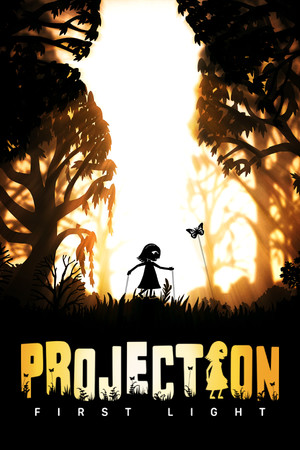
Projection: First Light
Shadow puppetry as a platforming mechanic sounds like a design school pitch - Shadowplay Studios actually pulled it off, mostly, in a 4-5 hour wordless fable that's gorgeous to watch and occasionally maddening to play.
GamerScout Verdict
Best for patient, visual-first puzzle fans who can forgive fussy controls in exchange for one of indie gaming's most distinctive art styles.
Compare Prices(2 stores)
Every store in this table quotes us in euros, so the EUR figure is the price the seller actually set, not our arithmetic — which is why EUR is also the currency we rank in. We only list an offer here when the store gives us its price in euros, so nothing in this table is a number we invented.
Pick USD, PLN, GBP, CAD or AUD in the header and we convert from EUR at the European Central Bank reference rate — converted amounts are prefixed with ~. Your bank or the store may apply a different rate at checkout. We never hide offers based on where you are: everyone sees this whole table.
We may earn a commission when you buy games through links on this page — at no extra cost to you. It never affects our rankings or verdicts.
Price History
Screenshots & Media
About Projection: First Light
My first impression of Projection: First Light was that someone had folded an entire art history lecture into a side-scrolling puzzle game and somehow made it feel intimate. The whole thing originated as a Global Game Jam prototype, and that scrappy, handmade sincerity never quite leaves it. You control two things simultaneously: Greta, a young shadow puppet girl, and a free-floating ball of light guided with the right stick. The core idea is that shadows cast by that light become solid geometry - ramps, platforms, walls - letting Greta traverse environments that would otherwise be impassable. It sounds clever on paper and, when it clicks, it genuinely is. Nudging the light to angle a long diagonal ramp across a chasm, or lifting a stone jar on a shadow to drop it onto a distant switch, produces those small quiet triumphs that good puzzle design lives for. The world Greta moves through is the real star. The game travels through Indonesia, China, Turkey, Greece, and 19th-century England, and each setting is rendered in a distinct shadow puppet idiom. Characters and scenery are mounted on little sticks; backdrops slide in from the wings like a stagehand is working just out of frame. The soundtrack was recorded using antique instruments historically associated with shadow puppet performance, and it shows - each region has its own acoustic texture, something between field recording and scored theatre. There is no dialogue at all, spoken or written, yet the storytelling is expressive enough that you always know who everyone is and what they want. The development team consulted shadow puppet historian Richard Bradshaw during production, and the care taken to represent each culture authentically is palpable. This is not a game that treats world folklore as wallpaper. The honest caveat is that the shadow mechanic, for all its conceptual elegance, is finicky in practice. The light can snap to unexpected angles mid-platforming sequence, knocking Greta off ledges through no fault of the player. Certain object-pushing puzzles - moving boulders onto switches using shadow pressure - feel under-tuned, and a handful of reviewers at launch reported progress-blocking bugs, though patches have since addressed the worst of them. The opening Indonesia section acts as an extended tutorial and runs a touch long; patience is required before the mechanic complexity opens up. And the final chase sequence, a departure from the game's meditative pacing into forced-speed platforming, is the kind of climax that will frustrate players who came for the puzzles. The main path runs four to five hours; collectors chasing the 40 scattered butterflies will add time and encounter some of the game's most demanding optional platforming. Who is this for? Primarily, people who respond to handcrafted aesthetics and dialogue-free storytelling, the crowd that lingered too long in Gris or finished Limbo wishing it had more cultural texture. The light mechanic rewards patient, deliberate players far more than twitchy ones - if you're the kind of person who repositions carefully before committing to a jump, the frustration ceiling drops considerably. It is not a demanding game on the main path; the butterflies are where difficulty lives. Think of it as a moving picture book that occasionally asks you to solve a physics problem, scored by instruments you've probably never heard before.

Indie & narrative
Tags
System Requirements
Minimum
- OS
- Windows 7/8.1/10 x64
- Memory
- 780 MB RAM
- Storage
- 4 GB available space
- Graphics
- GeForce GTX 460 (1024 MB) / Radeon HD 6850 (1024 MB)
- Processor
- Intel Core i5-760 (4 * 2800) or equivalent / AMD Athlon II X4 645 AM3 (4 * 3100) or equivalent
Keep exploring
Community Discussion
Be the first to comment on Projection: First Light.
Reviews & Ratings
Game Info
- Developer
- Shadowplay Studios
- Publisher
- Blowfish Studios
- Release Date
- Sep 29, 2020