Polyology
A Sokoban-rooted puzzler so quietly confident in its one idea that it brought in GoldenEye composers to score it. Two hours well spent, or a surprisingly long afternoon if you chase every star.
GamerScout Verdict
Best for puzzle fans who value tight design and a great ambient score over volume of content.
Compare Prices(3 stores)
Every store in this table quotes us in euros, so the EUR figure is the price the seller actually set, not our arithmetic — which is why EUR is also the currency we rank in. We only list an offer here when the store gives us its price in euros, so nothing in this table is a number we invented.
Pick USD, PLN, GBP, CAD or AUD in the header and we convert from EUR at the European Central Bank reference rate — converted amounts are prefixed with ~. Your bank or the store may apply a different rate at checkout. We never hide offers based on where you are: everyone sees this whole table.
We may earn a commission when you buy games through links on this page — at no extra cost to you. It never affects our rankings or verdicts.
Price History
Screenshots & Media
About Polyology
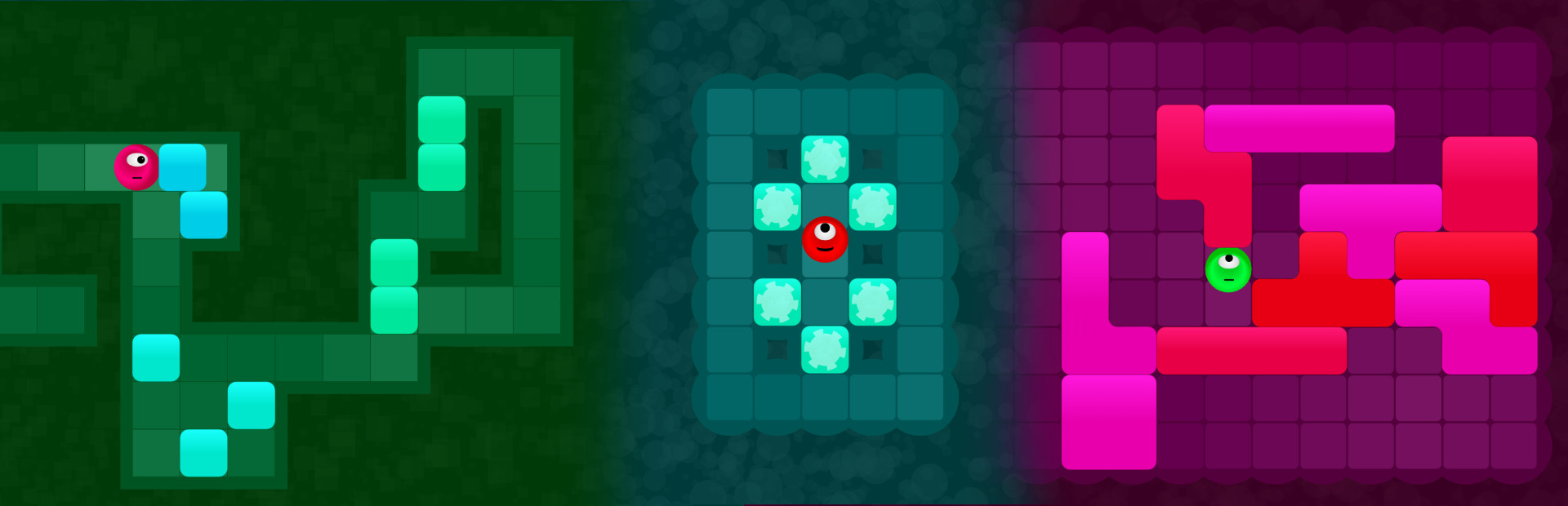
I have a soft spot for puzzle games that know exactly what they are and refuse to apologise for it. Polyology is that kind of game. You play as a small, expressive one-eyed sphere navigating grid-based rooms, pushing numbered blocks together until they vanish. A block marked 2 disappears when it touches one other 2; a block marked 3 needs two neighbours. The rule fits on a napkin. What Gridlock Interactive does with that napkin over 60 levels is genuinely worth your afternoon. The genius is in the layering. Early puzzles feel almost meditative, establishing rhythm rather than stress. Then the game introduces new block variants - switch blocks that swap places with you rather than sliding away from you - and suddenly the same ruleset opens into a different kind of spatial reasoning. Each new mechanic arrives when the previous one has been fully absorbed, which is the mark of a designer who actually playtested the thing. The star rating system ties everything together: complete a puzzle in any number of pushes and you earn one star, but tightening your solution to hit the move-count target earns up to three. Casual players can progress without sweating the optimals. People who hear "minimum moves" as a direct challenge will find real depth here. The safety net is generous and correctly designed. A step-by-step rewind function lets you undo mistakes without restarting the whole level, which keeps frustration low without removing the satisfaction of a clean solve. There is also an Arcade mode that generates randomised puzzles, adding replay value past the curated campaign, though user reports suggest the random element introduces some rough edges that the handcrafted levels avoid. The vector graphics scale cleanly to any resolution, and while the aesthetic is minimal rather than lush, the character animations on your little sphere are genuinely charming and react to what you are pushing in small, expressive ways. Now, the soundtrack. I want to sit with this for a moment, because it is doing more work than a game at this price point has any right to expect. The composers behind it are Graeme Norgate and Ross Tregenza, veterans whose credits include GoldenEye 007, Timesplitters 2, and Crysis 3. What they made for Polyology is low-key and ambient, the kind of music that keeps your brain in a productive, calm state without ever announcing itself. Players in the Steam community have noted, with some surprise, that they expected a throwaway chiptune loop and got something they actually wanted to listen to outside the game. That reaction tracks. It is a genuinely considered soundscape for a genuinely considered puzzle game. The honest caveats: the total puzzle count wraps up in a couple of hours for most players, and the Arcade mode, while a welcome extra, is a rougher experience than the main campaign. If you need a hundred hours of content to feel a purchase is justified, Polyology will not satisfy that particular itch. But if you value craft over volume, and you find joy in the moment a tight puzzle clicks into its optimal solution, this is a small game that earns every minute of the time it asks for.

Indie & narrative
Tags
System Requirements
Minimum
- OS
- Windows 7 or above
- Memory
- 512 MB RAM
- Storage
- 512 MB available space
- Graphics
- Integrated Graphics
- Processor
- 2.50 Ghz Dual-core
Keep exploring
Community Discussion
Be the first to comment on Polyology.
Reviews & Ratings
No ratings available
Game Info
- Developer
- Gridlock Interactive
- Publisher
- Gridlock Interactive
- Release Date
- Mar 28, 2016