

Police Quest: SWAT 2
A late-90s isometric tactics game where you run the LAPD SWAT or play the terrorists against them - the dual-campaign angle is genuinely clever, but the clunky interface will test your patience before the real decisions kick in.
GamerScout Verdict
Best for tactics completionists who can push through a rough interface to reach the genuinely layered dual-campaign design underneath.
Compare Prices(0 stores)
Loading prices...
We may earn a commission when you buy games through links on this page — at no extra cost to you. It never affects our rankings or verdicts.
Price History
Screenshots & Media
About Police Quest: SWAT 2
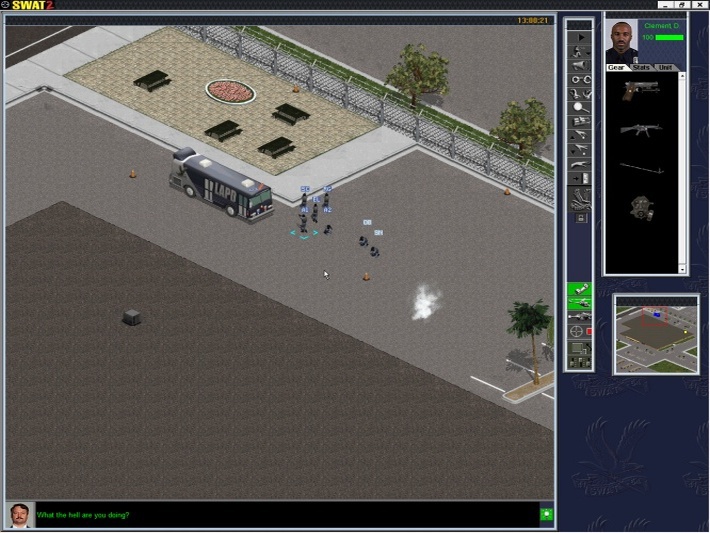
My first instinct when loading Police Quest: SWAT 2 was to treat it like a light real-time strategy game, clicking units around like a budget Command and Conquer. That instinct gets punished fast. This is a real-time tactics game built around squad-level decision-making, personnel budgets, rules of engagement, and the kind of mission debriefs that sting when you left a hostage unsecured. The structural hook is the best thing about it. You get two fully separate 15-mission campaigns: one commanding LAPD SWAT through escalating crises across Los Angeles, the other running the Five Eyes, a domestic terrorist militia that operates by completely different rules. SWAT must follow strict rules of engagement, preferring arrests over kills, managing department funding and public support as performance metrics that carry across missions. Lose officers carelessly, mishandle civilians, or botch a negotiation and you start the next mission with a smaller budget and less-trained personnel. The Five Eyes campaign flips this entirely - members must be recruited and paid rather than drawn from a ready pool, and lethal outcomes carry almost no consequences. The asymmetry between the two factions goes deeper than reskinned units: SWAT has four support options including air spotting, a breach vehicle, and sniper request; the terrorists get two. Weapons differ too, with SWAT fielding the MP5 and Robar SR60 sniper rifle while Five Eyes counters with the LR-300 and MSG-90. Picking the right loadout per mission, deciding whether to equip gas masks given the tight indoor spaces, choosing between a flashbang rush or tear gas first - this is where the decision-making lives, and it is legitimately interesting. The problems are real and you should know them going in. The interface is genuinely complicated, and player reviews consistently note you will spend several hours just getting comfortable with it before the tactical layer opens up properly. Unit AI is unreliable: officers frequently fail to follow proper procedure without constant nursemaiding, and the feedback loop when something goes wrong is weak. You fail a mission, but the game rarely tells you clearly why. There is also a known exploit where selling the sidearms of unused roster members effectively breaks the budget system, which undermines the financial pressure that is supposed to give the campaign structure. Playtime is short by modern standards - the full scenario set can be cleared in under ten hours on a first run. For a strategy and tactics player willing to absorb the learning curve, the depth of the pre-mission preparation screen is the real draw. Selecting your element composition, certifying officers as element leaders, rotating injured personnel, managing sniper team assignments and breach gear - this loop has more texture than the game's age and rough edges suggest. The missions themselves are drawn from real LAPD incidents, including a scenario based on the 1997 North Hollywood shootout and a riot sequence that echoes the 1992 LA events, which gives the SWAT campaign an unusual sense of grounded context. Sonny Bonds from the original Police Quest series also appears as a recruitable SWAT officer with strong starting stats - a detail longtime Sierra fans will appreciate. This is a nostalgia purchase or a curiosity pick for tactics completionists. The dual-campaign design and the faction asymmetry hold up as ideas even when the execution strains around them. If you have never touched the series, SWAT 3 (released the following year) solved most of the interface and AI problems in first-person. SWAT 2 is for the person who wants the campaign management layer and is willing to fight the controls to get to it.

Strategy & simulation
Tags
System Requirements
Minimum
- OS
- Windows XP / Vista
- Memory
- 256 MB RAM
- DirectX
- Version 7.0
- Storage
- 700 MB available space
- Graphics
- DirectX 7 compatible AMD / NVIDIA graphics card
- Processor
- 1.0 GHz
- Sound Card
- Direct X compatible
Recommended
- Memory
- 512 MB RAM
- DirectX
- Version 9.0
- Graphics
- DirectX 9 compatible AMD / NVIDIA graphics card
- Processor
- 1.4 GHz
Keep exploring
Community Discussion
Be the first to comment on Police Quest: SWAT 2.
Reviews & Ratings
No ratings available
Game Info
- Developer
- Yosemite Entertainment
- Publisher
- Sierra
- Release Date
- Apr 18, 2017