
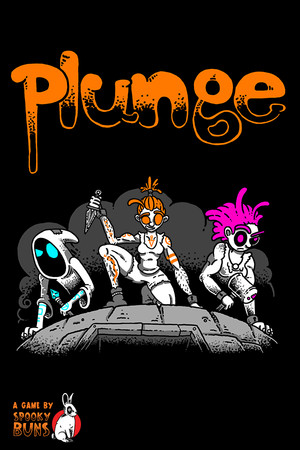
Plunge
Turn-based dungeon puzzler where your only move is a full-board slide - sounds limiting, but that one rule generates more tactical decisions per floor than most roguelites manage in an entire run.
GamerScout Verdict
Ideal for roguelite fans who want bite-sized sessions with real per-turn tactics, as long as the opaque unlocks and uneven difficulty curve don't put you off.
Compare Prices(0 stores)
Loading prices...
We may earn a commission when you buy games through links on this page — at no extra cost to you. It never affects our rankings or verdicts.
Price History
Screenshots & Media
About Plunge
My first instinct when I saw the movement system in Plunge was scepticism. You press a direction, your character slides the full length of the floor until a wall or enemy stops them. That's it. No stepping one tile at a time, no positioning finesse in the traditional sense. What Spooky Buns figured out, though, is that permanently removing precise movement forces you to treat every floor like a miniature logic puzzle before you commit to a single input. The calculus of "if I go left first, I collide with the guard, which positions me for the food item, which survives the next two slides" is happening on every single turn. That's a genuine mechanical surprise for a budget indie. The structure across the game's three sections is classic roguelite. Each world runs roughly 30 floors deep, drawn from a pool of over 400 randomly selected layouts, capped with a boss fight. Killing enemies is largely optional since there is no experience or leveling system - the real incentive is grabbing food to restore health, armor pieces that act as bonus hit points, and potions with effects ranging from temporary invulnerability to straight-up self-poisoning. Potions start unidentified, so the first time you drink one is a calculated gamble. Charges (passive abilities you earn from the shopkeeper every ten floors or so) are the run-defining layer: one lets you knock enemies backward if you slide from distance, another drains health from targets on contact. Losing a run wipes your Charges, which stings after a 25-floor push, but it also means each attempt plays out differently at the tactical level. The character roster adds a second axis of variance. The default Billie loads up on health; another character gets armor scaling; a low-health option that marks enemies for extra damage on follow-up hits was, by multiple accounts, the most skill-testing pick available. Unlock conditions are opaque, which is a real design miss - you will unlock characters without knowing why, and the game never tells you what milestones trigger them. The difficulty curve is similarly uneven: the first 60 floors tend to be forgiving enough that you can play reactively rather than carefully, which trains bad habits that the later sections then punish hard. No mid-run saving compounds this, so a long push that ends to a misidentified poison potion feels genuinely cheap. These are not dealbreakers in a game at this price point, but they are friction points worth knowing about before you sit down. Visually, Plunge is sharper than screenshots suggest. The predominantly black-and-white isometric style uses neon accents (primarily pink) to flag enemies, hazards, and keys at a glance, so the minimalist palette is doing real information work rather than just being aesthetic. Animations are snappy and responsive - players have noted that the feedback on attacks and floor landings has a physicality that many turn-based games lack. The music is a weak point; each section loops a single track that is serviceable but forgettable enough that background listening is a practical upgrade. One persistent technical note: the Mac version has compatibility issues with macOS Catalina and above, so Mac buyers should verify their OS version before purchasing. A small community has also reported minor post-game bugs involving black screens and unresponsive states after certain boss fights, which appear unpatched as of this writing. For strategy-minded players who want a short-session roguelite that actually demands forward planning rather than reflexes, Plunge punches above its weight. A full run lands somewhere in the 10-15 hour range depending on how methodically you play. The absence of a mod ecosystem and the thin community mean you are getting what ships in the box, no more. But what ships in the box is a tightly engineered movement gimmick that earns its design premise floor after floor.

Strategy & simulation
Tags
System Requirements
Minimum
- OS
- Windows 7
- Memory
- 4 GB RAM
- DirectX
- Version 9.0
- Storage
- 2 GB available space
- Graphics
- Intel HD 4400
- Processor
- Intel H81 core i3 4130T 2.90GHZ (dual core)
Recommended
Windows 7
Keep exploring
Community Discussion
Be the first to comment on Plunge.
Reviews & Ratings
No ratings available
Game Info
- Developer
- Spooky Buns
- Publisher
- N/A
- Release Date
- Aug 23, 2019