Pixel Survivors
A mixed-reception god-game where your production chain runs on vibes and the villager AI runs on chaos. Satisfying for patient builders, frustrating for everyone else.
GamerScout Verdict
Worth a look for patient god-game veterans who read guides first; everyone else will hit a wall within the first session.
Compare Prices(0 stores)
Loading prices...
We may earn a commission when you buy games through links on this page — at no extra cost to you. It never affects our rankings or verdicts.
Price History
Screenshots & Media
About Pixel Survivors
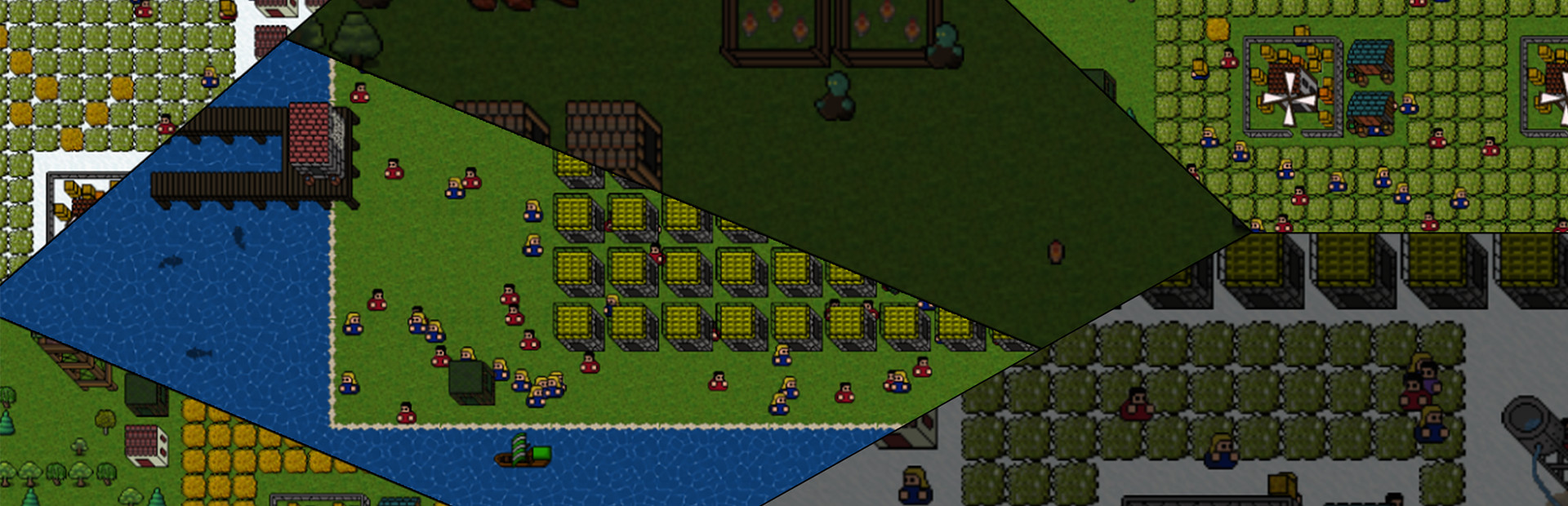
I went in expecting a lean, focused village-builder and came out having spent more time babysitting pixel people than actually planning anything. Pixel Survivors puts you in the seat of an absent deity: you terraform land, place housing, farms, chicken pens, forges, tailors, mines, foresting towers, windmills, and sawmills, then watch a tiny society either thrive or slowly eat itself. The god-game framing is accurate. You do not control villagers directly. You set the infrastructure conditions and hope the autonomous population figures out the rest. That hands-off tension is the core appeal, and on a good run it genuinely works. The production chain has real bones to it. Early pressure comes from food and shelter. Once those are stable you are pushed into a second tier: raw materials dry up on the surface, so mines and foresting towers become non-negotiable. Efficiency buildings like windmills and sawmills are the late-game multiplier layer, the closest this game gets to meaningful tech progression. For players who like thinking a few buildings ahead, there is a satisfying loop buried here. The problem is the loop is buried under a user-experience that actively fights you. There is no tutorial. You launch into a game with no explanation of what the buttons do, no build-order guidance, and no tooltip context for why your population is dying. The community has filled the gap with written guides, and if you read one before starting, the game opens up considerably. But requiring external documentation to understand a casual-tagged game is a design failure, not a quirk. The villager AI is the most consistently criticized aspect across player feedback, and the criticism is fair. Pathfinding breaks regularly, and villagers idle or jitter instead of completing assigned tasks, forcing you into constant micromanagement that undercuts the god-game fantasy entirely. When you should be planning your next expansion, you are instead debugging NPCs. The visual presentation is functional but sparse, and sound variety is limited. For a game that left Early Access after roughly two years and over fifty patches, the persistent pathfinding issues are a disappointment. The Steam review split sits at a mixed 57 percent positive across 173 reviews, which is an honest reflection of a game that works for a narrow audience and bounces the rest. Here is who will get something out of this: players already comfortable with the old-school Bullfrog god-game format, who are willing to read a community guide upfront and accept that the AI will require some hand-holding. If you have ever kept a spreadsheet for a Banished run, the resource chain here has enough structure to keep you occupied for a few sessions. If you need a game to explain itself or if AI autonomy is a dealbreaker for your playstyle, Pixel Survivors will frustrate you inside the first twenty minutes. There is no mod ecosystem worth noting, no multiplayer, and no clear post-launch content roadmap. What you see is what the game is.

Strategy & simulation
Tags
System Requirements
Minimum
- OS
- Windows 7
- Memory
- 2 GB RAM
- Storage
- 350 MB available space
- Graphics
- Intel HD 4400 or equivalent
- Processor
- Core 2 Duo or equivalent
Recommended
- OS
- Windows 7 - Windows 8/8.1
- Memory
- 4 GB RAM
- Storage
- 350 MB available space
- Graphics
- Dedicated Gpu - 1 GB+
- Processor
- Core i3, i5, i7 or equivalent
Keep exploring
Community Discussion
Be the first to comment on Pixel Survivors.
Reviews & Ratings
No ratings available
Game Info
- Developer
- Patagoniart
- Publisher
- Patagoniart
- Release Date
- May 5, 2016