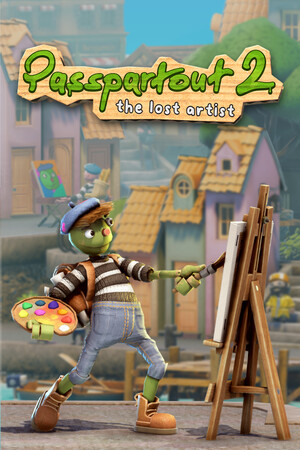
Passpartout: The Starving Artist
You draw actual paintings with a mouse, then haggle with snooty customers to fund your wine habit. Surprisingly addictive, deeply silly.
GamerScout Verdict
A charming, lightweight painting sim best enjoyed as a two-hour palette cleanser rather than a long-term commitment.
Compare Prices(6 stores)
Every store in this table quotes us in euros, so the EUR figure is the price the seller actually set, not our arithmetic — which is why EUR is also the currency we rank in. We only list an offer here when the store gives us its price in euros, so nothing in this table is a number we invented.
Pick USD, PLN, GBP, CAD or AUD in the header and we convert from EUR at the European Central Bank reference rate — converted amounts are prefixed with ~. Your bank or the store may apply a different rate at checkout. We never hide offers based on where you are: everyone sees this whole table.
We may earn a commission when you buy games through links on this page — at no extra cost to you. It never affects our rankings or verdicts.
Price History
Screenshots & Media
About Passpartout: The Starving Artist
Passpartout: The Starving Artist is a casual simulation from Flamebait Games that puts you in the beret of a broke French painter surviving on baguettes and self-delusion. The core loop is refreshingly direct: open your easel, draw something using basic brush tools, set a price, and watch a stream of opinionated customers either pay up or insult your work to your face. There are no resource trees, no tech queues, no fog of war. As someone who normally color-codes Paradox patches for fun, I'll admit this one caught me off guard by being genuinely engaging despite its total lack of systems complexity. What carries the game is the subjectivity baked into its economy. Customers have shifting tastes - some want abstract blobs, others want recognizable subjects, and the game never tells you exactly what will sell today. That loose feedback loop creates a surprisingly interesting micro-decision space: do you chase the crowd or hold your artistic line and wait for the right buyer? Your expenses are fixed (rent, wine, baguettes - yes, really), so there is a light survival pressure that keeps sessions from drifting into pure sandbox territory. The price negotiation mechanic, where customers make counter-offers you can accept or reject, adds a small but satisfying layer of read-the-room judgment. The drawing tools are intentionally limited. You get a handful of brush sizes and a color palette, and the results look exactly as chaotic as you would expect from someone using a mouse. That is the point. The game does not judge your technique; it judges whether you can convince its fictional audience that your stick figures have merit. New players will find no learning curve worth worrying about - if you can click and drag, you can play. The tutorial is minimal, which is fine here because the entire ruleset fits in one screen of reading. Where Passpartout runs short is in long-term depth. After a few hours the customer archetypes become predictable, the environments you unlock follow a clear prestige ladder, and the core loop does not introduce meaningful new mechanics. There is no mod ecosystem to speak of, the AI buyers never develop into genuinely reactive agents, and late-game progression is largely cosmetic. For a strategy player hunting decision density, this is closer to a palette cleanser than a main course. But that is not necessarily a flaw - the game is priced and scoped as a short, charming experience, and it delivers on that contract honestly. The Steam review sentiment (88% positive across nearly 7,000 reviews) lines up with what you actually get: a light, funny, low-stress few hours that works well when you need a break from something heavier. It respects your time by not padding itself out. If you have a friend who keeps saying games are too complicated, this is a genuinely low-friction entry point. For the strategy crowd, it is worth an afternoon, just do not expect a second playthrough to reveal hidden mechanics.

Strategy & simulation
Tags
System Requirements
Minimum
- Processor
- Intel Core i3 or equivalent
- Memory
- 1 GB RAM
- Graphics
- GeForce GTX 460 or Radeon HD 6850
- DirectX
- Version 9.0c
- Storage
- 2 GB available space
Recommended
- Processor
- Intel Core i5 or equivalent
- Memory
- 2 GB RAM
- Graphics
- GeForce GTX 680 or Radeon HD 7970
- DirectX
- Version 11
- Storage
- 2 GB available space
Keep exploring
Community Discussion
Be the first to comment on Passpartout: The Starving Artist.
Reviews & Ratings
Game Info
- Developer
- Flamebait Games
- Publisher
- Flamebait Games
- Release Date
- Jun 6, 2017