
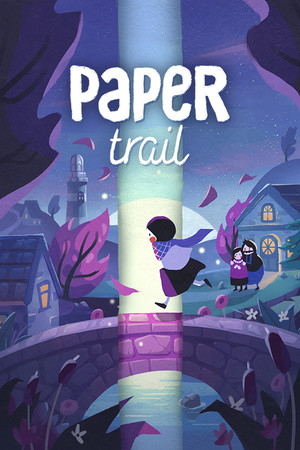
Paper Trail
Spatial reasoning disguised as a cozy storybook: Paper Trail's origami folding mechanic asks more of your brain than the watercolor art lets on, and 94% of Steam reviewers think that trade-off is worth it.
GamerScout Verdict
Confident buy for puzzle fans who want a mechanical hook they haven't seen before, with patience for a thin story.
Compare Prices(7 stores)
Every store in this table quotes us in euros, so the EUR figure is the price the seller actually set, not our arithmetic — which is why EUR is also the currency we rank in. We only list an offer here when the store gives us its price in euros, so nothing in this table is a number we invented.
Pick USD, PLN, GBP, CAD or AUD in the header and we convert from EUR at the European Central Bank reference rate — converted amounts are prefixed with ~. Your bank or the store may apply a different rate at checkout. We never hide offers based on where you are: everyone sees this whole table.
We may earn a commission when you buy games through links on this page — at no extra cost to you. It never affects our rankings or verdicts.
Price History
Screenshots & Media
About Paper Trail
I spend most of my hours in grand strategy, so a sub-10-hour puzzle game usually stays off my radar. Paper Trail changed that calculation the moment I understood what its core mechanic actually demands. You are not folding paper for decoration. You are performing multi-step spatial transforms on a double-sided grid, tracking what is on the reverse face, where Paige is standing, and how her position constrains which folds are even legal. That is a genuine systems problem, and it hooked me immediately. The setup is straightforward enough. You guide Paige, a young woman escaping her overprotective parents to pursue an astrophysics degree, through dozens of screens divided across several distinct areas: a cave, a swamp, ruins, an abandoned cathedral, and more. Each screen is a puzzle. The goal is always the same, get Paige to the exit, but the path requires folding each sheet of paper horizontally, vertically, or diagonally, combining front and back faces to stitch together walkable routes. Folds cannot cross each other, cannot cross Paige, and cannot cross certain blocking objects. Early on this feels like a warmup. By the time the game introduces lava circuits, portal doors, electrical currents routed through wires, and non-rectangular multi-sheet layouts, you are juggling a surprising number of variables per room. The complexity creep is well-paced: harder levels are occasionally followed by simpler ones rather than stacking difficulty indefinitely, which keeps frustration from calcifying into a wall. The tutorial deserves specific credit here. After the first level's brief text instructions, the game teaches every subsequent mechanic entirely through level design, no dialogue required. Each new area drops one fresh rule, lets you internalize it across a handful of screens, then layers the next rule on top. That is competent design by any standard. The hint system is also worth mentioning: pressing the hint key reveals the fold sequence for a given puzzle without solving Paige's movement for you, which threads the needle between useful and hand-holdy. Origami figurine collectibles, hidden throughout levels and requiring fiddly optional folding to reach, add a completionist track that genuinely extends the challenge for anyone who clears the main path without much trouble. Where Paper Trail earns its criticism is in two areas. The story, while emotionally earnest, functions mainly as set dressing. Paige's narrated transitions between areas and the journal entries explaining her family background are touching in isolation, but players chasing narrative depth will find it thin. More practically, the hint system's revelation of fold order does not always resolve the spatial confusion of working out what is actually on the other side of a given section, which means some players will still hit trial-and-error loops that the game cannot fully rescue them from. The pace also favors short sessions. Reviewed across extended play, the fold-move-fold rhythm can grow fatiguing, and several critics noted the same; it is a game that resets better after a break than it sustains across a long sitting. Production values are strong across the board. The watercolor and printmaking-influenced art shifts palette meaningfully between biomes, the autumn chapter in particular lands visually. The soundtrack is calm without being forgettable, and the gibberish character voices land somewhere between Peanuts and Banjo-Kazooie in the best possible way. At roughly eight to nine hours including collectibles, Paper Trail is a complete, self-contained experience with no padding. It knows exactly what it is.

Strategy & simulation
Tags
System Requirements
Minimum
- OS
- Windows 7 SP1+
- Memory
- 4 GB RAM
- DirectX
- Version 11
- Storage
- 1 GB available space
- Graphics
- Geforce GT 420, Radeon HD 7400G
- Processor
- Intel or AMD Dual Core at 2 GHz
Keep exploring
Community Discussion
Be the first to comment on Paper Trail.
Reviews & Ratings
Game Info
- Developer
- Newfangled Games
- Publisher
- Newfangled Games
- Release Date
- May 21, 2024