
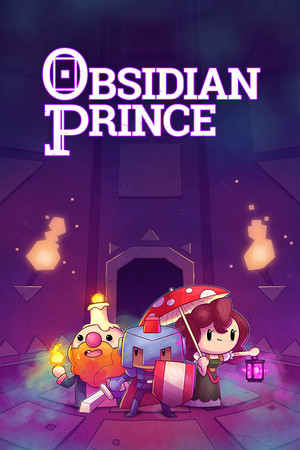
Obsidian Prince
Part Mystery Dungeon, part deck-builder, part base-rebuilder: Obsidian Prince quietly does several genre jobs at once and mostly gets away with it.
GamerScout Verdict
Solid pick for grid-tactics fans who want deck-building layered in without the randomness that usually comes with it.
Compare Prices(0 stores)
Loading prices...
We may earn a commission when you buy games through links on this page — at no extra cost to you. It never affects our rankings or verdicts.
Price History
Screenshots & Media
About Obsidian Prince
My spreadsheet brain lit up within the first twenty minutes of Obsidian Prince, and not in a good way. There is a lot happening here, and the game does not fully telegraph its own depth until you've died a couple of times and started paying attention to what actually killed you. That said, once the systems click, this small indie from Stockholm-based developer Unleash the Giraffe reveals genuine mechanical intelligence under its cheerful voxel surface. At its structural core, Obsidian Prince is a grid-based, turn-based dungeon crawler with permadeath, split across two distinct modes: a roguelike mode built around climbing high scores through increasingly punishing runs, and a campaign mode where you rebuild the world of Emalon, complete quests, and expand a base between expeditions. The campaign gives the game real staying power. Rather than dying and restarting from nothing, you carry a sense of progress across hero deaths, which softens the blow of permadeath without removing its teeth entirely. Each hero that falls makes the road fractionally easier for their successor, which is a smart meta-loop for players who find pure roguelikes exhausting. The combat is where the decision-making density really concentrates. The game uses a deterministic "you move, they move" system: no percentage rolls, no dice. Every action produces a predictable outcome, which means when you get hit, it is because you misread the board, not because the RNG laughed at you. Enemy attack ranges are displayed clearly, and a quality-of-life toggle shows all enemy zones of control simultaneously, which players have specifically praised in community discussion. The challenge comes from cognitive load, not artificial randomness. As room complexity scales, tracking every threat line becomes genuinely difficult, producing real tactical pressure from a fair system. Positioning matters the way it does in Into the Breach, with the added wrinkle of a diagonal move that attacks adjacent enemies as you pass through them, creating satisfying lines of play. Layered on top is the dual-deck system: Backstory cards and Inspiration cards. Backstory draws give temporary map-level bonuses, while three Inspiration cards are automatically drawn each turn and modify your available actions by changing costs, adding effects, or boosting damage. Your nine class options each bring their own starting weapon set and innate abilities. The Warrior charges and stuns, the Ranger calls in a crow for persistent damage-over-time, the Candlemage burns the board, and the Mold Druid corners enemies by spreading mold across tiles, which rewards patient players who plan movement three turns ahead. Multiclassing and gear swapping open further build variety. The combinations are genuinely interesting, not just numerically but positionally: a Mold Druid who also kites with ranged gear plays completely differently from one who goes melee and uses mold as a chokepoint tool. The honest caveats: the game sits at a modest 78% positive rating from a relatively small sample, and the music has been noted as disjointed, cutting between tracks abruptly without clean transitions. The campaign's pun-heavy writing leans hard into deliberate silliness, which will either charm you or grate on you within the first hour. Mod support and community tooling are essentially absent at this scale. But for the price point, the mechanical density is real. Players with a tolerance for learning-by-dying and a taste for positioning puzzles will find a surprisingly well-tuned tactical loop here. If you came from Into the Breach or the Shiren the Wanderer line and want something that grafts deck manipulation onto that formula, Obsidian Prince earns your time.

Strategy & simulation
Tags
System Requirements
Minimum
- OS
- Windows 10
- Memory
- 8 GB RAM
- DirectX
- Version 11
- Storage
- 2 GB available space
- Graphics
- Geforce GT 740 / Radeon R7 250 or above
- Processor
- Intel Core i3 or higher
Recommended
- OS
- Windows 10
- Memory
- 8 GB RAM
- DirectX
- Version 11
- Storage
- 2 GB available space
- Graphics
- Geforce GT 780 / Radeon R7 250 or above
- Processor
- Intel Core i5 or higher
Keep exploring
Community Discussion
Be the first to comment on Obsidian Prince.
Reviews & Ratings
No ratings available
Game Info
- Developer
- Unleash The Giraffe
- Publisher
- Unleash The Giraffe
- Release Date
- May 24, 2022