Nuclear War Simulator
If you have ever wanted to stress-test your Cold War deterrence theories with real warhead yields and actual population grids, this is the only PC tool that lets you do it at full scale - but go in knowing it is a simulator first and a game a distant second.
GamerScout Verdict
Best for wargame analysts and Cold War history enthusiasts who want simulation depth over competitive gameplay loops.
Compare Prices(6 stores)
Every store in this table quotes us in euros, so the EUR figure is the price the seller actually set, not our arithmetic — which is why EUR is also the currency we rank in. We only list an offer here when the store gives us its price in euros, so nothing in this table is a number we invented.
Pick USD, PLN, GBP, CAD or AUD in the header and we convert from EUR at the European Central Bank reference rate — converted amounts are prefixed with ~. Your bank or the store may apply a different rate at checkout. We never hide offers based on where you are: everyone sees this whole table.
We may earn a commission when you buy games through links on this page — at no extra cost to you. It never affects our rankings or verdicts.
Price History
Screenshots & Media
About Nuclear War Simulator
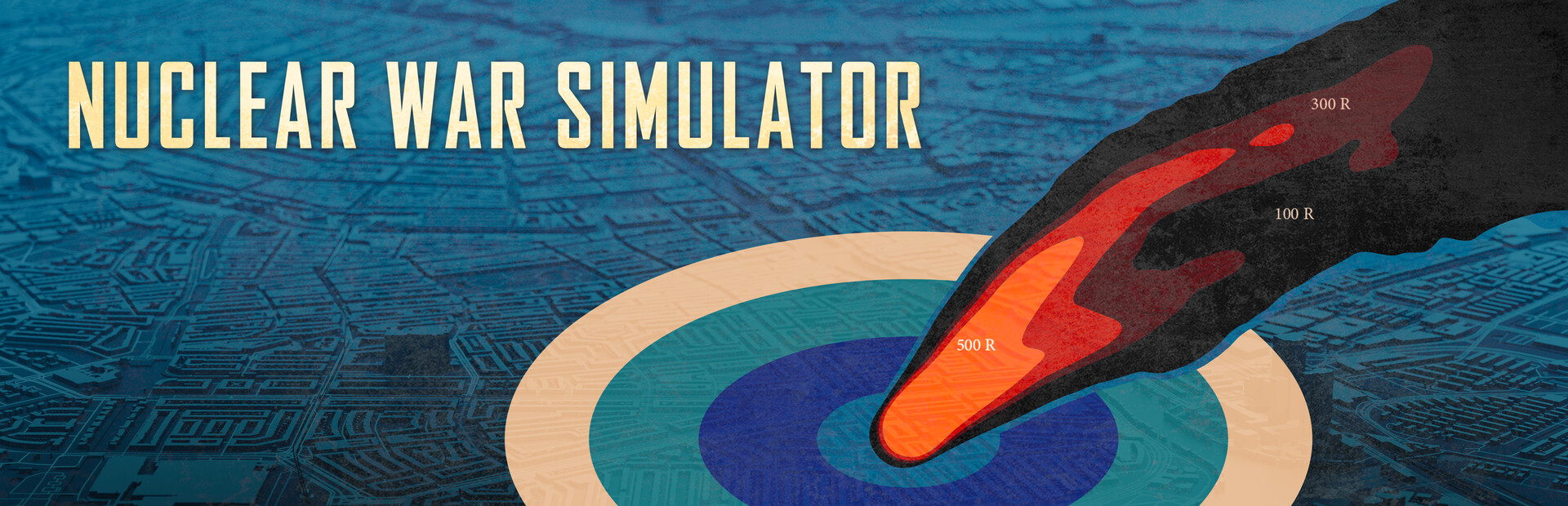
I spend a lot of time with numbers in strategy games - unit stats, supply lines, hex-grid probabilities - but Nuclear War Simulator put me in front of a different kind of spreadsheet entirely: a high-resolution global population density grid with blast radii overlaid on real cities. That combination of genuine sobriety and deep mechanical fidelity is what makes this one genuinely hard to categorize, and harder still to dismiss. At its core the tool - and calling it a tool is not a slight, it is an accurate description - lets you build nuclear conflict scenarios from scratch or modify over 22 pre-made ones. You design warheads from the ground up, mount them onto delivery systems ranging from ICBMs in silos to submarine-launched missiles, cruise missiles on aircraft, and road-mobile TELs, then place your forces on the map either by clicking manually or by importing real-world coordinates via KMZ files. Effects modeled include blast overpressure, thermal radiation, fires, and fallout, with wind data varying by month, day, and time of day feeding the fallout dispersal. A nuclear winter estimate derived from calculated soot output rounds out the consequences layer. The targeting AI will handle assignment if you want a fast first look, but the real depth comes from manual allocation: deciding how many warheads to dedicate to hardened silos versus soft civilian infrastructure, weighing circular error probable against target hardness, thinking through second-strike capacity. That decision loop is genuinely interesting and has more strategic texture than you might expect from something marketed primarily as a visualization tool. The Meyer Update, released in early 2025, added a structured Campaign mode whose missions escalate in complexity and effectively serve as a tutorial sequence - something the launch version badly needed. Before that update, newcomers were largely left to reverse-engineer the UI on their own. With it in place, the onboarding situation is meaningfully better, though the simulation still rewards patience and a willingness to read carefully. Integrated early warning and missile defense systems add another layer of decision-making that was undercooked at launch but has been progressively improved. The mods.io sharing pipeline lets you pull community scenarios directly in-game, which extends replay value considerably once you exhaust the preset library. The friction points are real and worth naming plainly. Steam community sentiment sits in mixed territory, with the recurring criticism being that several advertised systems felt incomplete at release and that the product asks full-release prices for what some reviewers felt was closer to a polished early-access build. Certain communication-chain mechanics between command authority and deployed units remain lightly tested by the developer's own admission. Modding is limited to textures, loading screens, and music rather than the deeper scenario scripting that a sim community would really want. Anyone coming in expecting a competitive real-time strategy experience like DEFCON will be confused and probably frustrated - this does not pit you against an adversarial AI in real time. You are the one pushing all the buttons on both sides. For the right buyer - someone drawn to wargame analysis, nuclear policy research, or the kind of cold mechanical curiosity that makes NUKEMAP compelling - this fills a niche nothing else on PC occupies at this fidelity. Post-launch updates have steadily addressed the roughest edges, and the developer shows no signs of abandoning it. Approach it as a serious simulation instrument with scenario-building at its center, not as a strategy game with a win condition, and the depth justifies the entry cost.

Strategy & simulation
Tags
System Requirements
Minimum
- OS
- Windows 10/11
- Memory
- 8 GB RAM
- Storage
- 11 GB available space
- Graphics
- DirectX 11 or OpenGL 4.3 compatible graphics card with 3 GB of VRAM
- Processor
- 1.5 GHz
Recommended
- OS
- Windows 10/11
- Memory
- 16 GB RAM
- Storage
- 11 GB available space
- Graphics
- DirectX 11 compatible graphics card with 6 GB of VRAM
- Processor
- quadcore or more
Keep exploring
Community Discussion
Be the first to comment on Nuclear War Simulator.
Reviews & Ratings
No ratings available
Game Info
- Developer
- Bit Mirror
- Publisher
- Matrix Games
- Release Date
- Feb 2, 2023