Not The Robots
Crouch behind the filing cabinet you're supposed to eat, or die. That tension loop is stupidly compelling for a budget roguelike stealth game from 2013, even if it runs out of ideas before you run out of lives.
GamerScout Verdict
Worth a session or two for stealth fans who want a clever tension loop, but expect depth to plateau well before the five-hour mark.
Compare Prices(6 stores)
Every store in this table quotes us in euros, so the EUR figure is the price the seller actually set, not our arithmetic — which is why EUR is also the currency we rank in. We only list an offer here when the store gives us its price in euros, so nothing in this table is a number we invented.
Pick USD, PLN, GBP, CAD or AUD in the header and we convert from EUR at the European Central Bank reference rate — converted amounts are prefixed with ~. Your bank or the store may apply a different rate at checkout. We never hide offers based on where you are: everyone sees this whole table.
We may earn a commission when you buy games through links on this page — at no extra cost to you. It never affects our rankings or verdicts.
Price History
Screenshots & Media
About Not The Robots
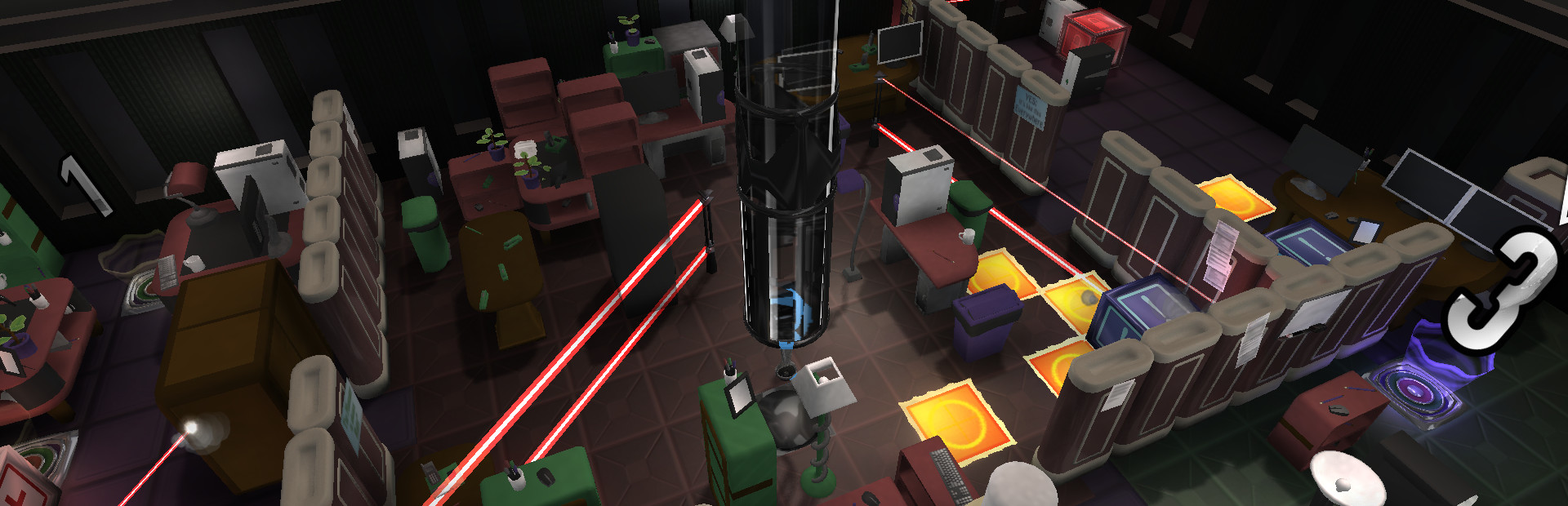
I picked up Not The Robots expecting a throwaway indie gimmick and got genuinely tense for forty minutes straight. The central mechanic is smarter than it sounds: furniture is simultaneously your objective and your only cover, so every piece you consume is a calculated gamble. Eat too fast and you are exposed to patrolling machine-gun guards and spinning sentry heads with no way to fight back. Eat too slow and you fail the floor's quota. That push-pull is the entire game, and for a while it absolutely works. The campaign runs across seven procedurally generated office buildings, each with two randomized floors. Hazards escalate at a decent pace: you start with simple laser tripwires, then layer in spotlight sweeps, pressure plates that must be touched in numbered order, and electrified wall segments that shift position. Controls are lean - WASD to move, Shift to crouch, Space to eat, right mouse for abilities - and controller support is solid. The leveling system hands out 21 unlocks across your runs, mixing genuine power-ups (tunneling through cubicle walls, temporary invisibility, deployable cover blocks) with difficulty spikes that add deadlier traps regardless of your settings. That design choice will annoy anyone who wants to stay at a comfortable skill level, though the semi-permanent progression means XP carries over through deaths, softening the permadeath sting somewhat. From a strategy angle, the decision space is real but shallow. You are constantly triaging: use the invisibility power now to grab a bonus laptop, or save it for the sentry cluster two desks over? Block that laser corridor with uneaten furniture, or clear it and find another route? It is genuine micro-decision-making. The problem is the ceiling. Reviewers across the board flagged that the unlock tree bottoms out at around five to six hours, and once you have seen the procedural generator's full toolkit, the rooms start feeling like remixes of the same dozen configurations. The story, delivered through voiced audio logs found on glowing laptops, is charming and genuinely well-acted, but the logs are RNG-distributed and can cluster or go missing entirely across multiple runs, which makes the narrative feel unfocused rather than mysterious. The camera is the other sticking point worth flagging. It sits low for a 3D stealth game - closer to a dramatic isometric angle than a tactical overview - and rotating rooms with the mouse mid-chase is clumsy when you need to read enemy positions quickly. Top-down stealth games give you a map read for free; here you are squinting past a desk to figure out if that sentry is facing toward you. It is not a dealbreaker at low difficulty, but it compounds the frustration on later buildings. Short, medium, and long session modes at least let you match the run length to your patience level. The honest verdict for strategy-minded players: the core resource tension is clever, the early buildings are a good time, and the price-to-entertainment ratio at any meaningful discount is fair. But the game reaches its mechanical depth limit well before most roguelikes justify their replayability claim. Treat it as a compact, weird, well-designed snack rather than a genre staple and it holds up surprisingly well for something this old.

Strategy & simulation
Tags
System Requirements
Minimum
- OS
- Windows XP, Vista, 7, 8
- Memory
- 1 GB RAM
- DirectX
- Version 7.0
- Storage
- 300 MB available space
- Graphics
- Graphics card from 2004 or later
- Processor
- 1.5Ghz
Keep exploring
Community Discussion
Be the first to comment on Not The Robots.
Reviews & Ratings
Game Info
- Developer
- 2DArray
- Publisher
- tinyBuild
- Release Date
- Dec 12, 2013