Night Call
Strong writing and a gorgeous Parisian noir aesthetic doing the heavy lifting for an investigation system that barely pulls its weight - worth it if you read for the characters, not the clues.
GamerScout Verdict
Best for literary fiction fans who want atmosphere and character writing over actual detective challenge.
Compare Prices(0 stores)
Loading prices...
We may earn a commission when you buy games through links on this page — at no extra cost to you. It never affects our rankings or verdicts.
Price History
Screenshots & Media
About Night Call
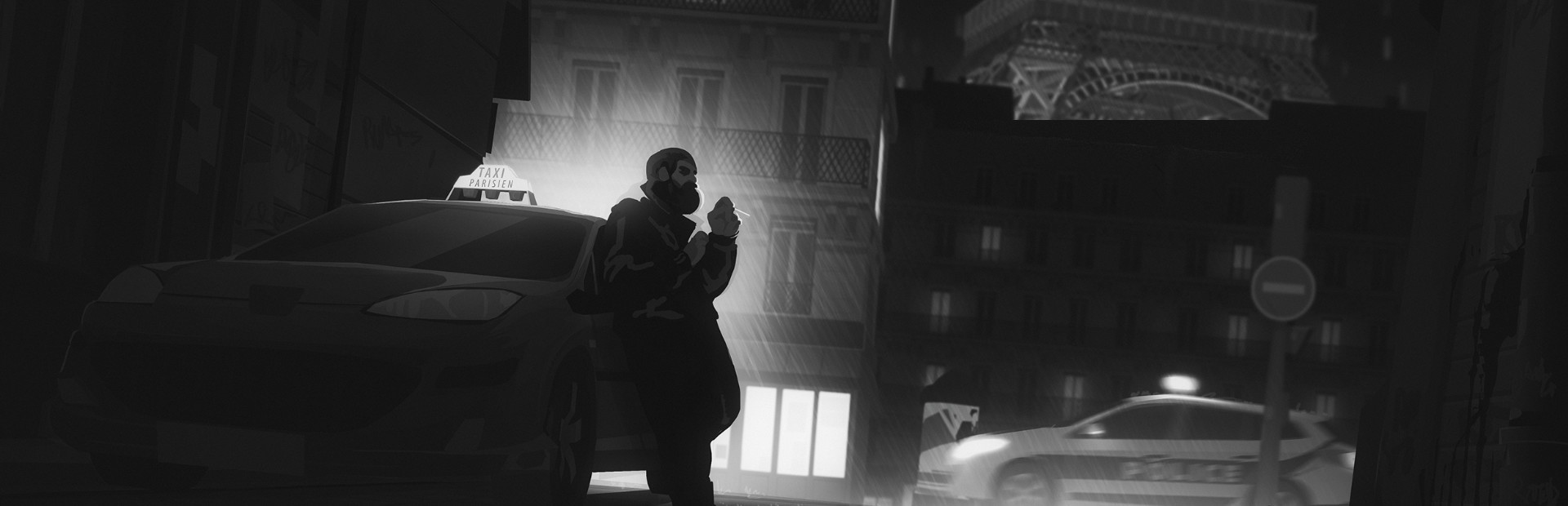
My first pass at Night Call had me mapping out the decision tree in my head like a resource-allocation problem: six nights, a fixed pool of passengers, two competing priorities (cash for rent versus clues for the case), and a deadline that forces you to commit. On paper that sounds like the kind of taut management loop I live for. The reality is more complicated, and mostly in the wrong direction. The game puts you in the seat of Houssine, a Parisian cabbie who survived a serial killer's attack and woke from a coma to find a detective coercing his cooperation. Each night you pull up a map of Paris - based on the actual city layout - and select fares from a scatter of waiting passengers. Nearby pickups cost less time but pay less; distant ones eat into your shift but fatten the wallet. You also have to watch your fuel gauge, because running dry mid-fare kills your earnings. Back home after the shift, you review a bulletin board where clues auto-connect to suspects via visible links, and after enough nights you name your killer or fail the case. There are three distinct investigations, each with different suspects and victims, plus three difficulty settings that tighten the money supply and the investigation window on harder runs. A separate free-roam mode strips out the murder mechanic entirely so you can just collect passenger vignettes and fill out the Passidex, a character log tracking everyone you have met. Where Night Call genuinely earns its score is in its writing. The passenger cast runs to over 85 characters drawn from a cosmopolitan, deliberately non-homogenous Paris - tourists, immigrants, night workers, people carrying secrets they apparently cannot resist confessing to a stranger in the back seat. A maudlin Japanese businessman who shares no language with Houssine, a musician who has been forgotten, a couple navigating a sperm donor search: the vignettes are specific, often funny in a quietly French way, and occasionally genuinely affecting. The hand-drawn black-and-white art holds up, and the ambient soundtrack sits exactly where it should - low, atmospheric, not calling attention to itself. There is no voice acting, but the dialogue is crisp enough that it mostly does not need any. The problems are structural. The investigation layer, which should be the spine of the game, is closer to a decoration. Clues connect themselves to suspects automatically; the deduction board asks little of you beyond waiting for enough nights to pass. Critics and players alike flagged this at launch, and nothing has fundamentally changed: the mystery feels bolted on to what is essentially a slice-of-life visual novel. Worse, the three cases largely recycle the same passenger pool, so if you play all of them you will sit through many of the same conversations word for word. The procedural generation that populates each night's fare list means you can miss a character mid-story and never finish that thread because the random draw just never serves them again. At launch there were also notable stability issues - crashes mid-shift that wiped progress back to the start of the night - though the save-at-shift-end structure makes these especially punishing. Each investigation runs roughly three to four hours, so the total runtime is short enough that the repetition does not become ruinous, but it is clearly a symptom of a design that has not been fully resolved. For my taste this sits in uncomfortable middle ground: not systemic enough to satisfy as a management sim, not investigative enough to work as a detective game, but written well enough that anyone who reads literary fiction and tolerates low-interactivity play will get something real out of it. Think of it less as a game with a mystery grafted on and more as a curated anthology of short stories about ordinary Parisian life, with a thin resource layer giving you a reason to make choices about whose story you hear tonight.

Strategy & simulation
Tags
System Requirements
Minimum
- OS
- Windows 7
- Memory
- 4 GB RAM
- Storage
- 2 GB available space
- Graphics
- Intel UHD 630, Geforce GTX 275, Quadro 2000D or equivalent
- Processor
- Intel Core i3-7100, AMD FX-8100 or equivalent
- Sound Card
- 🔊
Keep exploring
Community Discussion
Be the first to comment on Night Call.
Reviews & Ratings
Game Info
- Developer
- Monkey Moon
- Publisher
- Raw Fury
- Release Date
- Jul 17, 2019