Neverending Nightmares
Handcrafted psychological horror with genuine soul behind it - but its glacial pacing and repetitive rooms will test anyone who needs more than atmosphere to stay invested.
GamerScout Verdict
Best for mood-first horror fans who value atmosphere and craft over mechanical depth, and can forgive a slow mid-game.
Compare Prices(6 stores)
Every store in this table quotes us in euros, so the EUR figure is the price the seller actually set, not our arithmetic — which is why EUR is also the currency we rank in. We only list an offer here when the store gives us its price in euros, so nothing in this table is a number we invented.
Pick USD, PLN, GBP, CAD or AUD in the header and we convert from EUR at the European Central Bank reference rate — converted amounts are prefixed with ~. Your bank or the store may apply a different rate at checkout. We never hide offers based on where you are: everyone sees this whole table.
We may earn a commission when you buy games through links on this page — at no extra cost to you. It never affects our rankings or verdicts.
Price History
Screenshots & Media
About Neverending Nightmares
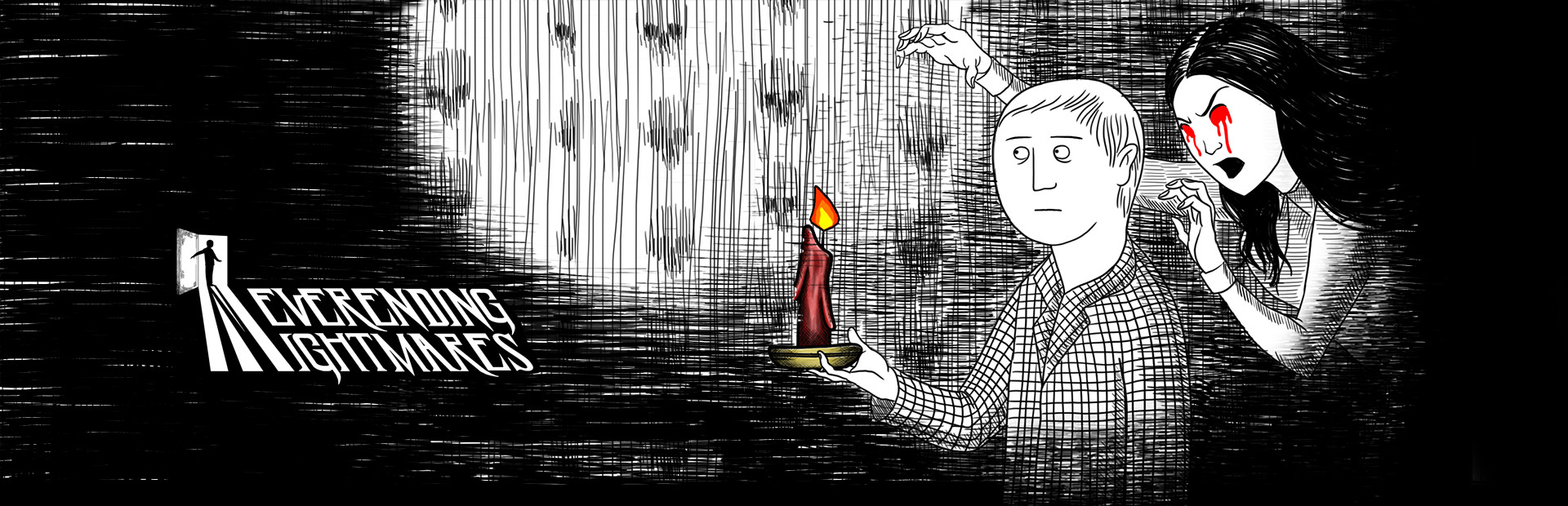
I kept thinking about this one for hours after I put it down, which is either a compliment or a symptom - and Neverending Nightmares would probably say those are the same thing. Made by a single developer, Matt Gilgenbach, as a direct expression of his lived experience with OCD and depression, this is one of the few games where the design philosophy and the subject matter are completely inseparable. That alone makes it worth paying attention to. You play as Thomas, a man who wakes from one nightmare only to find himself inside another. The loop is the point. Locations shift through a Victorian mansion, a forest, a graveyard, and an asylum, all rendered in a stark black-and-white style that draws openly from Edward Gorey's crosshatched illustration work. Interactable objects are the only things rendered in color - a smart, unobtrusive system that keeps you moving without UI clutter. When blood appears, and it appears often, the red hits like a slap. The art direction is genuinely one of the most confident visual identities I have seen in a horror indie, and the soundtrack by Skyler McGlothlin - dark ambient pieces with titles like "Eternal Dread" - is the kind of work you want to experience with headphones and the lights off. The game actually includes a binaural audio mix specifically for headphone listening, and it earns that recommendation. Mechanically, this is about as minimal as a game can get. Thomas can walk, sprint for roughly ten seconds before wheezing to a halt, hide inside wardrobes, and interact with a handful of objects like candles and axes. There are no weapons. Contact with any monster means instant death and a return to the nearest checkpoint, which the game frames as waking from one nightmare into another. That helplessness is intentional - it mirrors the OCD experience of anxiety patterns you cannot break - and the first chapter, set in the house, makes that connection feel genuinely insightful. The asylum section that follows is where critics and players have consistently pointed to a loss of focus, and they are not wrong. The pacing loosens, the environmental variety thins out, and the repetition of nearly identical rooms starts working against the atmosphere rather than feeding it. The branching narrative leads to three distinct endings, and all three are worth seeing. A single playthrough clocks in around two hours, so completing all branches in an evening is entirely realistic. The endings themselves are divisive - some find them ambiguous and affecting, others find them abrupt and under-cooked. I lean toward the former: the deliberate vagueness about whether Thomas ever actually wakes up is the most honest thing the game does, and it sits with you longer than a tidy resolution would. What the game communicates about OCD - the compulsive loop of checking, the worst-case scenarios that feel indistinguishable from reality - is handled with more craft and less exploitation than most horror games bother to attempt. This is not a game for players who need combat variety, environmental puzzles, or a clear genre skeleton to hang onto. It is closer to an interactive short story with a soundscape doing a lot of the heavy lifting. If you already love the quieter end of horror - the atmospheric, introspective space that something like Silent Hill 2 carved out - Neverending Nightmares belongs in that conversation, even if it does not reach those heights. Go in for the art and the audio. Forgive the mid-game drag. Let the endings sit overnight.

Indie & narrative
Tags
System Requirements
Minimum
- OS
- Windows XP, Vista, 7, 8
- Memory
- 1 GB RAM
- Storage
- 500 MB available space
- Graphics
- OpenGL 2.0 compliant video card
- Processor
- 1.7GHz Intel/AMD CPU
Keep exploring
Community Discussion
Be the first to comment on Neverending Nightmares.
Reviews & Ratings
Game Info
- Developer
- Infinitap Games
- Publisher
- Infinitap Games
- Release Date
- Sep 26, 2014