Compare Near Death prices across 50+ stores and find the best deal. Developed by Orthogonal Games. Published by Orthogonal Games. Released on 8/2/2016. Available on PC, Mac, Linux. Genres: Action, Adventure, Indie, Simulation. Metacritic score: 70/100.

Four to five hours of pure tension, no combat, no HUD stats - just you, a dying flashlight, and an Antarctic blizzard trying to kill you at every door.

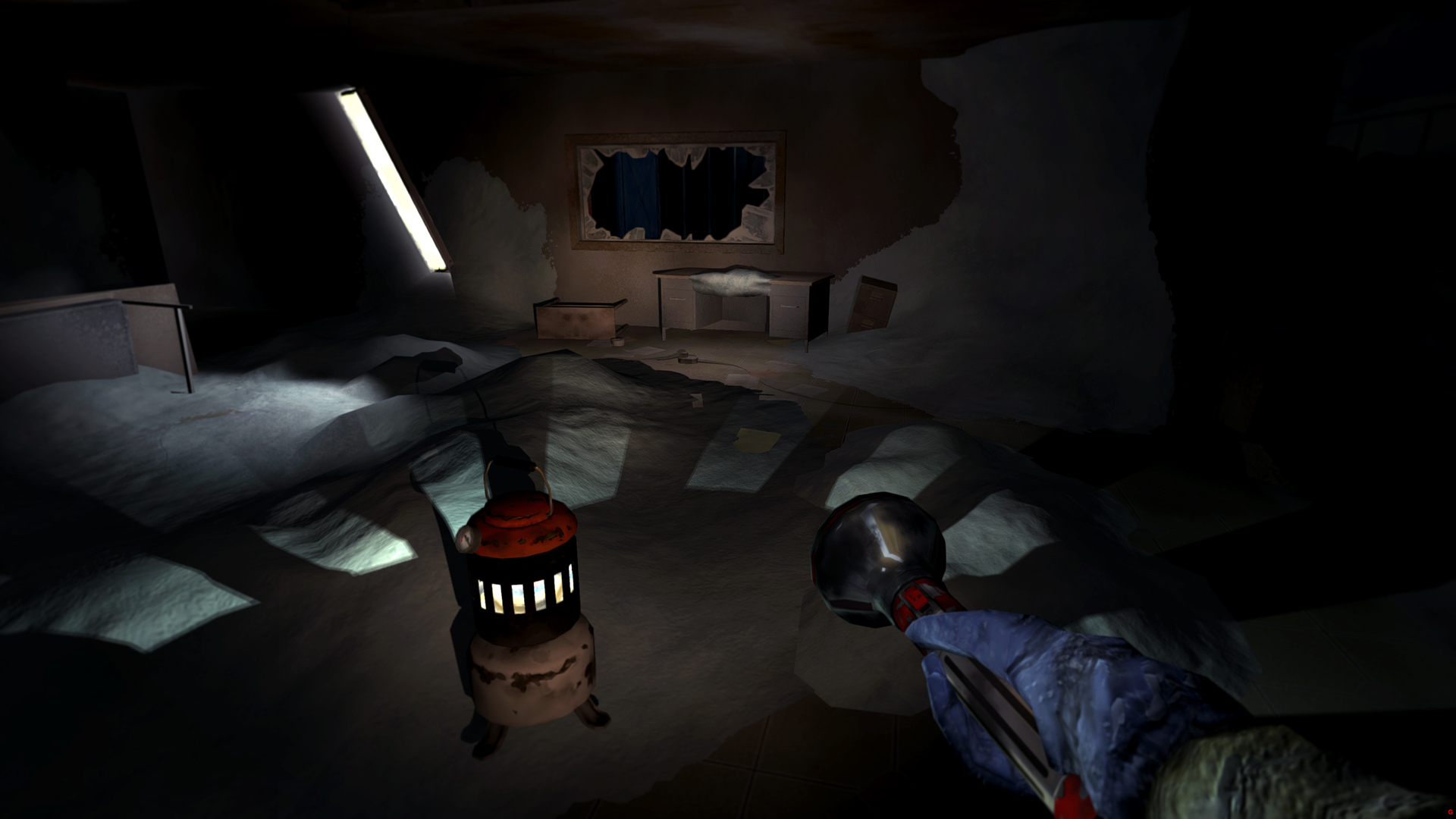
I spend most of my time with games that have fifty-page wikis and patch notes longer than a novel, so a four-hour survival experience with no skill trees looked, on paper, like a lunch break. Near Death is not a lunch break. It is one of the tightest, most deliberate designs I have played in years, and it earns every minute of its short runtime by making each of those minutes feel genuinely precarious. The setup is 1982 Antarctica: your plane has gone down near the abandoned Sutro Station research base and rescue is weeks away. The cold is the only antagonist here. There are no monsters, no enemy factions, no hunger or sleep meters to micromanage. What there is instead is a real-time room-by-room temperature simulation that freezes and thaws the environment based on wind exposure, building layout, and the power state of the base. Broken windows let in killing cold; doors held open by the wind have to be wrestled shut. You patch gaps with canvas and duct tape, fire up portable kerosene heaters in sealed spaces, and ration flashlight batteries whose alkaline cells drain brutally fast in sub-zero conditions. Every resource decision has immediate physical consequences, and that discipline-versus-desperation loop is where the game lives. Navigation deserves its own paragraph. There are no quest markers. Your map does not show your position. You plant light poles in the snow to mark paths between buildings, string rope lines between structures so the wind cannot knock you off course, and learn the station's layout the hard way through repeated cold sprints across open ground. The optional third generator - the hardest to restore, requiring you to haul a replacement part halfway across the base - is the kind of side objective I wish more games designed: completely voluntary, genuinely punishing, and mechanically meaningful because it powers up the rest areas near the radio tower late in the game. That is good systems design. Two post-launch difficulty additions, Hard and Condition 1, give returning players a real reason to go back, and the handful of visual filter modes (a John Carpenter-era 2.35:1 letterbox, pixelation overlays, a black-and-white TV effect) are a clever free update for atmosphere chasers. The criticisms are honest ones. The graphics are functional rather than impressive - you can tell a scavengeable desk from a decorative table, but do not come in expecting visual spectacle. First-person jumping, used on rare occasions, feels clumsy and lacks animation feedback. The story, delivered through teletype exchanges with a contact named Jack McMurdo, is lean to the point of sparse, and the ending lands as quietly as a foot of fresh powder. Players who want a sprawling open-world survival sandbox like The Long Dark will be frustrated by the hand-crafted, linear structure. This is not that game. It is a focused, authored experience that runs at a sprint and ends cleanly rather than padded out. For simulation and strategy players used to optimizing under pressure, Near Death translates that instinct into something physical and atmospheric. You are not reading numbers off a spreadsheet; you are reading a room, calculating how long your kerosene will last, deciding whether that supply shack is worth the frostbite risk. The decision-making is genuinely rewarding, and the absence of bloat keeps every call meaningful. At 91 percent positive across over a thousand Steam reviews and a 70 on Metacritic, the consensus is about right: excellent craft in a compact package. Diego, Scout Team

Near Death
ActionAdventureIndieSimulation

Near Death

Aug 2, 2016Orthogonal Games
GamerScout Says

Four to five hours of pure tension, no combat, no HUD stats - just you, a dying flashlight, and an Antarctic blizzard trying to kill you at every door.

PCMacLinux
Best Price Available
0.00
at N/A
Historical low: $4.99

Compare Prices(0 stores)

Loading prices...

We may earn a commission when you buy games through links on this page — at no extra cost to you. It never affects our rankings or verdicts.

Screenshots & Media

Screenshot

About Near Death

I spend most of my time with games that have fifty-page wikis and patch notes longer than a novel, so a four-hour survival experience with no skill trees looked, on paper, like a lunch break. Near Death is not a lunch break. It is one of the tightest, most deliberate designs I have played in years, and it earns every minute of its short runtime by making each of those minutes feel genuinely precarious. The setup is 1982 Antarctica: your plane has gone down near the abandoned Sutro Station research base and rescue is weeks away. The cold is the only antagonist here. There are no monsters, no enemy factions, no hunger or sleep meters to micromanage. What there is instead is a real-time room-by-room temperature simulation that freezes and thaws the environment based on wind exposure, building layout, and the power state of the base. Broken windows let in killing cold; doors held open by the wind have to be wrestled shut. You patch gaps with canvas and duct tape, fire up portable kerosene heaters in sealed spaces, and ration flashlight batteries whose alkaline cells drain brutally fast in sub-zero conditions. Every resource decision has immediate physical consequences, and that discipline-versus-desperation loop is where the game lives. Navigation deserves its own paragraph. There are no quest markers. Your map does not show your position. You plant light poles in the snow to mark paths between buildings, string rope lines between structures so the wind cannot knock you off course, and learn the station's layout the hard way through repeated cold sprints across open ground. The optional third generator - the hardest to restore, requiring you to haul a replacement part halfway across the base - is the kind of side objective I wish more games designed: completely voluntary, genuinely punishing, and mechanically meaningful because it powers up the rest areas near the radio tower late in the game. That is good systems design. Two post-launch difficulty additions, Hard and Condition 1, give returning players a real reason to go back, and the handful of visual filter modes (a John Carpenter-era 2.35:1 letterbox, pixelation overlays, a black-and-white TV effect) are a clever free update for atmosphere chasers. The criticisms are honest ones. The graphics are functional rather than impressive - you can tell a scavengeable desk from a decorative table, but do not come in expecting visual spectacle. First-person jumping, used on rare occasions, feels clumsy and lacks animation feedback. The story, delivered through teletype exchanges with a contact named Jack McMurdo, is lean to the point of sparse, and the ending lands as quietly as a foot of fresh powder. Players who want a sprawling open-world survival sandbox like The Long Dark will be frustrated by the hand-crafted, linear structure. This is not that game. It is a focused, authored experience that runs at a sprint and ends cleanly rather than padded out. For simulation and strategy players used to optimizing under pressure, Near Death translates that instinct into something physical and atmospheric. You are not reading numbers off a spreadsheet; you are reading a room, calculating how long your kerosene will last, deciding whether that supply shack is worth the frostbite risk. The decision-making is genuinely rewarding, and the absence of bloat keeps every call meaningful. At 91 percent positive across over a thousand Steam reviews and a 70 on Metacritic, the consensus is about right: excellent craft in a compact package. Diego, Scout Team

Tags

singleplayerachievementscontroller-supporttrading-cardscloud-savestier:aaaAtmospheric HorrorResource ManagementNo HUD StatsFirst-Person ExplorationRetro SettingHandcrafted WorldWeather MechanicsShort Completionist

Steam Deck & Linux

Steam Deck Verified

Valve rates this game Steam Deck Verified.

System Requirements

Minimum

OS
Windows 7 (64-bit OS required)
Memory
4 GB RAM
Storage
1 GB available space
Graphics
Nvidia GeForce GTX 650 with 1GB memory (or AMD equivalent)
Processor
Intel Core i5 2.00 GHz or AMD equivalent (64-bit processor required)

Community Discussion

Be the first to comment on Near Death.

Reviews & Ratings

Metacritic
70

Game Info

Developer
Orthogonal Games
Publisher
Orthogonal Games
Release Date
Aug 2, 2016

Price Alert

Get notified when the price drops below your target!

Create Alert

Price History

2026-06-104.99(lowest)

More from Orthogonal Games

Buy smarter: helpful guides

Looking for more? See games like Near Death

Frequently asked questions about Near Death

How much does Near Death cost?

Near Death pricing changes often and varies by store, edition and region. The live price table on this page compares the cheapest in-stock key and store offers across 50+ verified shops, so you always see the current lowest price before you buy.

Where can I buy Near Death cheapest?

Compare Near Death prices across every verified store in the price table on this page. We list the cheapest in-stock key and store offers, updated regularly, so you always see the best current deal before you buy.

What platforms is Near Death available on?

Near Death is available on PC, Mac, Linux.

When was Near Death released?

Near Death was released on 2 August 2016.

Who developed Near Death?

Near Death was developed by Orthogonal Games.

Is Near Death worth buying?

Near Death holds a Metacritic score of 70/100, making it one of the standout Action titles. See the full reviews, ratings and how-long-to-beat times on this page to decide.