
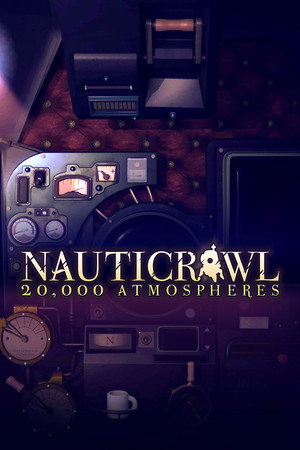
Nauticrawl
Sit down at an alien cockpit with zero instructions and figure out how to not die. If that sentence excites you, Nauticrawl is engineered specifically for your brain.
GamerScout Verdict
Built for players who want to reverse-engineer a machine from scratch; the atmosphere is superb but the challenge fades once you crack the cloak loop.
Compare Prices(4 stores)
Every store in this table quotes us in euros, so the EUR figure is the price the seller actually set, not our arithmetic — which is why EUR is also the currency we rank in. We only list an offer here when the store gives us its price in euros, so nothing in this table is a number we invented.
Pick USD, PLN, GBP, CAD or AUD in the header and we convert from EUR at the European Central Bank reference rate — converted amounts are prefixed with ~. Your bank or the store may apply a different rate at checkout. We never hide offers based on where you are: everyone sees this whole table.
We may earn a commission when you buy games through links on this page — at no extra cost to you. It never affects our rankings or verdicts.
Price History
Screenshots & Media
About Nauticrawl
I spend a lot of time with games that reward systems mastery, so when something drops you into a dim cockpit with a wall of unlabeled dials, levers, and screens and simply says "go", my instinct is to take notes. Nauticrawl is the rare title where taking notes is not just advisable, it is the entire game. You play as a fugitive laborer who has stolen a machine designed for the ruling elite, and the core puzzle is not a dungeon or a map. It is the vehicle itself. Every run starts from the same point of total ignorance, and the knowledge you build across deaths is the only real currency the game offers. The structure is a compact hybrid of escape-room puzzle, cockpit simulator, and roguelike, and it earns each of those labels in sequence rather than all at once. The first phase is pure deduction: you press buttons, watch which screens flicker to life, listen to the creak of the hull, and try to get the engine running without killing yourself. The audio design does serious heavy lifting here. The sound of fuel leaking or a sentinel tower locking onto your radar feels genuinely alarming in a way that most games with ten times the visual budget never achieve. Once you crack the startup sequence and get moving, the game shifts into something closer to a turn-based stealth sim: redirect power, engage the cloaking device, manage heat buildup, navigate the sonar map to avoid hostile patrols. The moment the cockpit transforms mid-run and the whole instrument panel changes shape is a genuine design surprise that most players will not see coming and should not be spoiled. There is a legitimate criticism to address, and it is the difficulty curve running in the wrong direction. The opening hour is the tensest and most satisfying stretch; once you have internalized the cloak-recharge loop and understand how turns interact with enemy movement, the challenge flattens significantly. Some players in the Steam community and across reviews have noted that a well-understood cloaking exploit essentially removes all threat from the back half of the game. The developer has acknowledged this in community discussions, and the tension between accessibility and late-game depth is a real trade-off. A completed playthrough lands somewhere around four to six hours, which is short enough that a second run is not a commitment. That compact length is also why the difficulty plateau hurts more than it would in a longer game. For strategy and sim players who care about decision-making depth, the honest verdict is that Nauticrawl is heavy on the front end and lighter on the back. What it does brilliantly is use the interface itself as a teaching tool with no tutorial, no tooltip pop-ups, no objective markers. The field notes you find mid-run and the scattered logs from previous escapees serve as the game's only guidance system, and they are well-judged enough that confusion never tips into genuine roadblock. Anyone who enjoys the process of reverse-engineering a system from first principles, whether that is a Paradox interface or a factory layout in a production game, will find the opening sessions deeply satisfying. The 92 percent positive rating on Steam across several hundred reviews reflects a community that responded strongly to the atmosphere and originality, even while acknowledging the game could have pushed its systems harder. Nauticrawl is not a long-haul strategy game and it has no mod ecosystem to speak of, so approach it as a tightly designed short experience rather than a systems sandbox. Played in a quiet room with headphones, the first successful escape lands with a sense of accomplishment that the game earns honestly.

Strategy & simulation
Tags
System Requirements
Minimum
- OS
- Windows 7
- Memory
- 4 GB RAM
- Storage
- 200 MB available space
- Graphics
- 2GB - Radeon R7 260 2GB / GTX 750 Ti 2GB
- Processor
- 3.1 GHz - AMD FX 8350 / Intel Core i5 - 4460
Recommended
- OS
- Windows 7
- Memory
- 8 GB RAM
- Graphics
- 4GB - Radeon R7 260 2GB / GTX 750 Ti 2GB
- Processor
- 3.4 GHz - AMD FX 8350 / Intel Core i5 - 4460
Keep exploring
Community Discussion
Be the first to comment on Nauticrawl.
Reviews & Ratings
No ratings available
Game Info
- Developer
- Spare Parts Oasis
- Publisher
- Armor Games Studios
- Release Date
- Sep 16, 2019