
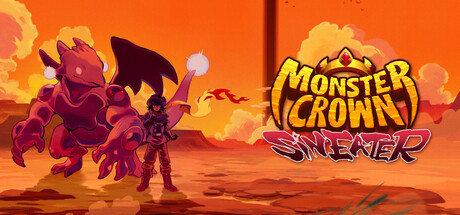
Monster Crown: Sin Eater
If you ever wanted a creature-taming RPG that actually respects your intelligence, Sin Eater's genetics-driven crossbreeding and fusion engine will consume your evenings in the best way possible - bring a notepad.
GamerScout Verdict
Built for players who want creature-taming with real strategic depth - the fusion engine alone is worth the admission price if you can stomach the mid-game drift.
Compare Prices(4 stores)
Every store in this table quotes us in euros, so the EUR figure is the price the seller actually set, not our arithmetic — which is why EUR is also the currency we rank in. We only list an offer here when the store gives us its price in euros, so nothing in this table is a number we invented.
Pick USD, PLN, GBP, CAD or AUD in the header and we convert from EUR at the European Central Bank reference rate — converted amounts are prefixed with ~. Your bank or the store may apply a different rate at checkout. We never hide offers based on where you are: everyone sees this whole table.
We may earn a commission when you buy games through links on this page — at no extra cost to you. It never affects our rankings or verdicts.
Price History
Screenshots & Media
About Monster Crown: Sin Eater
I have spent more hours than I care to admit reading stat inheritance screens in this game, and I am not even slightly embarrassed about it. Monster Crown: Sin Eater is a turn-based creature-collector RPG set in the Crown Nation, a grim, oppressive island under the boot of an authoritarian ruler named Lord Taishakuten and his Heavenly Kings. You play as Asur, a farmboy whose brother Dyeus - the Crown Nation's most celebrated tamer - is seized and his beloved monster killed in front of the family. What follows is a vengeance arc that earns the word "mature" in a way most indie RPGs frankly do not: there is blood, moral weight to your dialogue choices, and a world that feels genuinely hostile rather than thematically dressed-up. The systems are where Sin Eater separates itself from every pixel-art creature-collector competitor on the market. At its core is a True Crossbreeding and Fusion engine that gives you direct control over which stats, move pools, types, and even visual palettes carry forward from two parent monsters into their offspring. Fusion consumes both parents at their current level to create a single, near-equal-level result - which is the fast option for keeping your team competitive mid-run. Breeding preserves both parents but produces a level-one egg, giving you long-term dynasty planning at the cost of grinding it back up. A separate genome editor lets you manually bias which genes pass down, though it costs in-game currency and reduces a monster's monetary value - a deliberate economic tension that the game uses to keep resource management meaningful. With over 1,000 hand-crafted sprites, five elemental types each with their own per-type mana pool (not per-move PP), elemental transformations triggered by specific items, and Brilliant 1-in-1000 rare variants, the combinatorial space is enormous. Completionists should understand upfront: tracking down base monsters, their crossbreeds, their transformations, and the transformations' crossbreeds is a project the game itself flags as territory for dedicated players only. Combat is 1-on-1 turn-based and immediately readable, but the Synergy meter adds real decision-making texture. Dealing and absorbing damage builds Synergy, and spending it unlocks Crown versions of moves with boosted effects - or, at maximum, a full Crown transformation. Bosses are calibrated around this system; they are not stat-padded walls but compositions designed to punish brute-force rosters and reward teams you have actually engineered. There are three difficulty settings, and the highest - called Monster Crown difficulty - is the one reviewers broadly agree feels like the intended experience. The lowest setting lets you follow the story with minimal friction. The type chart is simpler than comparable titles: five types, each weak to one and resistant to another, with Crown type reserved mostly for bosses and neutral to everything. That simplicity is a feature, not a shortcut - the depth comes from build variety, not chart memorisation. The rough edges are real and worth naming before you buy. The open-world structure that unlocks after you clear the Windy Province is genuinely non-linear, which is admirable, but the game's signposting does not keep pace with its ambition. Objectives exist as loose suggestions, and if you wander into the wrong region at the wrong level, the difficulty spikes sharply. Conversely, players who engage seriously with the fusion system early will find themselves badly overleveled for wild encounters, since the map lacks level scaling outside the tamer battles. Fast travel and healing both cost in-game currency, and experience is monster-specific rather than shared across your party - both are genre-standard frustrations, but worth knowing. The studio has already shipped balance patches post-launch and has a free content pack flagged for later in the year, so the trajectory is positive. For strategy-minded players who want to treat team-building as the actual game - not a secondary system bolted onto a story - Sin Eater is the most mechanically serious creature-collector released in years. The Game Boy Color aesthetic is deliberate and well-executed, the Crown Nation's environments have a consistency that comes from having a single environment artist build the whole thing, and the audio design is handled with matching care. Newcomers to the genre can start on the lowest difficulty and learn the systems at their own pace; the fusion and breeding menus are dense but not opaque once you sit with them. Just go in knowing that the mid-game will expect you to set your own direction.

Strategy & simulation
Tags
System Requirements
Minimum
- OS
- 10/11
- Memory
- 2 GB RAM
- Storage
- 3 GB available space
- Graphics
- Integrated/Dedicated
- Processor
- Intel/AMD
Recommended
- OS
- 10/11
- Storage
- 3 GB available space
Keep exploring
Community Discussion
Be the first to comment on Monster Crown: Sin Eater.
Reviews & Ratings
No ratings available
Game Info
- Developer
- Studio Aurum
- Publisher
- Studio Aurum
- Release Date
- Apr 30, 2026