
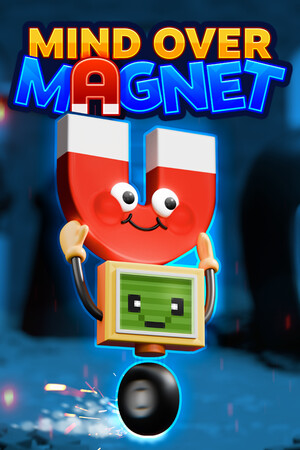
Mind Over Magnet
A love letter to the 'a-ha moment' from the person who spent years explaining why they work, now asking you to feel one yourself. Short, focused, and quietly charming.
GamerScout Verdict
Best for puzzle fans who want a clean, well-crafted thinker under four hours, especially if you follow game design discourse.
Compare Prices(3 stores)
Every store in this table quotes us in euros, so the EUR figure is the price the seller actually set, not our arithmetic — which is why EUR is also the currency we rank in. We only list an offer here when the store gives us its price in euros, so nothing in this table is a number we invented.
Pick USD, PLN, GBP, CAD or AUD in the header and we convert from EUR at the European Central Bank reference rate — converted amounts are prefixed with ~. Your bank or the store may apply a different rate at checkout. We never hide offers based on where you are: everyone sees this whole table.
We may earn a commission when you buy games through links on this page — at no extra cost to you. It never affects our rankings or verdicts.
Price History
Screenshots & Media
About Mind Over Magnet
I came to Mind Over Magnet already knowing its origin story, and honestly that framing is impossible to shake. This is Mark Brown's game, the same person behind Game Maker's Toolkit, the YouTube channel that has spent years dissecting what makes puzzle design click. Knowing that, every single-screen room feels less like a level and more like a proof of concept, which is either the most fascinating context you can bring to a puzzle platformer, or a quiet source of pressure the game can never fully escape. You play as Uni, a small one-wheeled robot freshly fired and dumped into a factory basement. Your companions are Magnus, Min, and Max, three magnet friends whose distinct abilities layer onto the core mechanic across five worlds and 50-plus single-screen puzzles. The early chapters are gentle, teaching you that Magnus is attracted to suspended metal bars, that flashing blue columns mark the pull boundaries, and that placing Magnus on a pressure plate lets you use the vacuum tube exit without him. These first puzzles land closer to tutorial than test, and the honest review note here is that the opening hour can feel like it is running on a slow burn before the complexity earns its keep. Puzzle veterans who grew up with Portal or Braid may find the first half accessible to the point of feeling undemanding. Then the throw mechanic arrives. Once you can hurl a magnet in any direction, the puzzle space opens up in ways that feel genuinely inventive. Lasers, polarity-switching mechanics, and moments where both magnets work in tandem push the spatial reasoning into a satisfying gear. The obsession over giving players those sudden realizations is real and it mostly succeeds, especially in the back half where multi-step logic requires you to mentally map out three or four actions before moving. The puzzles are logic-first, execution second, which means deaths and resets are low-friction. Room resets are instant, hints exist, and if a puzzle has you stuck for over six minutes the game quietly offers to let you skip it. That last affordance says a lot about who this game is designed to welcome. Visually, the aesthetic is functional and clean rather than striking. Thick outlines and simple shapes keep everything readable even when the camera pulls back to make Uni feel small. The background art across the five factory worlds builds atmosphere through monotone moving collages of gears, conveyor belts, and cranes, which look slick without demanding attention away from the puzzle. The soundtrack by honeyboy jones is a genuine highlight, the kind of rhythmic, ambient music you leave running after you close the window. Sound effects for the magnetic mechanics carry a satisfying physicality, even if some of the mono audio placement can feel slightly off when you are far from the source. The developer commentary mode, unlocked after completing the game, is something I would argue is the real bonus feature. Scattered speakers throughout each level trigger audio from Brown explaining design decisions, why certain ideas were cut, and what he learned. For anyone curious about how a game goes from prototype to finished product, it is more valuable than any bonus level pack could be. The story itself is breezy and light, gesturing at corporate themes through Uni's firing without pushing into anything deeper, which suits the game's warm, cartoony tone even if it leaves the narrative feeling thin. Mind Over Magnet knows what it is: a precise, polished small game that ends before it outstays its welcome, built by someone who understood the theory and set out to prove the practice.

Indie & narrative
Tags
System Requirements
Minimum
- OS
- Windows 7+
- Memory
- 4 GB RAM
- Storage
- 700 MB available space
- Graphics
- Nvidia 450 GTS / Radeon HD 5750
- Processor
- Intel i5+
Keep exploring
Community Discussion
Be the first to comment on Mind Over Magnet.
Reviews & Ratings
No ratings available
Game Info
- Developer
- Game Maker's Toolkit
- Publisher
- Game Maker's Toolkit
- Release Date
- Nov 13, 2024