
Microtopia
If you've ever wanted Factorio's spaghetti-infrastructure anxiety repackaged inside a robot ant colony, Microtopia delivers that itch with surprising elegance and a deceptively steep late-game cliff.
GamerScout Verdict
Best for automation fans who want Factorio-style logistics wrapped in a colony sim that rewards patient path-optimization over raw throughput.
Compare Prices(9 stores)
Every store in this table quotes us in euros, so the EUR figure is the price the seller actually set, not our arithmetic — which is why EUR is also the currency we rank in. We only list an offer here when the store gives us its price in euros, so nothing in this table is a number we invented.
Pick USD, PLN, GBP, CAD or AUD in the header and we convert from EUR at the European Central Bank reference rate — converted amounts are prefixed with ~. Your bank or the store may apply a different rate at checkout. We never hide offers based on where you are: everyone sees this whole table.
We may earn a commission when you buy games through links on this page — at no extra cost to you. It never affects our rankings or verdicts.
Price History
Screenshots & Media
About Microtopia
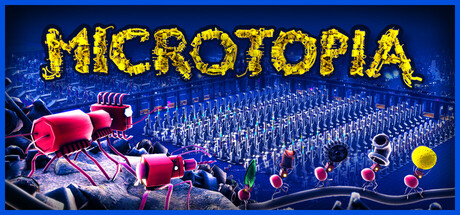
I mapped out my first pheromone trail in Microtopia expecting a casual colony sim, and three hours later I was furiously rebuilding a supply chain because my Inventor Ants kept dying before generating enough science points. That should tell you everything about the audience this game is really for. On the surface the minimalist visuals and calm ambient soundtrack signal something meditative. Underneath, the logistics puzzle tightens like a vice. The core mechanic that separates Microtopia from its factory-builder peers is the replacement of conveyor belts with living (well, mechanical) workers. Your ants are the transport layer. You draw pheromone trails across the terrain, attach ants to those paths, and they dutifully carry resources between nodes - gatherers pulling scrap and food, workers feeding the queen, specialists running dedicated production lines. The path-drawing system supports seven distinct trail types and logic gates, which means by the mid-game you are essentially writing conditional routing logic for your workforce. That is either the most exciting sentence you have read today or a hard warning to close this tab. Progression is gated through the tech tree, unlocked via a specialized caste called Inventor Ants. The mechanic works like this: you breed basic workers, combine pairs into stronger units, then nurture specific ants with pollen on dedicated platforms until they generate a science boost and expire. It is novel in concept but the execution draws the sharpest criticism from reviewers and rightly so. The constant cycle of breeding, feeding, and losing Inventor Ants before you have queued enough research can disrupt an otherwise satisfying flow state. Pair that with a UI that lacks an easy global view of idle ants - meaning a single worker stuck off-path can silently bottleneck your entire colony - and you have friction that a quality-of-life patch could fully resolve. The Workshop support is already live, which gives me genuine optimism that the community will fill those gaps. What holds up without qualification is the structural depth of the colony itself. There are 30 distinct ant types and 45 building types to work with across multiple biomes. Each new island you unlock via radio tower introduces different resources and terrain that demands different ant castes - flying ants for elevation, diggers for resource veins. Critically, colonies on separate islands run independently, so you can fully automate an established base and then approach a fresh expansion with a more hands-on mindset. That layered autonomy is exactly the kind of late-game design that keeps a strategy sim on the hard drive for months. Steam's overall player reception sits firmly positive, which for a debut title from a three-person Netherlands studio is a meaningful signal. For players new to the automation genre, Microtopia is actually a reasonable entry point. The structured tutorial walks you through path-drawing, resource gathering, and the queen-feeding loop before complexity escalates. The early game is genuinely gentle. The difficulty curve is honest: it does not hide its spaghetti from you, it gradually hands you more string. If you can name a Factorio build order from memory you will find Microtopia approachable but not trivial, especially once multi-island logistics and the nuptial flight cycle to breed new queens enter the picture. Everyone else should accept that a few restarts are not failures, they are tutorials in disguise.

Strategy & simulation
Tags
System Requirements
Minimum
- OS
- Windows 10/11 64-bit
- Memory
- 8 GB RAM
- DirectX
- Version 11
- Storage
- 3 GB available space
- Graphics
- RTX 2060 / RX 5600
- Processor
- i7-6700 / Ryzen 5 1500X
Recommended
- OS
- Windows 10/11 64-bit
- Memory
- 16 GB RAM
- DirectX
- Version 11
- Storage
- 3 GB available space
- Graphics
- RTX 3060 / RX 6700
- Processor
- i5-10400, Ryzen 5 3500X
Keep exploring
Community Discussion
Be the first to comment on Microtopia.
Reviews & Ratings
No ratings available
Game Info
- Developer
- Cordyceps Collective
- Publisher
- Goblinz Publishing
- Release Date
- Feb 18, 2025