Medieval Crafter: Blacksmith
Satisfying forge loop with real decision weight, but the content wall arrives sooner than you'd like. Worth it for sim fans who can spot a solid foundation under rough edges.
GamerScout Verdict
Solid blacksmithing sim for players who enjoy hands-on production chains, but expect a content ceiling around 20 hours.
Compare Prices(5 stores)
Every store in this table quotes us in euros, so the EUR figure is the price the seller actually set, not our arithmetic — which is why EUR is also the currency we rank in. We only list an offer here when the store gives us its price in euros, so nothing in this table is a number we invented.
Pick USD, PLN, GBP, CAD or AUD in the header and we convert from EUR at the European Central Bank reference rate — converted amounts are prefixed with ~. Your bank or the store may apply a different rate at checkout. We never hide offers based on where you are: everyone sees this whole table.
We may earn a commission when you buy games through links on this page — at no extra cost to you. It never affects our rankings or verdicts.
Price History
Screenshots & Media
About Medieval Crafter: Blacksmith
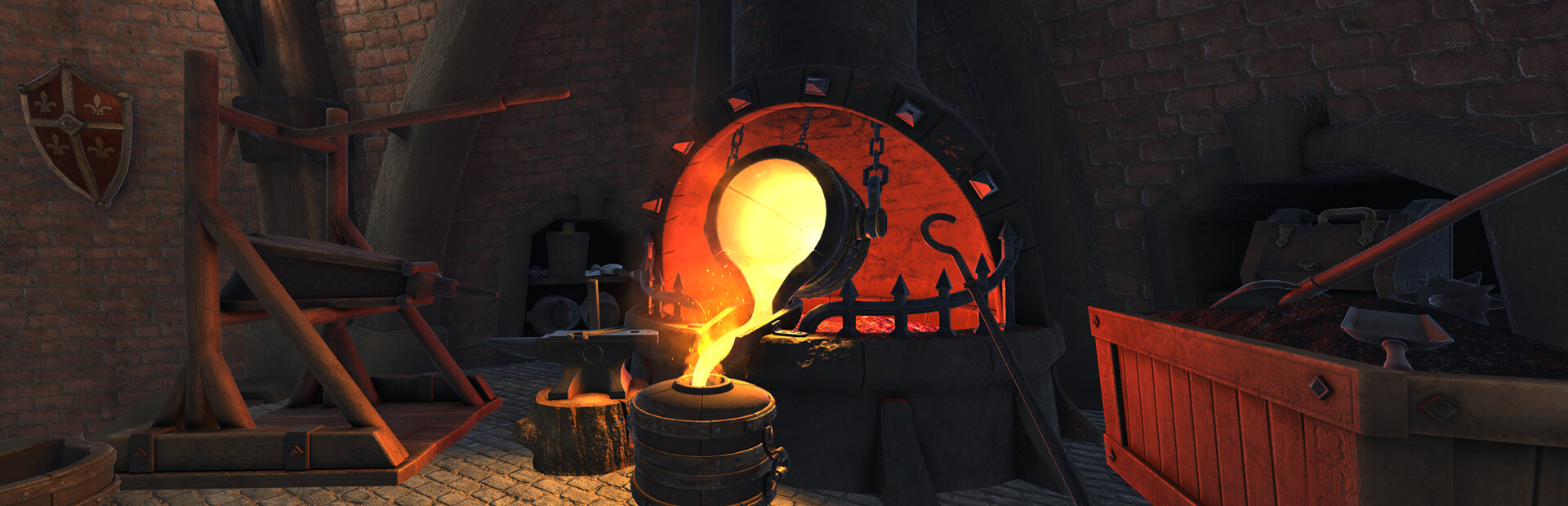
I put this one on my radar the moment I heard it handled the full production chain manually, and after spending time with the 1.0 release, the fundamentals hold up better than the skeptic in me expected. You are not clicking a "craft" button and watching a timer tick down. You physically mine ore, keep your furnace stocked with coal, manage heat and timing while pouring molten metal, hammer parts on the anvil using a minigame that now shows a rarity-outcome bar, and then sharpen or enchant the finished piece before it goes on a display rack. That multi-step pipeline is what this game sells, and for the most part it delivers. The hero-and-quest layer is the smarter addition, and sim fans who underestimate it will miss the most interesting resource loop in the game. You recruit heroes, kit them out with gear you forged yourself, and send them into dungeons for loot and new crafting recipes. Better output from the anvil means better survival odds, which means better raw material returns, which feeds back into finer weapons. That recursive chain gives the crafting genuine stakes instead of just filling customer orders for gold. The haggling minigame, a timing-based interaction that lets you push customers for a better price, adds a small but welcome micro-decision layer on the economic side. The 1.0 update also opened up the Docks zone for merchant trading and added the Arena, which meaningfully extends the late-game beyond what early reviewers encountered during Early Access. Now for the honest part, because this game has some friction that matters. The tutorial moves quickly and loading-screen hint text scrolls faster than most people can read. Some of the minigames, sharpening in particular, had genuinely awkward controls at launch. Post-release hotfixes addressed the sharpening fail condition and adjusted the minigame difficulty, but the controls still feel less intuitive than the core hammering loop. NPC character models are stiff and visually rough, which undercuts the atmosphere during customer interactions. Deep into a session, around the 20-hour mark, a content ceiling becomes visible: quests start thinning out and NPC interactions outside basic vendor trading drop off noticeably. The world has distinct zones, including the castle, village, mines, Heroes Hall, the forest, and the Docks, but you will be staring at the same spaces repeatedly and the environmental variety does not keep pace with the hours the game asks of you. On the technical side, the optimization is genuinely impressive for a small-team title. The game runs well on modest hardware, cloud saves work, and the developer has been responsive with patches. There is no controller support, which is a gap for couch players, and the use of AI-generated content in some assets is disclosed on the Steam page, worth knowing before you buy. The progression system, unlocking new racks, mine layers, enchantment recipes, and workshop upgrades, gives a steady sense of advancement through roughly the first 15 to 20 hours. If you enjoy the genre and can tolerate a game that is clearly still being expanded, the core loop has enough pull to justify the time. If you need a dense late-game or deep NPC systems from day one, wait for another content update.

Strategy & simulation
Tags
System Requirements
Minimum
- OS
- Windows 10 64-Bit
- Memory
- 8 GB RAM
- DirectX
- Version 11
- Storage
- 5 GB available space
- Graphics
- GeForce GTX 750 Ti (2 GB VRAM) or AMD Radeon RX 460 (2 GB VRAM) or higher
- Processor
- Intel Core i5-4440 with 3,1 GHz or AMD FX-8150 with 3,6 GHz or higher
Recommended
- OS
- Windows 10 64-Bit
- Memory
- 16 GB RAM
- DirectX
- Version 11
- Storage
- 5 GB available space
- Processor
- Intel Core i7-3820 with 3,6 GHz or AMD FX-8350 with 4,0 GHz or higher
Keep exploring
Community Discussion
Be the first to comment on Medieval Crafter: Blacksmith.
Reviews & Ratings
No ratings available
Game Info
- Developer
- Compact Core Games
- Publisher
- GameDev.ist
- Release Date
- Apr 22, 2026