Mech Armada
Build a squadron of custom mechs from over 80 parts, then watch your carefully planned loadout get dismantled by a Dodger insect with close-combat immunity. The real game is in the build, not the battle grid.
GamerScout Verdict
Best for roguelite fans who want to spend more time in the build screen than on the battle map.
Compare Prices(5 stores)
Every store in this table quotes us in euros, so the EUR figure is the price the seller actually set, not our arithmetic — which is why EUR is also the currency we rank in. We only list an offer here when the store gives us its price in euros, so nothing in this table is a number we invented.
Pick USD, PLN, GBP, CAD or AUD in the header and we convert from EUR at the European Central Bank reference rate — converted amounts are prefixed with ~. Your bank or the store may apply a different rate at checkout. We never hide offers based on where you are: everyone sees this whole table.
We may earn a commission when you buy games through links on this page — at no extra cost to you. It never affects our rankings or verdicts.
Price History
Screenshots & Media
About Mech Armada
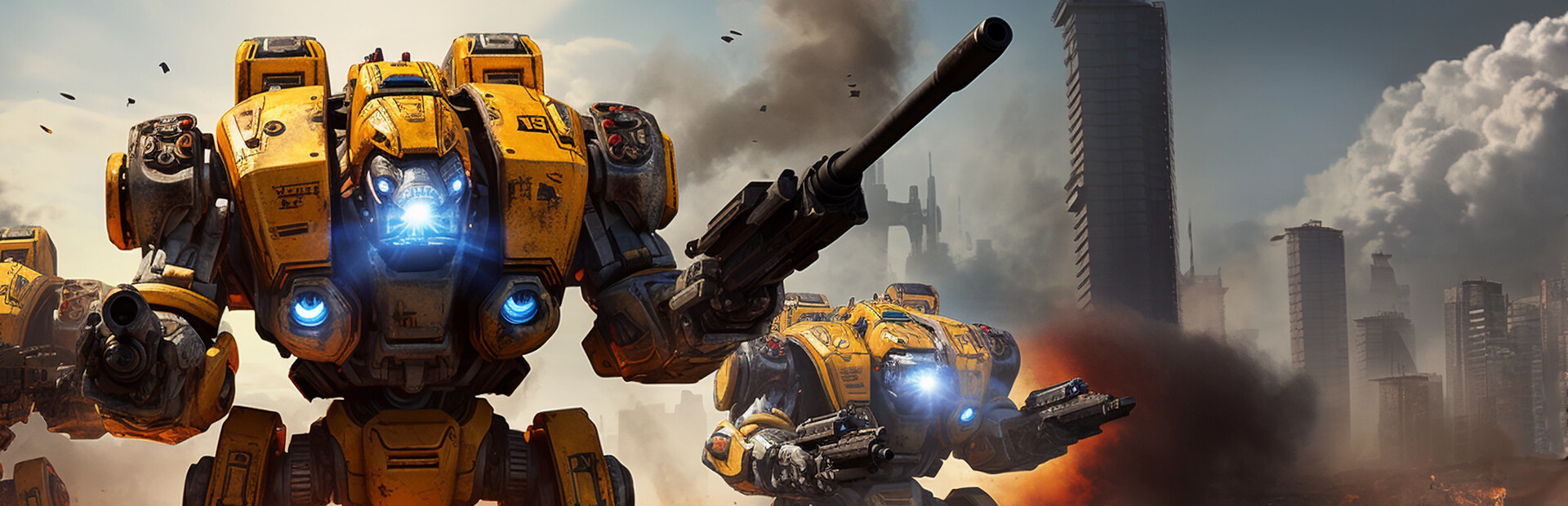
I went in expecting something with the mechanical weight of BATTLETECH and came out with something closer to a lean, procedurally-driven puzzle box. That comparison is not a complaint. Mech Armada is a solo-developed roguelite tactics game built around one genuinely good idea: every mech you field is a custom assembly of three part categories. Transport determines how your unit moves, whether that is legs that let it act after moving, treads that charge down roads at speed, or a flight platform that ignores ground topology entirely. Bodies layer on abilities like expanded weapon hardpoints, range boosts, or auras that ripple out to adjacent units. Weapons run the gamut from flamethrowers and sniper railguns to fighter drone bays and rayguns. On any given run you are working with a random research pool, so the meta-game is really about adapting your intended build strategy to whatever parts the game decides to offer you. The clearest design ancestors are Into the Breach and Slay the Spire. From Into the Breach it borrows the chess-like grid and the emphasis on positioning over raw stats. From Slay the Spire it takes the run-based unlock loop where every failed attempt banks points that widen your options next time. What it adds on top is the mech-assembly layer, which is where most of the interesting decisions live. Pairing a long-range sniper body with a tread transport and a mega missile pod sounds dominant until the Swarm sends in Dodger enemies that are immune to anything except close-range attacks. The game is consistently good at punishing single-axis builds and rewarding squads with complementary roles. The campaign map, added during Early Access development, meaningfully improved the structure. You now choose between branching paths that trade resource density for combat difficulty, pick one of two available boss fights per stage, and manage energy economy across the whole run rather than just round to round. That layer of routing decisions is where the strategy-brained player will find the most grip. The boss encounters themselves are large, aggressive, and require genuine preparation rather than just throwing your strongest mech forward. Where the game falls shorter is in the individual battle maps, which critics and players have consistently flagged as sparse. Tile variety is limited, and per-battle tactical expression is narrow compared to genre benchmarks. Most of the depth is in the garage, not on the grid. For newcomers worried about the roguelite death loop: the Sandbox mode lets you assemble any parts freely and test them against Swarm encounters without consequence. It is a sensible pressure valve and doubles as an effective tutorial substitute. The game also runs on modest hardware, supports full controller input, and offers adjustable difficulty. One legitimate friction point is the lack of an undo action in combat. A misclick on a committed attack can cascade badly, and the game will not let you walk it back. Experienced roguelite players will absorb this as normal; players coming from XCOM expecting procedural miss-chance to be the main source of randomness will need to recalibrate, because every attack here hits as declared, which actually makes misclicks sting more, not less. Completionists have put around 20 hours into a full achievement run at higher difficulties, which tells you this is not a sprawling sandbox. It is a tight, replayable tactics game with a well-designed central loop, a content ceiling that some players will hit faster than others, and an honest 81 percent positive Steam rating that reflects exactly that ceiling. If your appetite is for a concentrated roguelite that rewards build planning over raw reflexes, Mech Armada delivers that without filler.

Strategy & simulation
Tags
System Requirements
Minimum
- OS
- Windows 7 (64 bit)
- Memory
- 4 GB RAM
- DirectX
- Version 11
- Storage
- 6 GB available space
- Graphics
- Radeon HD 7770, GeForce GTX 460 or better
- Processor
- Dual Core 2.66GHz (64 bit)
Recommended
Requires a 64-bit processor and operating system
Keep exploring
Community Discussion
Be the first to comment on Mech Armada.
Reviews & Ratings
No ratings available
Game Info
- Developer
- Lioncode Games
- Publisher
- Lioncode Games
- Release Date
- Jun 16, 2022