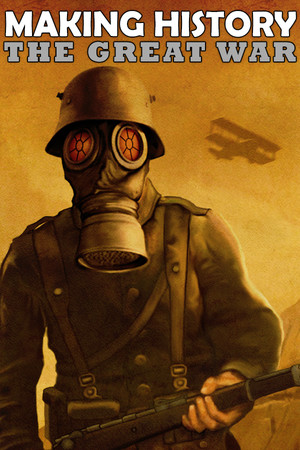
Making History: The Great War
WWI grand strategy that actually respects the period's complexity, but the AI cracks under pressure and veteran players will find the mid-game too readable too fast.
GamerScout Verdict
Solid entry point for WWI grand strategy if you accept the AI has a ceiling and the scenario count is thin without Workshop mods.
Compare Prices(6 stores)
Every store in this table quotes us in euros, so the EUR figure is the price the seller actually set, not our arithmetic — which is why EUR is also the currency we rank in. We only list an offer here when the store gives us its price in euros, so nothing in this table is a number we invented.
Pick USD, PLN, GBP, CAD or AUD in the header and we convert from EUR at the European Central Bank reference rate — converted amounts are prefixed with ~. Your bank or the store may apply a different rate at checkout. We never hide offers based on where you are: everyone sees this whole table.
We may earn a commission when you buy games through links on this page — at no extra cost to you. It never affects our rankings or verdicts.
Price History
Screenshots & Media
About Making History: The Great War
I keep a mental shelf of grand-strategy games sorted by how well they model the actual levers of historical power, and Making History: The Great War earns a slot there for one specific reason: it treats the First World War as the economic-political catastrophe it was, not just a parade of trenches and artillery barrages. Managing coal, oil, food, munitions, government stability, and ideological unrest all feed into each other in ways that will feel familiar to anyone who has lost a Paradox campaign to overextension. The week-long turn structure runs over a global map with twelve data overlays covering diplomacy, resources, demographics, supply, and national stability, and seven tabbed windows let you drill into politics, military, trade, and production. That is a lot of UI to internalize, and the game does not hold your hand for long. Here is where I will make the newcomer case, because I think most dismissals of this game misjudge it. The tutorial is functional rather than brilliant, but the smarter entry point is the 1912 scenario, which drops you two years before hostilities and lets you quietly learn resource stockpiling, city development, and the trade web before anyone declares war. Starting as a mid-tier power, Serbia or Bulgaria for instance, teaches the diplomatic pressure system faster than reading any guide. The political climate of the era means war arrives eventually regardless of your intentions, which is itself a genuinely educational design choice: the alliance entanglements that dragged the great powers in feel organic rather than scripted. Each major nation also plays differently enough to justify multiple runs. Winning as the British Empire, with its sprawling colonial logistics chain, demands a completely different approach than managing Germany's two-front pressure or Russia's chronic instability and revolution risk. The depth of decision-making covers technology research (tanks, warplanes, submarines, poison gas all arrive as researchable options), trench construction, adjacent-region artillery bombardments, colonial governance choices between direct control, protectorates, and puppet states, and covert operations including funding coups and stoking civil wars in rival nations. That is a genuine sandbox of levers. The AI is the game's ceiling, though. At lower difficulties it telegraphs moves early, and once you internalize a few patterns you can read it reliably. Reviewers noted the AI can surprise with ahistorical choices, Germany abandoning the Schlieffen Plan in favor of a Russia-first strategy for instance, which adds some variance, but the surprise factor diminishes after two or three full campaigns. The graphics are functional rather than impressive, built for information density over presentation, and resource fluctuations in the economic model can feel erratic in ways that punish players for things outside their control. The mod ecosystem through Steam Workshop is a meaningful plus. A scenario editor lets the community fill the content gap the base game leaves, and given that the title ships with only two scenarios (1912 and August 1914), community content matters for long-term replay. Cross-platform multiplayer on PC, Mac, and Linux broadens the pool if you want to test yourself against humans rather than the AI, which is the honest answer to the AI ceiling problem. This is not a competitor to Hearts of Iron IV in scope or mechanical precision, and players expecting that level of granularity will bounce off it. What it does offer is a lower entry barrier to globe-spanning WWI strategy, an authentic economic interdependency model, and a period that is genuinely underserved in the genre.

Strategy & simulation
Tags
System Requirements
Minimum
- OS
- Windows 10 / Windows 8 / Windows 7 / Windows Vista / Windows XP with Service Pack 2
- Memory
- 2 GB RAM
- DirectX
- Version 9.0c
- Storage
- 2 GB available space
- Graphics
- 256 MB DirectX 9.0c-Compliant, Shader 2.0 3D Video Card
- Processor
- Pentium 4 or better
DLC & Add-ons for Making History: The Great War1
Expansions, DLC packs and add-on content for this game. Click any item to see store offers.
Keep exploring
Community Discussion
Be the first to comment on Making History: The Great War.
Reviews & Ratings
No ratings available
Game Info
- Developer
- Muzzy Lane Software
- Publisher
- Factus Games
- Release Date
- Jan 29, 2015