
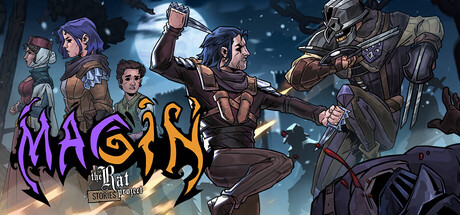
Magin: The Rat Project Stories
The central idea here is genuinely clever: every story choice reshapes your deck, and every card you hold reflects who your characters are becoming. The execution, though, is rougher than that premise deserves.
GamerScout Verdict
Best for narrative-first players who can overlook combat balance flaws; strategy purists will hit the stun-lock ceiling and bounce off fast.
Compare Prices(8 stores)
Every store in this table quotes us in euros, so the EUR figure is the price the seller actually set, not our arithmetic — which is why EUR is also the currency we rank in. We only list an offer here when the store gives us its price in euros, so nothing in this table is a number we invented.
Pick USD, PLN, GBP, CAD or AUD in the header and we convert from EUR at the European Central Bank reference rate — converted amounts are prefixed with ~. Your bank or the store may apply a different rate at checkout. We never hide offers based on where you are: everyone sees this whole table.
We may earn a commission when you buy games through links on this page — at no extra cost to you. It never affects our rankings or verdicts.
Price History
Screenshots & Media
About Magin: The Rat Project Stories
My first instinct when I saw the Essence system was to pull up a spreadsheet. Fear, hope, anger, despair - all of it converts directly into cards, and the cards you carry into every fight are shaped by the narrative decisions you made hours earlier. That is a mechanical loop that most card-battler RPGs never bother to attempt. Respond to a character with aggression and your deck shifts toward that emotional posture; take a cautious or empathetic line and your options move elsewhere. On paper, every story beat doubles as a deckbuilding decision, which is the kind of tight system integration that earns genuine respect from someone who spends weekends parsing Paradox patch notes. The two protagonists - Elester, a veteran hitman and Magin (essence-user) tied to a shadowy criminal underworld, and Tolen, a younger figure only beginning to understand what Essence can do - run on parallel tracks that occasionally intersect. The world itself sells the premise well: a grimdark setting caught between medieval tradition and the arrival of industrial, magic-powered machinery, rendered in a sharp comic-book visual style with full voice-over throughout. Three dungeons structure the mid-game, each with their own buff and debuff systems that layer on top of your deck heading into each encounter. The double-sided Essence cards are the mechanical highlight - cards can flip and shift depending on use, which forces forward-thinking over rote repetition, at least in theory. Here is where the strategy lens becomes uncomfortable. The deck starts at 10 cards with a five-card draw per turn, which means cycling happens fast. Stun cards, once acquired, break the balance equation entirely. A 13-card deck with four stun slots produces fights where enemies never take a single action - the entire combat system collapses into a one-note loop before the midpoint. The complexity is heavily frontloaded, with little meaningful new mechanical material arriving as the game progresses. Hard mode does not fix this; it swings in the opposite direction, producing damage spikes that can kill the player before they move, giving the stun problem an ironic mirror image. Normal offers a more considered pace, but the same exploit-friendly ceiling applies. Reviewers across multiple outlets flagged the same issue independently, which suggests this is a balance problem baked into the design, not an edge case. Beyond the combat wobbles, the writing has a maturity problem of its own. The grimdark tone is genuinely atmospheric in its world-building, but the character dialogue leans on profanity as a shorthand for edge in ways that feel more adolescent than actually adult. Stability is also a concern at launch - multiple outlets reported crashes and background rendering failures during playthroughs. Whether patches have addressed these issues post-launch is worth checking before committing. Steam's early user review split sits around 70 percent positive across 64 reviews, which tells you the game has a real audience, but the 47 percent positive rate in the first 30 days signals that initial buyers ran into the problems described above. For strategy-minded players, the honest recommendation is conditional. If the narrative-deckbuilding link sounds compelling enough to tolerate uneven combat balance and some rough technical edges, there is a genuinely interesting 12-to-14-hour experience buried in here, one with multiple endings and a world with real atmospheric weight. Anyone arriving primarily for tactical combat depth will hit the stun-lock ceiling fast and disengage. Wait for a patch cycle or a discount if you sit in the second camp.

Strategy & simulation
Tags
System Requirements
Minimum
- OS
- Windows XP, Vista, 7, 8/8.1, 10
- Memory
- 2 GB RAM
- Storage
- 4 GB available space
- Graphics
- 1Gb Video Memory, capable of OpenGL 3.0+ support (2.1 with ARB extensions acceptable)
- Processor
- 2.0 Ghz
Recommended
Requires a 64-bit processor and operating system
DLC & Add-ons for Magin: The Rat Project Stories1
Expansions, DLC packs and add-on content for this game. Click any item to see store offers.
Keep exploring
Community Discussion
Be the first to comment on Magin: The Rat Project Stories.
Reviews & Ratings
No ratings available
Game Info
- Developer
- The Rat Project
- Publisher
- Daedalic Entertainment
- Release Date
- Apr 29, 2026