
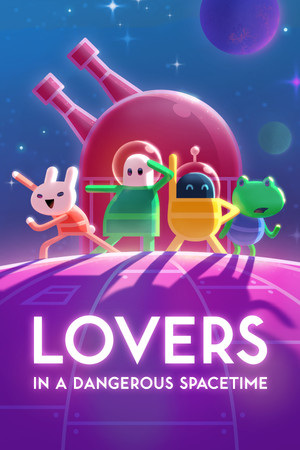
Lovers in a Dangerous Spacetime
The best couch co-op argument simulator in a neon spacesuit: thrilling when your crew is in sync, genuinely stressful when they aren't, and that tension is the whole point.
GamerScout Verdict
Essential couch co-op for 2-4 players; solo mode works on Casual but the real game only exists when someone is yelling beside you.
Compare Prices(5 stores)
Every store in this table quotes us in euros, so the EUR figure is the price the seller actually set, not our arithmetic — which is why EUR is also the currency we rank in. We only list an offer here when the store gives us its price in euros, so nothing in this table is a number we invented.
Pick USD, PLN, GBP, CAD or AUD in the header and we convert from EUR at the European Central Bank reference rate — converted amounts are prefixed with ~. Your bank or the store may apply a different rate at checkout. We never hide offers based on where you are: everyone sees this whole table.
We may earn a commission when you buy games through links on this page — at no extra cost to you. It never affects our rankings or verdicts.
Price History
Screenshots & Media
About Lovers in a Dangerous Spacetime
I keep a mental list of games that weaponize cooperation as a core mechanic rather than a bullet point, and Lovers in a Dangerous Spacetime sits near the top of it. The concept originated from a game jam and the DNA shows in all the right ways: the loop is tight, the fiction is absurd, and the entire design revolves around one deliciously simple constraint. You and up to three friends are tiny pilots scrambling around the interior of a single battleship, and nobody gets to control the whole thing at once. The ship has eight stations. At any moment you can only staff two of them. There are four directional cannons, a rotating shield, the helm, a map, and the Yamato Cannon, a limited-use superweapon that, misused, will get you both killed in spectacular fashion. The resource allocation problem that creates is surprisingly rich for a game with two buttons and a stick. One player weaves through asteroid fields while the other sprints to cover an exposed flank with the shield. A boss appears and suddenly both gunners are mandatory, leaving nobody on engines. That tug between roles is where the game actually lives, and it lands closer to a light resource-management puzzle than a shooter once you internalize it. Gems collected from level boxes can be socketed into stations to add or alter abilities, and the combinations change how you prioritize crew movement. That layered upgrade system is the closest the game gets to build theory, and it is modest but satisfying. Solo play with the AI space-pet companion is functional and the pet can be directed via a radial command menu to any station except the pilot seat. On Casual difficulty it holds up reasonably well. On Normal, the AI tends to shine as a gunner but becomes unreliable on shield duty, and levels without checkpoints mean a bad late-stage decision costs you the whole run. It works, but the gap between playing alone and playing with even one human partner is significant. The game was conceived explicitly around the Millennium Falcon turret-gunner fantasy and that framing makes the single-player feel like a rehearsal more than the main event. With two to four humans the friction flips from frustrating to hilarious. Enemy count and aggression scale with player count, so a four-player session is controlled chaos by design. The neon bubblegum art style looks great on a TV, though the pilots are tiny enough that some players report losing them in busier scenes. Levels are procedurally arranged so repeat runs do not mirror each other exactly, and rescuing the ten captive space-creatures per level both advances progress and unlocks improved station layouts, giving completionists a real incentive to sweep each map. The campaign is not long by strategy-game standards, and the content ceiling is the most common criticism in the community. What is here is polished, but once the final boss is down the replay driver is primarily social rather than systemic. For anyone searching for a gateway co-op title to play with a partner or a casual gaming friend, this is close to an ideal pick. The controls are simple enough to hand a second controller to someone who does not usually play, and the shared pressure of a hard encounter teaches communication faster than any tutorial screen could. Metacritic landed it at 80 on PC and Steam users sit at 93 percent positive across nearly 1,900 reviews, which is about as consistent a signal as you will find. The caveat is plain: if you are buying this primarily as a solo experience, drop to Casual and temper your expectations. The soul of the game is in the couch, not the single-player queue.

Strategy & simulation
Tags
System Requirements
Minimum
- OS
- Windows XP or later
- Memory
- 2 GB RAM
- DirectX
- Version 9.0
- Storage
- 900 MB available space
- Graphics
- 256 MB VRAM
- Processor
- 1.7 GHz Core 2 Duo
Keep exploring
Community Discussion
Be the first to comment on Lovers in a Dangerous Spacetime.
Reviews & Ratings
Game Info
- Developer
- Asteroid Base
- Publisher
- Asteroid Base
- Release Date
- Sep 9, 2015