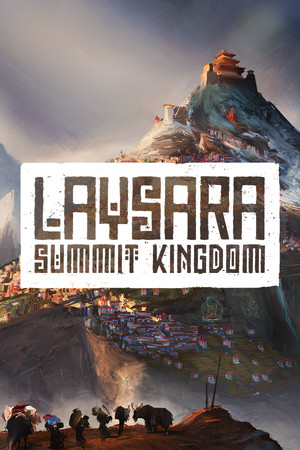
Laysara: Summit Kingdom
A vertical logistics puzzle wearing a city-builder's coat: if micromanaging yak supply chains across Himalayan-inspired peaks sounds like your idea of a good time, Laysara has your number.
GamerScout Verdict
Built for logistics obsessives who want their city-builder to fight back; casual builders should budget time for a learning curve that bites.
Compare Prices(4 stores)
Every store in this table quotes us in euros, so the EUR figure is the price the seller actually set, not our arithmetic — which is why EUR is also the currency we rank in. We only list an offer here when the store gives us its price in euros, so nothing in this table is a number we invented.
Pick USD, PLN, GBP, CAD or AUD in the header and we convert from EUR at the European Central Bank reference rate — converted amounts are prefixed with ~. Your bank or the store may apply a different rate at checkout. We never hide offers based on where you are: everyone sees this whole table.
We may earn a commission when you buy games through links on this page — at no extra cost to you. It never affects our rankings or verdicts.
Price History
Screenshots & Media
About Laysara: Summit Kingdom
I sat down with Laysara: Summit Kingdom expecting the city-builder loop I know cold, production grows, city expands, repeat. What I got instead was closer to a spatial efficiency puzzle that uses city-builder furniture as its pieces. That distinction matters, and being clear about it upfront will save a lot of players a lot of frustration. This is not a game about watching a metropolis bloom. It is a game about whether your yak-to-market ratio can survive an altitude gain of 400 meters. The core concept is genuinely fresh. Your three castes, Lowlanders who handle agriculture and basic labour, Artisans who produce processed goods, and Monks who drive research and spiritual progress, each carry their own needs. Satisfying those needs requires production chains that must physically climb the mountain with your population. Roads and switchbacks, rope lifts, vertical shafts through rock faces, bridges over ravines: every logistical connection you build is a bet on your future layout. Because space on a narrow alpine terrace is always at a premium, every placement decision has downstream consequences. Running out of cash reserves while in negative balance ends your run, so the pace is deliberately measured. Build too fast, hire ad-hoc yaks to cover gaps in your transport network, and watch your treasury drain faster than a leaky water barrel. The economic loop rewards incrementalism in a way that will feel either deeply satisfying or maddening depending on how you approach resource games. The avalanche system is the headline hazard, and it is more nuanced than it first appears. You cannot stop a slide once it starts, but you can prepare: foresters weaken avalanche strength, Snow Compressors reduce it further, Avalanche Barriers redirect flows, and Avalanche Inducers let you trigger controlled releases before snow caps build to dangerous levels. On higher difficulties, avalanche strength scales with your population, so the toolbox you build early has to expand alongside your settlement. Some critics argue the mechanic is too easily neutralised once you understand it, and there is truth to that, but treating it as a simple "place trees" checkbox misses the mid-to-late-game layer where you are managing multiple snow caps across a cramped footprint that also needs to host farms, markets, and praying places for your monks. The tension is real, even if it is not cinematic. The 1.0 release added a fully voiced 15-mission campaign that gives the settlement-building a narrative spine, something the Early Access version lacked. The humour in the monk character's dialogue is a genuine surprise and stops the experience from feeling sterile. Sandbox and self-contained run modes give players who find the campaign's objective structure frustrating a cleaner on-ramp. The UI is the game's most consistent complaint across reviewers: buildings cannot be rotated, connecting multiple buildings requires more clicks than it should, and the lack of batch-placement tools becomes noticeable once your building list grows. These are real friction points, not nitpicks. If you are the type who builds spreadsheets about build order, you will adapt. If you need the interface to get out of your way, it occasionally will not. Visually and aurally, the game earns its reputation. Mountains feel imposing and alive, weather rolls across slopes in real time, and watching a functioning transport network of yaks and carriers hum between switchbacks has that characteristic ant-farm satisfaction of a system you built from scratch. The Steam rating settled at a strong 81% Very Positive across over 1,300 reviews, which is a fair reflection of a game that delivers on a specific promise while leaving some quality-of-life work on the table. Quite OK Games spent two years in Early Access, and the 1.0 version feels genuinely complete rather than rushed, but a few interface rough edges suggest there is still room for post-launch polish.

Strategy & simulation
Tags
System Requirements
Minimum
- OS
- Windows 10 (64 bit)
- Memory
- 4 GB RAM
- DirectX
- Version 11
- Storage
- 12 GB available space
- Graphics
- GeForce GTX 660 equivalent
- Processor
- Quad Core Processor
Recommended
Requires a 64-bit processor and operating system
Keep exploring
Community Discussion
Be the first to comment on Laysara: Summit Kingdom.
Reviews & Ratings
No ratings available
Game Info
- Developer
- Quite OK Games
- Publisher
- Future Friends Games
- Release Date
- Feb 27, 2026