Knights in Tight Spaces
Positioning-based deckbuilding with a three-person party and over 300 cards sounds like a strategy lover's checklist - it mostly delivers, with a few rough edges that patches haven't fully smoothed out yet.
GamerScout Verdict
Solid pick for positional deckbuilder fans who read tooltips; weaker for roguelike players who expect high run variance or a polished UI.
Compare Prices(8 stores)
Every store in this table quotes us in euros, so the EUR figure is the price the seller actually set, not our arithmetic — which is why EUR is also the currency we rank in. We only list an offer here when the store gives us its price in euros, so nothing in this table is a number we invented.
Pick USD, PLN, GBP, CAD or AUD in the header and we convert from EUR at the European Central Bank reference rate — converted amounts are prefixed with ~. Your bank or the store may apply a different rate at checkout. We never hide offers based on where you are: everyone sees this whole table.
We may earn a commission when you buy games through links on this page — at no extra cost to you. It never affects our rankings or verdicts.
Price History
Screenshots & Media
About Knights in Tight Spaces
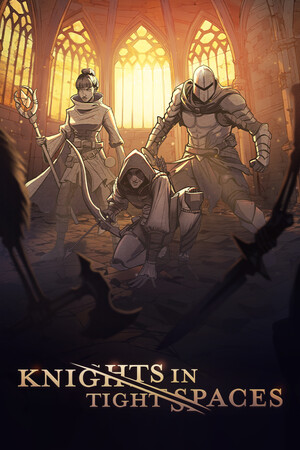
I mapped out the decision tree before my third run and realized this game has more honest tactical depth than its mixed Steam rating suggests. Knights in Tight Spaces is Ground Shatter's follow-up to Fights in Tight Spaces, and the core loop is immediately legible to anyone who has spent time with Slay the Spire or Into the Breach: small-grid positional combat where every action is a card draw, every move costs momentum, and the best outcomes come from chaining effects together rather than brute-forcing damage. The medieval fantasy setting replaces the John Wick spy-thriller aesthetic of the predecessor, and the woodcut-inspired art style gives battles a distinctive look, even if some reviewers find the color palettes too close together for quick enemy-type reads. The biggest mechanical addition over the original is the three-character party system, and it genuinely reshapes how you build. Each recruit joins with their own card subset and gear slots - Fighters carry armor, melee weapons, and shields, Brawlers go unequipped and rely on throws and grapples, Mages need the Attuned keyword to cast spells, and Rangers trigger free bonus Support Attacks when an enemy walks into their arc. Your deck is shared across all three, but card eligibility is locked to the right loadout. That means deck bloat is a real threat: adding a bow-user to your party is useless if you never draw arrows at the right moment. The Blacksmith, Tavern, and Trader nodes on the spiderweb map give you structured windows to manage this - upgrade gear, swap party members, thin the deck - but the pacing of those opportunities is fixed enough that runs can start feeling scripted around chapter three. Three modes cover different player moods. Story mode runs a linear node map with branching side quests, secret alternate paths (the Ring of Treachery route is genuinely harder and worth discovering), and text-based events that occasionally redirect your party composition. Daily Play locks everyone into the same preset seed and posts scores to a leaderboard - the closest thing to competitive play here. Endless mode strips the narrative entirely and measures survival. For a strategy player, Daily and Endless are where the long-term value lives; the story campaign is short enough on a first clear (roughly four to five hours) that you will be back in the prologue for your second run before the day is out. The criticisms worth taking seriously: the UI is genuinely cluttered. Tooltips are sparse, card interactions between party members are not always clearly telegraphed, and some players hit soft-locks on specific attacks at launch. Ground Shatter pushed three patches in the weeks after release and has been responsive on the community forums, so the worst of the launch bugs are largely addressed - but the underlying information-design problem predates those fixes. The story itself is forgettable by consensus; if you are here for narrative, look elsewhere. The map structure is also notably less variable than genre peers, with fight sequences in each chapter following a fixed order regardless of which path fork you choose. That is a real replayability ceiling that Endless mode partially papers over but does not solve. For someone coming in cold with no Fights in Tight Spaces history, the learning curve is steeper than the genre average. The game does not do much hand-holding past the tutorial, and the first few runs will likely end in ugly defeats while you work out which card archetypes actually synergize versus which ones just look appealing. That is not a flaw in my book - that is the genre doing its job. Commit to reading every card effect, treat the Brawler or Fighter as your first-run training wheels, and the systems start clicking into satisfying shape well before the twenty-hour mark. At a Metacritic of 72, expectations should be calibrated accordingly: this is a competent, enjoyable tactical deckbuilder with identifiable rough patches, not a genre-defining release.

Strategy & simulation
Tags
System Requirements
Minimum
- OS
- Windows 10
- Memory
- 4 GB RAM
- DirectX
- Version 9.0
- Storage
- 3 GB available space
- Graphics
- NVIDIA GeForce GTX 1050 3GB VRAM/AMD Radeon RX 560 3GB VRAM or equivalents
- Processor
- Intel Core i5-2300 CPU @ 2.80GHz/AMD Ryzen 5 1600 or equivalents
Recommended
- OS
- Windows 10
- Memory
- 8 GB RAM
- DirectX
- Version 9.0
- Storage
- 3 GB available space
- Graphics
- NVIDIA GeForce GTX 1060 6GB VRAM/Radeon RX 480 Graphics 6GB VRAM or equivalents
- Processor
- AMD Ryzen 7 5800X 8-Core/Intel Core i5-4670K CPU @ 3.40GHz or equivalents
Keep exploring
Community Discussion
Be the first to comment on Knights in Tight Spaces.
Reviews & Ratings
Game Info
- Developer
- Ground Shatter
- Publisher
- Raw Fury
- Release Date
- Mar 4, 2025