Kingdoms and Castles
If you want a city-builder that respects your lunch break but still punishes sloppy granary placement come winter, this medieval sim has quietly earned over 19,000 Steam reviews at 93% positive for a reason.
GamerScout Verdict
Ideal first city-builder for strategy newcomers; veterans may want more late-game depth, but the castle-building loop holds up surprisingly well.
Compare Prices(5 stores)
Every store in this table quotes us in euros, so the EUR figure is the price the seller actually set, not our arithmetic — which is why EUR is also the currency we rank in. We only list an offer here when the store gives us its price in euros, so nothing in this table is a number we invented.
Pick USD, PLN, GBP, CAD or AUD in the header and we convert from EUR at the European Central Bank reference rate — converted amounts are prefixed with ~. Your bank or the store may apply a different rate at checkout. We never hide offers based on where you are: everyone sees this whole table.
We may earn a commission when you buy games through links on this page — at no extra cost to you. It never affects our rankings or verdicts.
Price History
Screenshots & Media
About Kingdoms and Castles
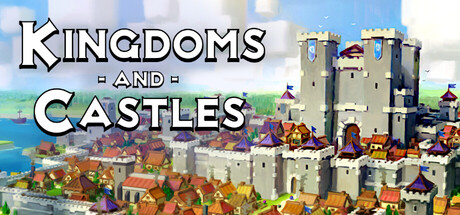
I'll be upfront: my usual playground is grand strategy with eight-hundred-page wikis, so a low-poly medieval city-builder that fits on a single island felt like a busman's holiday. What kept me in my chair was the same slow-burn loop that makes Banished addictive, crossed with the castle-building tactility of the old Stronghold games. Lion Shield cited SimCity, Banished, and Stronghold as direct inspirations, and you can feel all three in the DNA once the session clock ticks past an hour. The core loop runs on a short chain of dependencies that any strategy player will recognise immediately. Drop a Keep, clear trees with woodcutters, place quarries for stone, seed farms close enough to granaries that the harvest does not spoil in transit. Libraries, churches, bathhouses, and taverns must sit within walking radius of housing or the happiness bonuses evaporate. Roads speed up peasant pathfinding, which matters more than it sounds once your population scales. The tension lives in space: islands are procedurally generated but finite, so every quarry footprint is also a farm you are not building, and every stretch of wall is real estate your growing population wanted. The castle construction system earns its own paragraph: walls and towers are placed as modular blocks, and archer range actually scales with tower height, so there is a genuine build puzzle in how you stack your defences before the Viking raids arrive. A later update added building integrity decay, meaning masons become a meaningful allocation decision rather than filler, and the AI Kingdoms layer lets you host up to three neighbouring rulers on the same map, manage diplomats out of a Hall of Diplomacy, form alliances, arrange trade routes, or declare war. Here is the honest pitch for newcomers who bounce off Dwarf Fortress or who find Civilization VI's tech tree overwhelming on a Tuesday night: Kingdoms and Castles is legitimately accessible without being trivial. The difficulty sliders let you toggle Viking aggression, dragon frequency, and harsh-winter length independently before a map loads, so a first run without external threats is a valid learning mode rather than a cheat. The UI surfaces the right information at a glance: a single overlay shows which buildings need mason repairs, another shows happiness radii. Tooltips are clear. The tutorial is light but not absent. I would have no hesitation pointing a genre newcomer at this and saying start on peaceful, no enemies, small island, figure out the food chain, then add one threat layer per session. Where the game honestly shows its limits is in late-game depth. Once a functioning supply chain is humming, the economy rarely breaks again unless you deliberately push hard difficulty. The AI kingdoms follow predictable escalation scripts and veteran players will learn their rhythms quickly. The building roster, while charming, stops expanding before you expect it to, and the Steam Workshop mod scene is active but not enormous. Players who want the late-game complexity of a Paradox title or the emergent weirdness of RimWorld will hit a ceiling. The game is closer to a relaxing city-painting exercise past a certain population threshold than a white-knuckle resource crisis simulator. Controller support is solid if you want the couch experience on Xbox, and the voxel art style means even modest hardware runs it without complaint. For strategy-curious players who want something that teaches resource-chain thinking without a fifty-hour learning tax, this is one of the cleanest on-ramps the genre has.

Strategy & simulation
Tags
System Requirements
Minimum
- OS
- Microsoft Windows XP/Vista/7/8/8.1 (64-bit)
- Memory
- 4 GB RAM
- DirectX
- Version 11
- Storage
- 1 GB available space
- Graphics
- nVIDIA GeForce GTX 260 256mb or ATI Radeon HD 5670 256mb or Intel HD Graphics 4600
- Processor
- Intel Core 2 Duo, 2.0GHz or AMD Athlon 64 X2 6400+, 2.5GHz
Recommended
- OS
- Microsoft Windows XP/Vista/7/8/8.1 (64-bit)
- Memory
- 4 GB RAM
- Storage
- 1 GB available space
- Graphics
- nVIDIA GeForce GTX 660, 1gb or AMD Radeon HD 7870, 1gb
- Processor
- Intel Core i5-3470, 2.7GHz or AMD FX-6300, 3.2Ghz
Keep exploring
Community Discussion
Be the first to comment on Kingdoms and Castles.
Reviews & Ratings
Game Info
- Developer
- Lion Shield, LLC
- Publisher
- Lion Shield, LLC
- Release Date
- Jul 20, 2017