Keep Talking and Nobody Explodes
One person stares at a ticking bomb. Everyone else holds the manual. Nobody can see what the other sees. Talk fast or lose.
GamerScout Verdict
Best for groups who enjoy talking under pressure - bring at least one friend and print the manual before you start.
Compare Prices(6 stores)
Every store in this table quotes us in euros, so the EUR figure is the price the seller actually set, not our arithmetic — which is why EUR is also the currency we rank in. We only list an offer here when the store gives us its price in euros, so nothing in this table is a number we invented.
Pick USD, PLN, GBP, CAD or AUD in the header and we convert from EUR at the European Central Bank reference rate — converted amounts are prefixed with ~. Your bank or the store may apply a different rate at checkout. We never hide offers based on where you are: everyone sees this whole table.
We may earn a commission when you buy games through links on this page — at no extra cost to you. It never affects our rankings or verdicts.
Price History
Screenshots & Media
About Keep Talking and Nobody Explodes
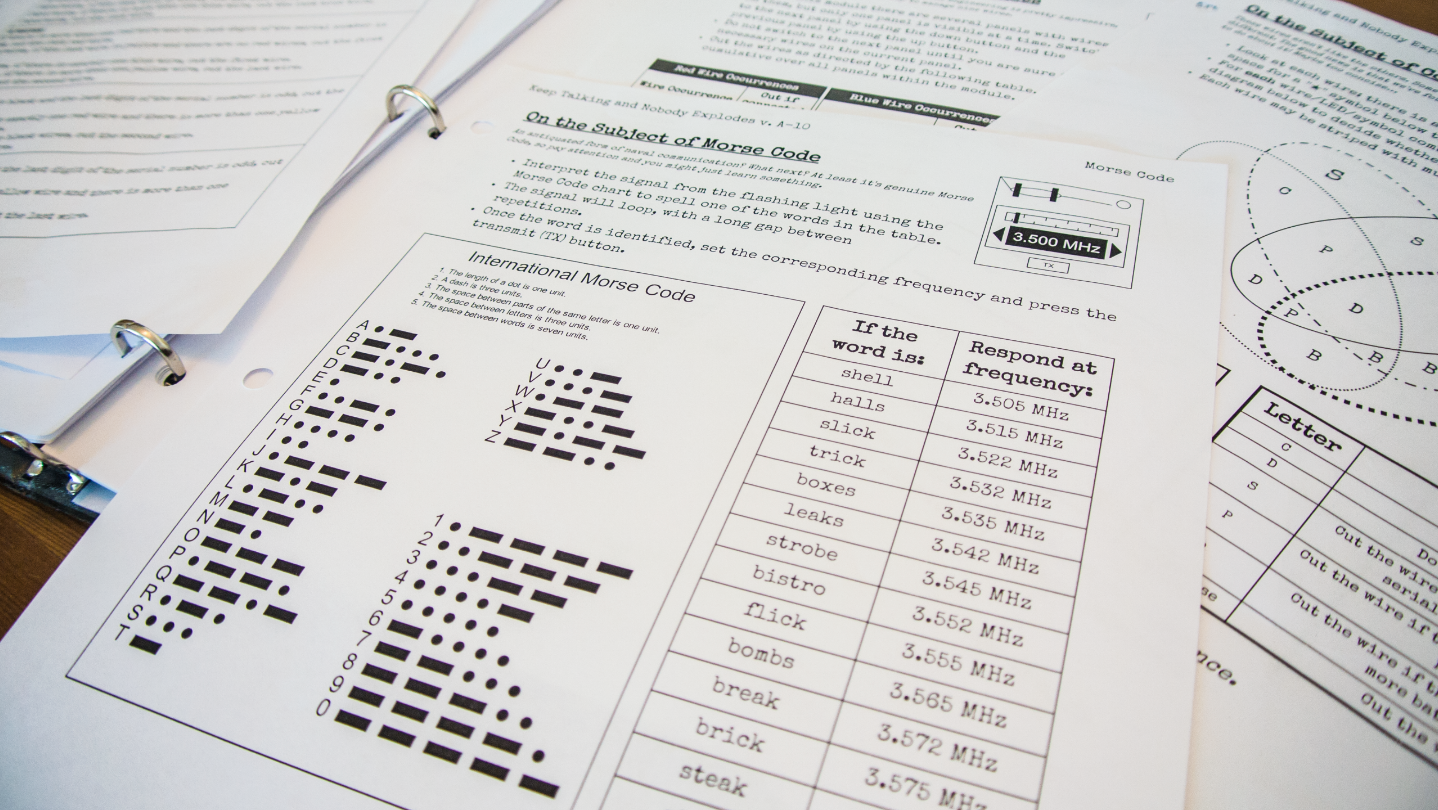
Keep Talking and Nobody Explodes is a co-op party game built on a single, elegant premise: the person at the keyboard is looking at a bomb made of wires, buttons, symbols, and timers, and has no idea how to defuse any of it. Everyone else in the room holds the Bomb Defusal Manual, a printable PDF packed with charts, logic puzzles, and procedural rules. They can see the manual. They cannot see the bomb. Communication is the entire game, and it is brutally, brilliantly unforgiving about that. What Steel Crate Games understood when they built this is that asymmetric information is a comedy engine. The defuser will describe a module poorly. The expert will read back the wrong rule. Someone will mishear "three" as "free" and cut the wrong wire with four seconds left. The bomb will explode. The room will erupt. And then everyone will immediately want to play again. Each run is short, usually two to five minutes, and the game generates modules procedurally so no two bombs are quite the same configuration. The learning curve is real, though. Early modules like simple wiring and buttons feel approachable, but the game layers in Simon Says-style sequences, Morse code, mazes, and a memorisation module that will genuinely test friendships before it rewards them. The manual rewards study. Groups who put in time between sessions, who actually sit down and learn a module together, feel it when a bomb clicks into place under pressure. This is not a game for solo play. There is no single-player mode, no offline fallback, no way to experience it without at least one other person in the room (or on a voice call). That is both its greatest strength and its real limitation. If you have the right group, a couple of friends who enjoy talking through problems under pressure, it becomes a genuinely repeatable ritual. If your social circle is remote and you have bad microphone discipline, some of the physical comedy of watching someone panic at a keypad is lost. It also runs long only if you want it to, which is a feature, not a bug. A party session can last thirty minutes or three hours depending on difficulty settings. The game knows its format and does not pad it. Visually it is clean rather than remarkable. The bomb sits on a table in a sparse room, and the modules are functional and readable, which matters more here than aesthetics. The sound design earns real attention though: the ticking is calibrated to raise your heart rate at exactly the right moments, and the jingle that plays when you successfully defuse feels disproportionately satisfying for how simple it is. Small craft decisions like that tell you the developers were playing the experience, not just shipping a mechanic. The Metacritic score of 71 is the kind of number that happens when critics review a party game alone or in a sterile environment. The 97% positive Steam verdict from over sixteen thousand reviews is the real signal here. This is a game whose quality is almost entirely context-dependent, and in the right context it is quietly one of the most replayable local co-op experiences available on PC. It does what it sets out to do with precision, and it never overstays its welcome.

Indie & narrative
Tags
System Requirements
Minimum
- Processor
- 1.5 Ghz
- Memory
- 2 GB RAM
- Graphics
- 256MB DirectX 9 or higher
- Storage
- 1 GB available space
Keep exploring
Community Discussion
Be the first to comment on Keep Talking and Nobody Explodes.
Reviews & Ratings
Game Info
- Developer
- Steel Crate Games
- Publisher
- Steel Crate Games
- Release Date
- Oct 8, 2015
