
Kapital: Sparks of Revolution
Tropico meets early-20th-century class war, but the revolution turns out to be surprisingly relaxed - worth a look at the right price if you can accept a one-map sim with teeth that are blunter than advertised.
GamerScout Verdict
Best for budget-conscious sim fans who want political texture that Frostpunk-style builders skip, if they can accept a one-map constraint.
Compare Prices(9 stores)
Every store in this table quotes us in euros, so the EUR figure is the price the seller actually set, not our arithmetic — which is why EUR is also the currency we rank in. We only list an offer here when the store gives us its price in euros, so nothing in this table is a number we invented.
Pick USD, PLN, GBP, CAD or AUD in the header and we convert from EUR at the European Central Bank reference rate — converted amounts are prefixed with ~. Your bank or the store may apply a different rate at checkout. We never hide offers based on where you are: everyone sees this whole table.
We may earn a commission when you buy games through links on this page — at no extra cost to you. It never affects our rankings or verdicts.
Price History
Screenshots & Media
About Kapital: Sparks of Revolution
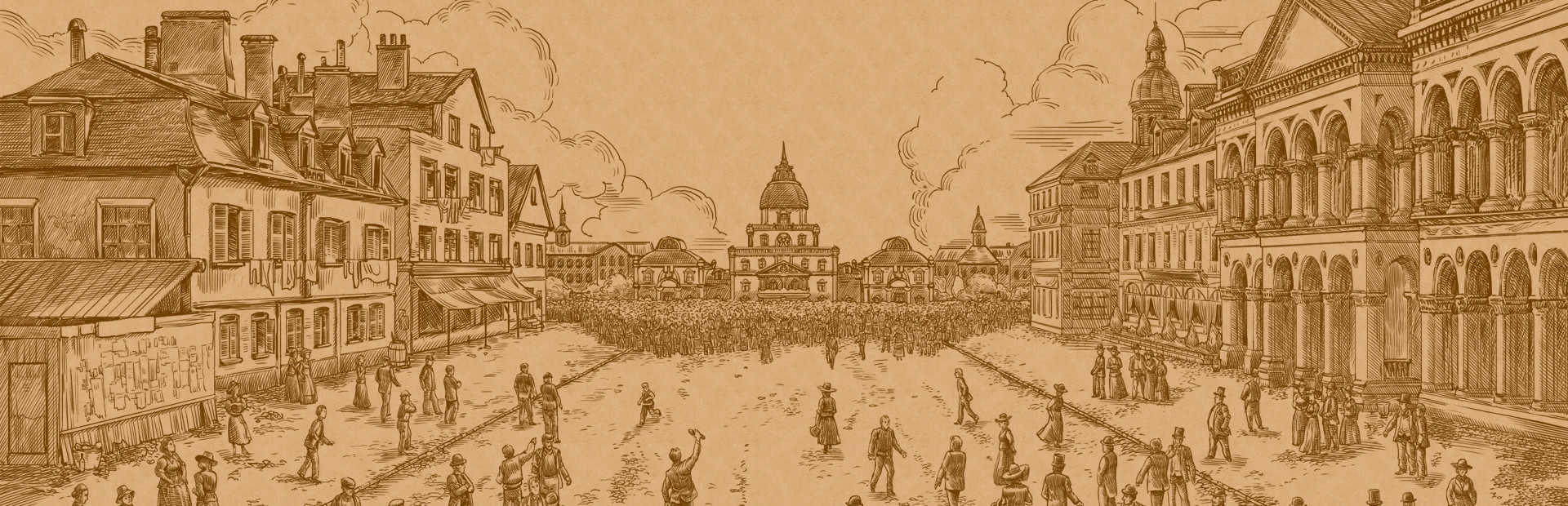
My first instinct when loading up Kapital: Sparks of Revolution was to start spreadsheet-tracking grain flows and class loyalty meters, which tells you something about who this game is actually aimed at. What you get is a 2D isometric city-builder set in a nameless post-Great War European capital, somewhere between Tropico's satirical politics and Anno's resource chains, but operating at a noticeably smaller scale than either. The core loop is approachable: rebuild ruined infrastructure from rubble, keep a supply chain of grain, food, beer, wood, stone, and eventually steel moving, and satisfy the divergent demands of three social classes - Workers who man the factories, Bourgeois who pay the taxes, and Nobles who staff the administrative machinery and demand exquisite treatment from day one. The class-tension mechanics are the game's most interesting contribution to the genre. Each faction sends a spokesperson who drops mission objectives on you, but crucially those objectives are suggestions, not orders. The real priority queue lives at the bottom of the screen as an urgent-needs tracker, and if you spend too long appeasing the Nobles' requests while your Workers are going hungry, the streets fill with Molotovs faster than you can commission a security bureau. There is also a corruption system layered on top: cracking down via police spending keeps graft low but tanks Noble loyalty, creating a genuine trade-off that goes a step beyond the standard happiness sliders you find in Cities: Skylines equivalents. Technology research and law adoption add a light progression layer, letting you unlock buildings and legal frameworks that nudge your city toward whatever ideological flavor you prefer - communist, capitalist, or cynically pragmatic. Here is where the honest critique lands, though. Critics and Steam users alike have flagged that the difficulty is inconsistent: Easy mode is genuinely tutorial-soft, while Normal can spike harshly because the game never stops sending new citizens regardless of whether your supply lines can absorb them. Worse, there is only one map in both campaign and sandbox, and the map has restricted buildable area, which means late-game play becomes a tight puzzle of demolition and reconstruction rather than expansion. Camera rotation is absent, which hurts spatial planning more than it should. Construction timers, standard genre furniture, start feeling like filler in later stages when you are waiting on queues rather than making decisions. The campaign mode runs through the full technology tree from ruins to functioning city, but reviewers noted it does not hold your hand - if you do not self-discover that the needs ticker outranks faction mission queues, you will hit a wall. For genre newcomers, that is actually a solvable problem and not a reason to avoid the game. The first campaign run on Easy acts as a low-pressure tutorial that teaches resource flow organically, and the mechanics are clear enough that a second Normal run feels meaningfully different once you understand the pacing. Experienced sim players will get 15-20 hours of reasonable content before the single-map constraint starts to chafe. The 2D art style is functional and readable - you can identify building types and track which class is rioting without confusion - though the aesthetic is closer to a late-1990s strategy game than anything modern. There is no background music to speak of, and the writing in campaign dialogue is blunt and on-the-nose in a way that is more amusing than immersive. Bugs at launch included crashes and save corruption for some players, though patch activity post-launch addressed balance issues. Kapital: Sparks of Revolution sits at a Metacritic score of 64 and mixed Steam user reviews, which is about right. The ideas - class warfare as a resource-management constraint, corruption as a policy dial, ideology as a late-game unlock path - are genuinely interesting for a small indie release. The execution runs out of room too quickly, literally and figuratively. At the sub-five tier price point it currently occupies, the calculus shifts. If you have already logged your hours in Frostpunk, Anno 1800, and Surviving Mars and want something with a different political texture at a budget spend, this scratches an itch that almost nothing else in the genre attempts. Go in expecting a compact, slightly rough indie experiment, not a genre-defining release, and you will get your money's worth.

Strategy & simulation
Tags
System Requirements
Minimum
- OS
- Windows 7/8/10
- Memory
- 8 GB RAM
- DirectX
- Version 11
- Storage
- 4 GB available space
- Graphics
- GeForce GTX 660, Radeon R7 370 or equivalent with 2 GB of video RAM
- Processor
- 3.2 GHz Dual Core Processor
- Sound Card
- DirectX compatible
Recommended
Requires a 64-bit processor and operating system
Keep exploring
Community Discussion
Be the first to comment on Kapital: Sparks of Revolution.
Reviews & Ratings
Game Info
- Developer
- Lapovich Team
- Publisher
- Fulqrum Publishing
- Release Date
- Apr 28, 2022