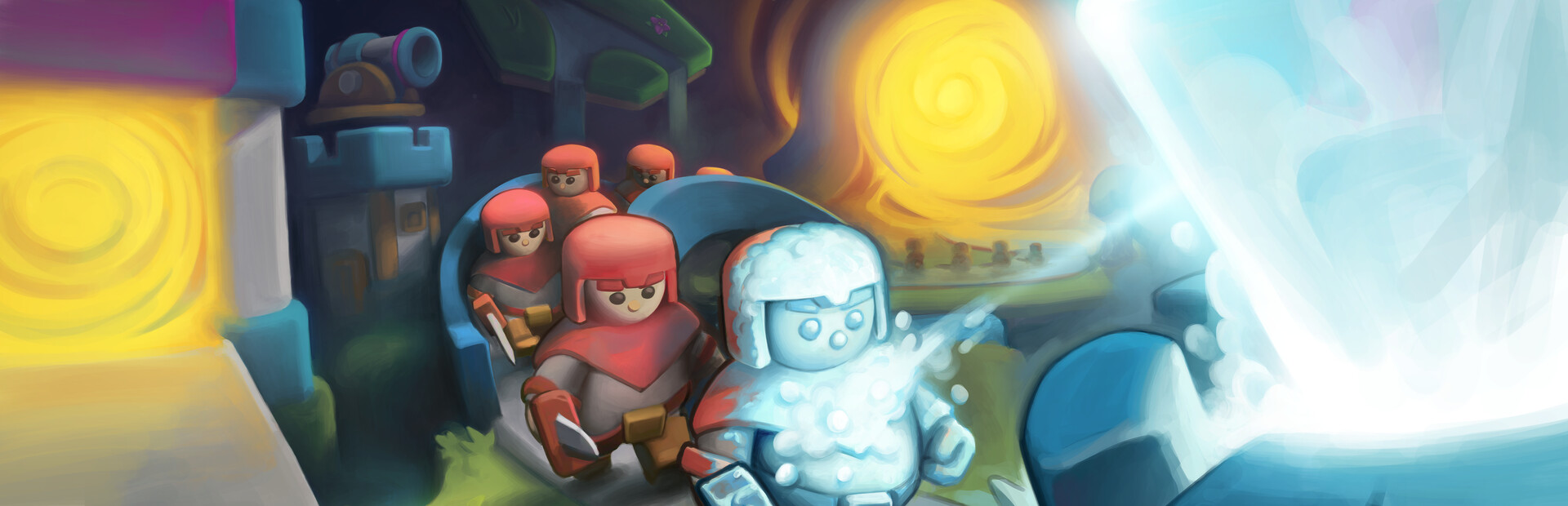
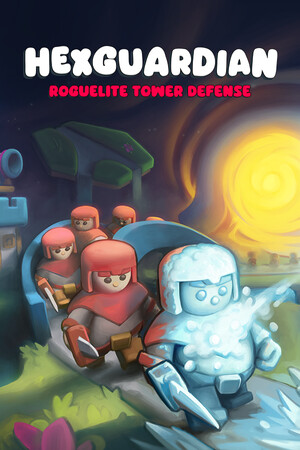
Hexguardian
Tower defense meets Carcassonne in a roguelite that looks friendly but will overrun your castle the moment you stop thinking two tiles ahead.
GamerScout Verdict
Best for strategy players who want tower defense with an active map-building layer and can stomach a slow early unlock curve.
Compare Prices(10 stores)
Every store in this table quotes us in euros, so the EUR figure is the price the seller actually set, not our arithmetic — which is why EUR is also the currency we rank in. We only list an offer here when the store gives us its price in euros, so nothing in this table is a number we invented.
Pick USD, PLN, GBP, CAD or AUD in the header and we convert from EUR at the European Central Bank reference rate — converted amounts are prefixed with ~. Your bank or the store may apply a different rate at checkout. We never hide offers based on where you are: everyone sees this whole table.
We may earn a commission when you buy games through links on this page — at no extra cost to you. It never affects our rankings or verdicts.
Price History
Screenshots & Media
About Hexguardian
I kept underestimating Hexguardian. The cartoony art style and mouse-only controls make it read as a casual afternoon project, and then wave twelve sends armored soldiers down three simultaneous roads I accidentally left open, and my crossbow towers do absolutely nothing about it. That tension between approachable presentation and genuine strategic bite is what makes this one interesting to me as a sim-and-strategy player who usually needs depth to stay engaged. The core loop is a build-phase, attack-phase cycle where every decision stacks. During the build phase you place towers, position melee swordsmen and ranged archers from army buildings, and pick from three randomly offered upgrades after surviving each wave. The upgrade draws can hand you a new tower type, a damage buff, a gold-economy building, or a spell to weaponize in the next wave. So far, standard roguelite. Where it gets structurally interesting is the tile system: kill enough enemies and you earn hex tiles to expand the map itself. Connecting rivers and roads can funnel enemies into longer kill corridors, but closing a loop entirely removes that spawn point at the cost of making the remaining enemies more aggressive. That tradeoff is the game's best decision space. Elevated terrain extends tower range, and rainstorms interact with elemental towers and spells, so terrain composition is never cosmetic. The Carcassonne comparison is apt and it's not just flavor. You are genuinely doing tile-matching logic under combat pressure. The three unit categories give some build flexibility. Melee units intercept and hold enemies on roads, ranged units deal sustained damage from a distance, and spellcasters apply status effects and elemental damage. Enemy variety escalates to armored infantry, naval units on rivers, and eventually airships, which forces you to cover multiple threat vectors simultaneously rather than stacking one tower type and calling it done. Late runs balloon to huge map sizes, and there are community reports of significant frame-rate degradation past the 40-60 day range on mid-range hardware, worth knowing before you commit to a very long session. Early players also flagged balance quirks on lower difficulties and some unit pathfinding oddities near bridges, though the game received post-launch support. Progression is handled through two modes. Standard Mode uses a persistent tech tree where trophies earned across runs unlock new towers, wonders, spells, and difficulty tiers. The talent-locking system deserves a call-out: you can pin specific unlocked talents out of the draw pool to stop them cluttering up runs where they are irrelevant, which is exactly the kind of meta-management control that separates a well-designed roguelite from a slot machine. Challenge Mode rotates weekly with a fixed set of perks and a global leaderboard, which provides a scoring target for players who want structure beyond personal best. The unlock pace in Standard can feel slow in the early sessions, so patience with the meta-layer is a prerequisite. No story, no lore, no controller support, and no Steam Deck compatibility at time of writing. This is a keyboard-and-mouse-on-a-monitor game. For strategy players who have bounced off pure tower defense before, the tile-placement layer is the reason to reconsider. It converts passive waiting between waves into active map construction, and that keeps the brain engaged in a way most TD games do not. The difficulty curve has teeth at any setting, and new players should expect early runs to end badly while the tile logic clicks into place. Treat those failed runs as tutorial sessions and the game opens up considerably.

Strategy & simulation
Tags
System Requirements
Minimum
- OS
- Windows 10
- Memory
- 4 GB RAM
- DirectX
- Version 11
- Storage
- 1 GB available space
- Graphics
- NVIDIA GeForce GTX 960 or AMD R9 270
- Processor
- Intel Core i3-7100 3.9GHz or AMD Ryzen 3 2200G
Recommended
- OS
- Windows 11
- Memory
- 8 GB RAM
- DirectX
- Version 12
- Storage
- 1 GB available space
- Graphics
- NVIDIA GeForce GTX 1660 or AMD RX 580
- Processor
- Intel Core i5-7500 or AMD Ryzen 5
Keep exploring
Community Discussion
Be the first to comment on Hexguardian.
Reviews & Ratings
No ratings available
Game Info
- Developer
- Split Second Games
- Publisher
- Yogscast Games
- Release Date
- May 2, 2024