Here Be Dragons
Witty writing and a gorgeous parchment art style carry this dice-driven naval tactics game further than its RNG-heavy combat probably deserves, worth a look if board game logic is your comfort zone.
GamerScout Verdict
Best for board game fans who can stomach dice variance, strategy purists wanting build depth should look elsewhere.
Compare Prices(4 stores)
Every store in this table quotes us in euros, so the EUR figure is the price the seller actually set, not our arithmetic — which is why EUR is also the currency we rank in. We only list an offer here when the store gives us its price in euros, so nothing in this table is a number we invented.
Pick USD, PLN, GBP, CAD or AUD in the header and we convert from EUR at the European Central Bank reference rate — converted amounts are prefixed with ~. Your bank or the store may apply a different rate at checkout. We never hide offers based on where you are: everyone sees this whole table.
We may earn a commission when you buy games through links on this page — at no extra cost to you. It never affects our rankings or verdicts.
Price History
Screenshots & Media
About Here Be Dragons
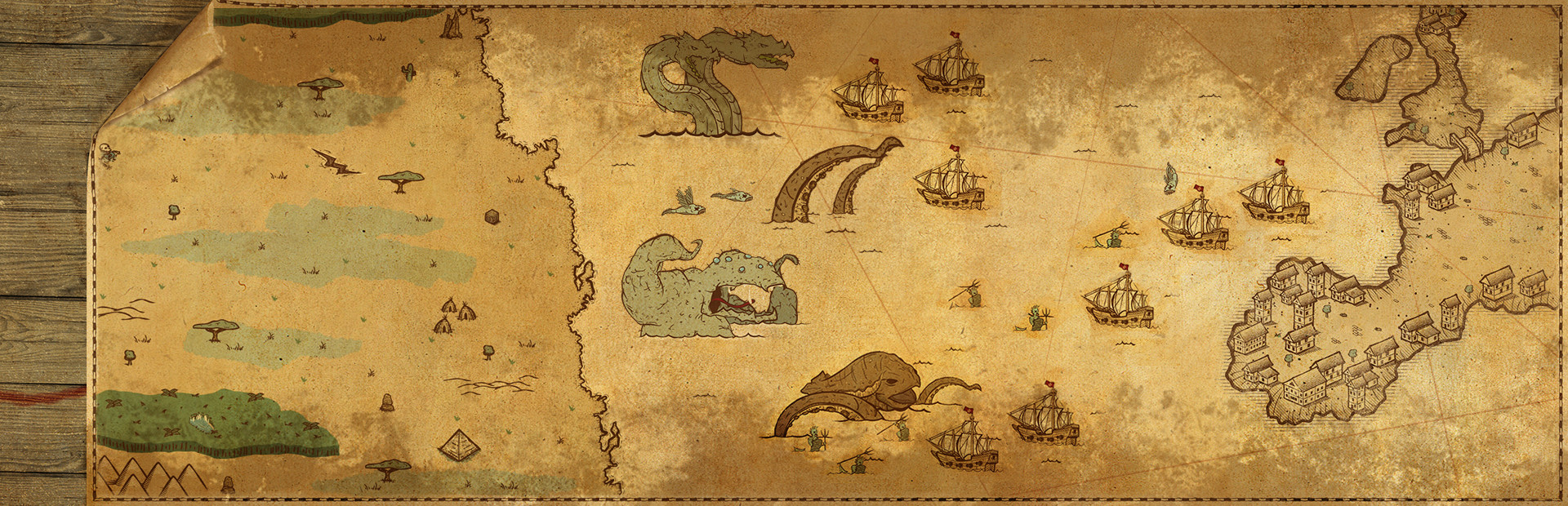
My spreadsheet instincts fired up the moment I saw the initiative system: lowest cumulative dice total from last turn goes first, which means deliberately rolling low can be a strategic weapon rather than bad luck. That single mechanic tells you almost everything you need to know about Here Be Dragons, it is a digital board game wearing a strategy costume, and how much that bothers you will define your entire experience. The core loop runs like this: a shared pool of dice is rolled at the start of each turn, one die per unit on screen, and you race your opponent to claim the numbers you need. Dice feed into three channels, Salvos for baseline attack and defense, special Actions that often require specific pip ranges like 4-6 or a single exact number, and stat boosts where a die assigned to attack or defense lingers for multiple turns before expiring. A precious ink resource, collected from floating bottles mid-battle, powers Errata: rule-bending interventions that let you reroll dice, deny the enemy numbers they need, or otherwise manipulate the pool. Denying enemy dice is especially satisfying; claim the numbers an opponent's action slots require and they eat chip damage for every unfilled slot. There is real decision-making here, and the game layers it in responsibly, the tutorial introduces concepts at a pace that never dumps the full rulebook at once, and a pop-up overlay on any ability keeps reference information a hover away. The problem is that the whole structure sits on a random number generator that can just veto your plans. On bad rolls, Errata and smart assignment still cannot fully compensate for a dice pool that has nothing useful in it. Reviewers who bounced hard off the game all land on the same complaint: a single-player experience where player skill occasionally ceases to be the deciding factor is simply less satisfying than one where it always matters. There are only two difficulty settings, and the campaign is linear, broken into chapters that each hand you a fresh captain and fresh action sets the moment you start internalizing the previous ones. Some reviewers appreciated the variety this creates; others found it cut off any sense of build investment before it could develop. There is no sandbox mode, no roguelite run structure, and replayability is limited once the campaign is done. On the positive side, the art direction is genuinely hard to argue with. The living-map aesthetic, sepia parchment, muted pastels, ink-black outlines, looks like someone animated a 15th-century cartographer's fever dream, and the monster roster (krakens, tritons, leviathans, ghost ships, cultists lifted loosely from Lovecraft) is both visually distinctive and tactically varied, with each creature carrying its own ability set and weaknesses. The writing earns its satirical label: the narrator is a barkeep recounting history through flashbacks, Columbus would rather be a pirate, and one captain communicates exclusively in the word 'Fish' until battle starts and he pivots inexplicably to disco karaoke. Whether that lands depends entirely on your tolerance for committed absurdism. The audio is the weak point, combat strips the soundtrack down to ocean waves and battle sounds, which reviewers consistently called sparse for a game this visually theatrical. For strategy players expecting Metacritic-70 depth, temper expectations: this is a light-to-mid-weight digital board game, not a tactics engine. For board game fans used to press-your-luck dice mechanics, it punches above its weight class. The campaign length runs a handful of hours with no meaningful post-game hook, so go in knowing that and you will not feel shortchanged by what it actually delivers.

Strategy & simulation
Tags
System Requirements
Minimum
- OS
- Windows 7+
- Memory
- 4000 MB RAM
- Graphics
- DirectX 9 compatible graphics card
- Processor
- Intel 1.2 GHz or equivilent AMD family
Recommended
Requires a 64-bit processor and operating system
Keep exploring
Community Discussion
Be the first to comment on Here Be Dragons.
Reviews & Ratings
Game Info
- Developer
- Red Zero Games
- Publisher
- Pansolo
- Release Date
- Jan 30, 2020