Haneda Girl
Sword-and-mech mayhem across 15 bite-sized worlds: ruthlessly tight, score-obsessed, and backed by a synthwave soundtrack that makes you feel like a threat even when you're dying on repeat.
GamerScout Verdict
Built for score-chasers and Katana Zero fans who want more mechanical depth and don't mind wall-sticking friction in the late game.
Compare Prices(4 stores)
Every store in this table quotes us in euros, so the EUR figure is the price the seller actually set, not our arithmetic — which is why EUR is also the currency we rank in. We only list an offer here when the store gives us its price in euros, so nothing in this table is a number we invented.
Pick USD, PLN, GBP, CAD or AUD in the header and we convert from EUR at the European Central Bank reference rate — converted amounts are prefixed with ~. Your bank or the store may apply a different rate at checkout. We never hide offers based on where you are: everyone sees this whole table.
We may earn a commission when you buy games through links on this page — at no extra cost to you. It never affects our rankings or verdicts.
Price History
Screenshots & Media
About Haneda Girl
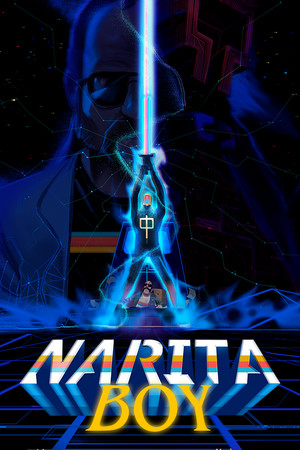
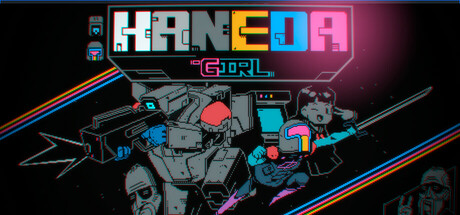
I went in expecting a breezy indie action romp and came out the other side with my palms damp and a slightly unhealthy fixation on shaving three seconds off level six. That tension is the whole point. Studio Koba, the Barcelona team behind Narita Boy, has stripped their ambitions down to something far more focused this time: a score-attack 2D platformer built around the push-pull between two wildly different characters, and it lands harder than it has any right to. The dual-character system is the mechanical heart of everything. Chichi Wakaba, call sign Haneda Girl, carries her light katana KenChan and moves like a threat multiplied. She can wall-hop, activate a cloaking device, and chain silent takedowns through narrow corridors that the mech could never reach. The trade-off is absolute: she dies from a single hit. M.O.T.H.E.R., the tactical combat mech, is her opposite in every sense. Slow, towering, capable of floating and breaking destructible walls, able to absorb punishment that would end Chichi in a frame. You can recall M.O.T.H.E.R. to your side at any point via a teleporter, which turns each encounter into a fast spatial puzzle. Do you stealth the sentry, or summon the mech and let the bullets fly? Both answers are valid. Neither is safe. As you push further in, unlockable mods and new ballistic weapons for M.O.T.H.E.R. open up more ways to approach each room, and collectible Floppy Codex medallions scattered across levels expand the lore of the Data Empire for players who want more than the kill-and-exit loop. The level structure is generous in a specific way. There are fifteen worlds, each holding one to three main stages, and most levels clock in under three minutes once you know them. That short loop means failure never stings the way it does in longer-form punishing games. The difficulty is real, especially in the final worlds where enemy placement turns aggressively hostile, but the kind of difficult that pulls you forward rather than slamming a door. Wall-sticking is the one recurring mechanical complaint worth flagging: Chichi grabs surfaces a little too eagerly in tight corridors, and it will kill your flow at the worst moment. The end-of-level grading system, scoring you on time, deaths, and kill efficiency across a bronze-to-onyx scale, is what the replayability hangs on. Chasing onyx ratings on stages you previously scraped through is its own compulsive loop. Some players will find the score requirements to unlock secret levels feel gatekeeping and a little mean; that criticism is fair. Aesthetically this is maximalist retro pixel chaos rendered at a chunky resolution that reads almost like a CRT arcade cabinet. Attacks light up the screen, every explosion lands with exaggerated weight, and Hackernaut blood and robot oil paint the level geometry as you move through. Still screenshots do not communicate any of it. The synthwave and techno soundtrack does the same work the Narita Boy OST did: it locks you into a rhythm that the level design actively rewards. Where Narita Boy leaned on deep lore and 80s mythology, Haneda Girl keeps its story light, told in short vignettes between Chichi and Professor Nakamura before each mission. It is warm and charming, but anyone expecting the worldbuilding density of the previous game will find it thin. If you want a pure play-feel game, the kind where the craft is in the controls and the choreography, Studio Koba has built something precise and genuinely satisfying here. It is not for people who resent being graded. It is not for people allergic to the one-hit-kill glass cannon fantasy. But if Katana Zero or Hotline Miami left you hungry for more mechanical texture, and you do not mind losing an evening to a single world just to land a clean run, this is the game that deserves more attention than it is getting.

Indie & narrative
Tags
System Requirements
Minimum
- OS
- Windows 10
- Memory
- 2 GB RAM
- DirectX
- Version 10
- Storage
- 2 GB available space
- Graphics
- NVIDIA Geforce 9800 GTX, 1 GB or Radeon HD 4870, 1 GB
- Processor
- Dual Core, Processor, 2.0 GHz
- Sound Card
- Windows Compatible Soundcard
Keep exploring
Community Discussion
Be the first to comment on Haneda Girl.
Reviews & Ratings
Game Info
- Developer
- Studio Koba
- Publisher
- Studio Koba
- Release Date
- May 23, 2025