Compare Growth prices across 50+ stores and find the best deal. Developed by VoodooDuck. Published by Assemble Entertainment. Released on 10/16/2023. Available on PC. Genres: Casual, Indie, Simulation, Strategy.

Closer to a zen puzzle than a traditional strategy game, Growth rewards careful tile-by-tile planning over aggression, making every animal placement feel genuinely consequential.

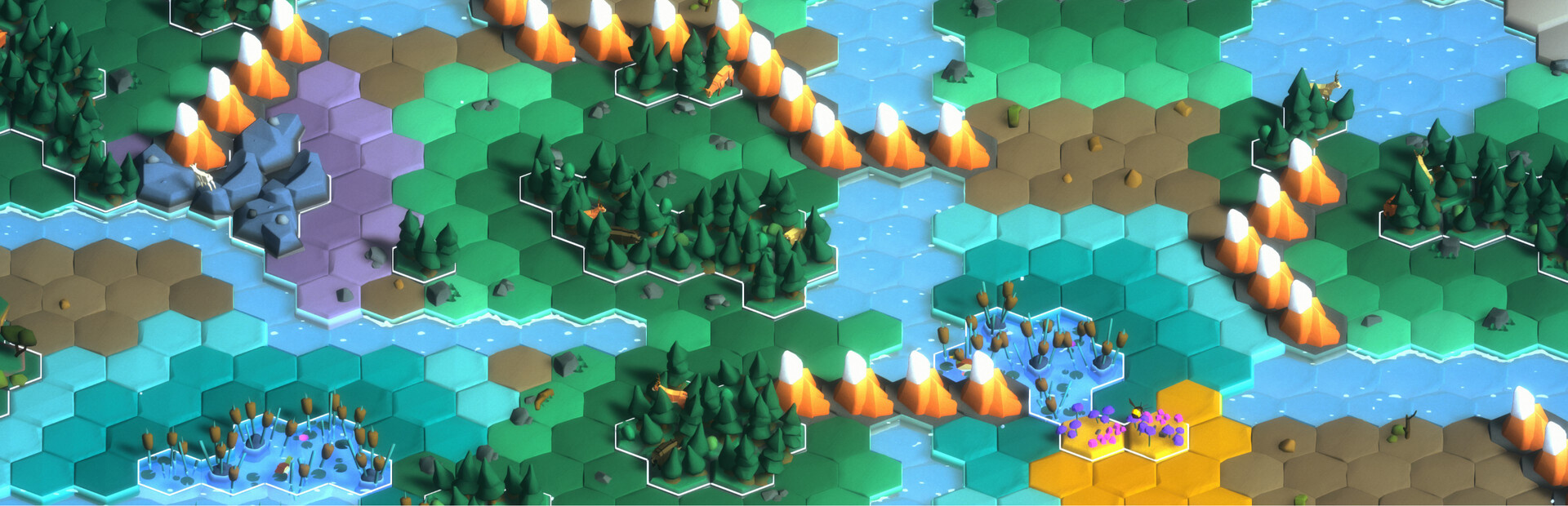
My first honest reaction to Growth was mild skepticism. As someone who color-codes Paradox patch notes, a hex-grid game where you send deer across meadows is not exactly my default Tuesday night. But the resource economy here has real teeth, and after two failed runs I stopped dismissing it and started thinking like a planner. The core loop is lean and precise. You drop into a procedurally generated hex map, starting with a small revealed forest at the center and a handful of deer to spend. Every animal you dispatch uncovers adjacent tiles, but the animal is consumed in the process, so each move is a small, irreversible commitment. The goal is to expose more than 80 percent of the current map, unlock an adjacent zone, and eventually locate and quell the hidden volcano that drives the loose narrative. There are seven distinct creatures to work with across the run, each tied to a specific biome: deer and boars handle forest tiles (green), bees cross water and obstacles (yellow tiles), mountain goats push through high terrain, beavers deal with water zones, and scout-class animals like eagles and bats reveal large swaths of the map at once without fully clearing them, letting you gather intel before committing. Chaining adjacent habitat clusters is the core strategic lever, because connected clusters replenish your supply; cut off a boar run that leads nowhere and you have quietly strangled your own late-game options. The UI does the right thing by showing exactly how many tiles a given move will uncover and whether landing there triggers an animal unlock. There is no timer and no online leaderboard, which removes competitive pressure entirely. Points of Interest scattered across maps act as risk-reward calculations: reaching them often costs several animals to navigate mountains or rivers, but the payoff can be a special creature that reframes your remaining moves. Procedural generation means map quality varies, and some seeds produce awkward obstacle distributions that feel punishing rather than interesting, which is the main honest criticism. A custom mode with adjustable starting conditions or biome density would go a long way here, and its absence is the most obvious gap in an otherwise well-considered design. For the strategy-minded player wondering whether there is enough depth to justify attention: the resource math is genuinely satisfying once it clicks. Planning a two-move chain that opens a beaver corridor to bridge two forest clusters is the kind of quiet optimization that keeps you coming back. The aesthetic is minimal but purposeful, with a subdued soundtrack that stays out of the way and tile color-coding that communicates biome rules clearly without a reference card. The Steam community sits well above 90 percent positive across roughly 200 reviews, which reflects a narrow but loyal audience rather than mainstream breakout status. Think of it as Dorfromantik's more demanding sibling, one where placement mistakes have actual consequences. No mod support, no multiplayer, no late-game complexity scaling, but the foundation is clean and the loop is honest. Treat it as a short-session puzzle game and it delivers consistently. Approach it expecting grand-strategy depth and you will bounce off within an hour. Diego, Scout Team

Growth
CasualIndieSimulationStrategy

Growth

Oct 16, 2023VoodooDuckAssemble Entertainment
GamerScout Says

Closer to a zen puzzle than a traditional strategy game, Growth rewards careful tile-by-tile planning over aggression, making every animal placement feel genuinely consequential.

PC
Best Price Available
0.00
at N/A
Historical low: $1.21

Compare Prices(0 stores)

Loading prices...

We may earn a commission when you buy games through links on this page — at no extra cost to you. It never affects our rankings or verdicts.

Screenshots & Media

Screenshot

About Growth

My first honest reaction to Growth was mild skepticism. As someone who color-codes Paradox patch notes, a hex-grid game where you send deer across meadows is not exactly my default Tuesday night. But the resource economy here has real teeth, and after two failed runs I stopped dismissing it and started thinking like a planner. The core loop is lean and precise. You drop into a procedurally generated hex map, starting with a small revealed forest at the center and a handful of deer to spend. Every animal you dispatch uncovers adjacent tiles, but the animal is consumed in the process, so each move is a small, irreversible commitment. The goal is to expose more than 80 percent of the current map, unlock an adjacent zone, and eventually locate and quell the hidden volcano that drives the loose narrative. There are seven distinct creatures to work with across the run, each tied to a specific biome: deer and boars handle forest tiles (green), bees cross water and obstacles (yellow tiles), mountain goats push through high terrain, beavers deal with water zones, and scout-class animals like eagles and bats reveal large swaths of the map at once without fully clearing them, letting you gather intel before committing. Chaining adjacent habitat clusters is the core strategic lever, because connected clusters replenish your supply; cut off a boar run that leads nowhere and you have quietly strangled your own late-game options. The UI does the right thing by showing exactly how many tiles a given move will uncover and whether landing there triggers an animal unlock. There is no timer and no online leaderboard, which removes competitive pressure entirely. Points of Interest scattered across maps act as risk-reward calculations: reaching them often costs several animals to navigate mountains or rivers, but the payoff can be a special creature that reframes your remaining moves. Procedural generation means map quality varies, and some seeds produce awkward obstacle distributions that feel punishing rather than interesting, which is the main honest criticism. A custom mode with adjustable starting conditions or biome density would go a long way here, and its absence is the most obvious gap in an otherwise well-considered design. For the strategy-minded player wondering whether there is enough depth to justify attention: the resource math is genuinely satisfying once it clicks. Planning a two-move chain that opens a beaver corridor to bridge two forest clusters is the kind of quiet optimization that keeps you coming back. The aesthetic is minimal but purposeful, with a subdued soundtrack that stays out of the way and tile color-coding that communicates biome rules clearly without a reference card. The Steam community sits well above 90 percent positive across roughly 200 reviews, which reflects a narrow but loyal audience rather than mainstream breakout status. Think of it as Dorfromantik's more demanding sibling, one where placement mistakes have actual consequences. No mod support, no multiplayer, no late-game complexity scaling, but the foundation is clean and the loop is honest. Treat it as a short-session puzzle game and it delivers consistently. Approach it expecting grand-strategy depth and you will bounce off within an hour. Diego, Scout Team

Tags

singleplayerachievementscontroller-supportcloud-savestier:sub-5Hex-Grid PuzzleResource ManagementAnimal AbilitiesProcedural MapsSingle-Run ProgressionNo-Timer StrategyBite-Sized SessionsDorfromantik-Like

Steam Deck & Linux

Steam Deck VerifiedProtonDB Gold

Valve rates this game Steam Deck Verified. Runs great on Linux after minor tweaks. Based on 6 ProtonDB community reports.

System Requirements

Minimum

OS
Windows 10
Memory
4 GB RAM
Storage
1 GB available space
Graphics
NVIDIA GeForce GT 730 (2GB VRAM) or higher
Processor
Intel(R) Core(TM) i3-3220 CPU @ 3.30GHz or higher

Community Discussion

Be the first to comment on Growth.

Reviews & Ratings

No ratings available

Game Info

Developer
VoodooDuck
Publisher
Assemble Entertainment
Release Date
Oct 16, 2023

Price Alert

Get notified when the price drops below your target!

Create Alert

Price History

2026-06-101.21(lowest)
2026-06-091.27

More from VoodooDuck

Buy smarter: helpful guides

Looking for more? See games like Growth

Frequently asked questions about Growth

How much does Growth cost?

Growth pricing changes often and varies by store, edition and region. The live price table on this page compares the cheapest in-stock key and store offers across 50+ verified shops, so you always see the current lowest price before you buy.

Where can I buy Growth cheapest?

Compare Growth prices across every verified store in the price table on this page. We list the cheapest in-stock key and store offers, updated regularly, so you always see the best current deal before you buy.

What platforms is Growth available on?

Growth is available on PC.

When was Growth released?

Growth was released on 16 October 2023.

Who developed Growth?

Growth was developed by VoodooDuck and published by Assemble Entertainment.