Going Medieval
Colony-builder meets castle sim in a post-plague dark age. Deep management, vertical construction, and real survival pressure that punishes complacency.
GamerScout Verdict
Solid colony-builder for players who enjoy tuning production chains and designing defensible bases - the 3D construction layer genuinely adds strategic weight.
Compare Prices(7 stores)
Every store in this table quotes us in euros, so the EUR figure is the price the seller actually set, not our arithmetic — which is why EUR is also the currency we rank in. We only list an offer here when the store gives us its price in euros, so nothing in this table is a number we invented.
Pick USD, PLN, GBP, CAD or AUD in the header and we convert from EUR at the European Central Bank reference rate — converted amounts are prefixed with ~. Your bank or the store may apply a different rate at checkout. We never hide offers based on where you are: everyone sees this whole table.
We may earn a commission when you buy games through links on this page — at no extra cost to you. It never affects our rankings or verdicts.
Price History
Screenshots & Media
About Going Medieval
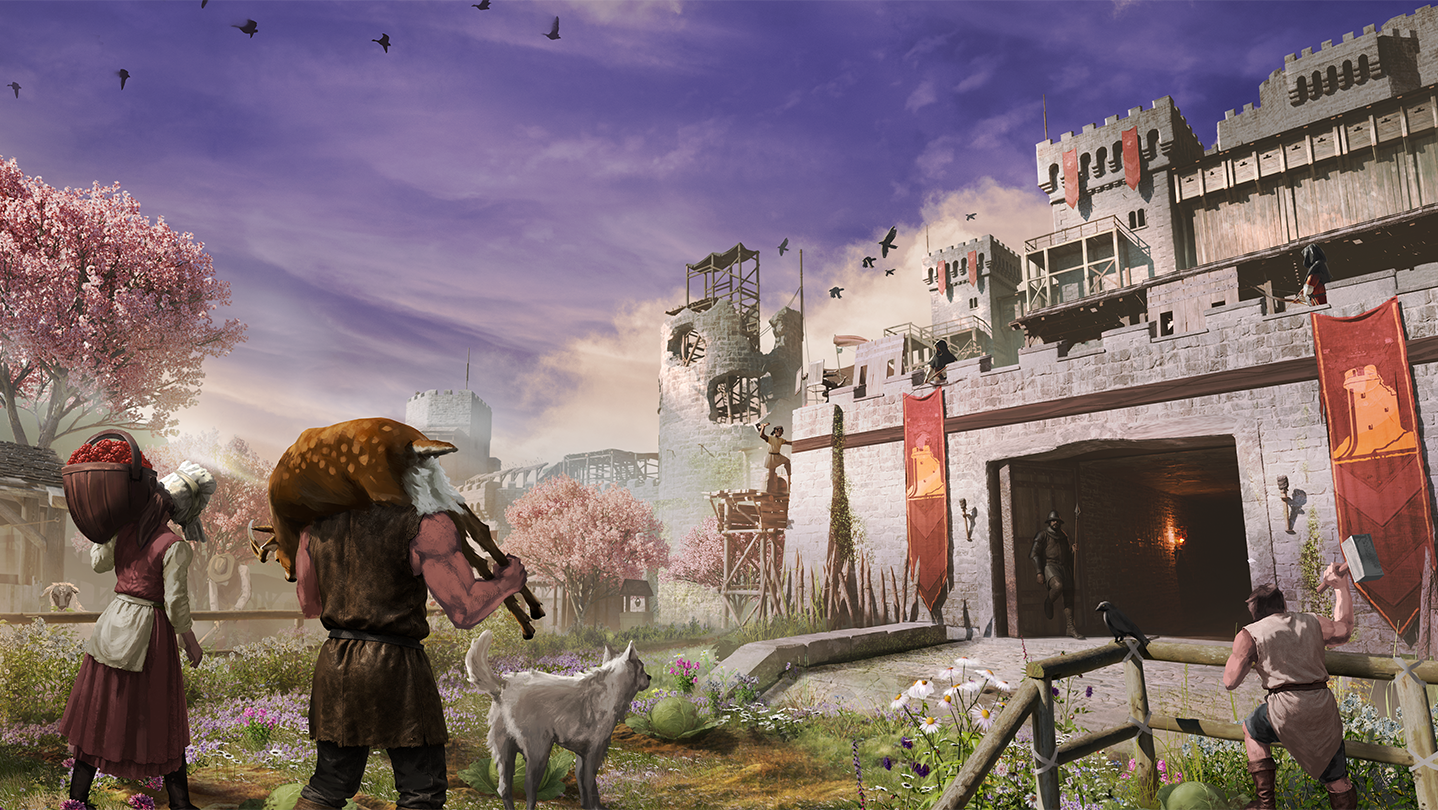
Going Medieval is a colony management sim set in a 14th-century world still crawling back from a civilisation-ending plague. You start with a handful of survivors, a patch of wilderness, and the slow, satisfying task of turning that nothing into a fortified settlement. It sits firmly in the same genre DNA as RimWorld and Dwarf Fortress, but it leans hard into the medieval aesthetic and, crucially, into three-dimensional castle construction. That vertical axis changes the decision calculus in ways that matter: you are not just zoning a flat town, you are thinking about where to put the granary relative to the great hall on the second floor, and whether your archers have sightlines from the battlements. The management layer is where the game earns its 89 percent approval rating. Colonists have skills, needs, moods, and schedules that you tune through priority systems that will feel familiar to anyone who has logged serious hours in the genre. Food chains, crop rotations, supply runs, research trees, and equipment tiers all interact with enough complexity to reward a spreadsheet mindset without requiring one. The mid-game is particularly well-paced: the moment your starter shack becomes a real compound with stone walls, a forge, and dedicated sleeping quarters, the game clicks into a satisfying feedback loop. Late-game raids force you to think about perimeter design and troop positioning, which turns the colony sim into something closer to a light tactical layer. For newcomers, the tutorial does enough heavy lifting to get you past the first winter without feeling patronised. The interface is cleaner than most genre competitors, zone placement is intuitive, and the game will gently flag critical shortfalls before they become fatal ones. A first playthrough at normal difficulty is genuinely approachable. That said, Going Medieval does expect you to read it. Production chains are not telegraphed by hand-holding pop-ups; you will need to spend some time understanding how flax becomes linen becomes clothing, and why your settlers are freezing despite a full stockpile of raw wool. Treat that learning curve as part of the game, not a flaw in it. Weaker spots exist. The AI pathfinding has quirks under load, especially in dense multi-level structures where colonists occasionally get stubborn about routing. The diplomatic and faction systems feel thin compared to how polished the base-building loop is. You are not going to find the political depth of a Paradox title here; external threats are mostly raids on a timer rather than emergent geopolitical story. The mod ecosystem is active but still maturing, so if you are coming from a heavily modded RimWorld install, the variety gap will be noticeable at launch. That gap should close with time, given the developer's patch cadence and community engagement. Bottom line for the strategy-minded buyer: the depth of decision-making in construction and resource management is genuine, not cosmetic. If you care about optimising production chains, designing defensible perimeters, and watching your colony evolve from desperate survival camp to functioning feudal compound, Going Medieval delivers that loop with polish and a distinct visual identity. It is not reinventing the genre, but it executes its specific slice of it with enough confidence to justify serious time investment.

Strategy & simulation
Tags
System Requirements
Minimum
- OS
- Windows 7 64-bit
- Processor
- AMD or Intel, 3.3 GHz (AMD FX 8300, Intel i5 3000)
- Memory
- 8 GB RAM
- Graphics
- AMD/NVIDIA dedicated GPU, 2GB dedicated VRAM (Radeon RX 560…
Recommended
- OS
- Windows 10 / Windows 11 (64-bit)
- Processor
- Intel Core i5-10600K / i7-10700 or AMD Ryzen 5 3600 XT
- Memory
- 16 GB RAM
- Graphics
- NVIDIA GeForce GTX 166…
Keep exploring
Community Discussion
Be the first to comment on Going Medieval.
Reviews & Ratings
Game Info
- Developer
- Foxy Voxel
- Publisher
- The Irregular Corporation
- Release Date
- Mar 17, 2026
