
Gods Against Machines
Populous meets Slay the Spire in a compact roguelite god-game that rewards build-hunting over brute reflexes - strong for the price, shallow for the long haul.
GamerScout Verdict
Best for roguelite fans who enjoy build-crafting and synergy-hunting over fast-paced combat or complex AI opposition.
Compare Prices(3 stores)
Every store in this table quotes us in euros, so the EUR figure is the price the seller actually set, not our arithmetic — which is why EUR is also the currency we rank in. We only list an offer here when the store gives us its price in euros, so nothing in this table is a number we invented.
Pick USD, PLN, GBP, CAD or AUD in the header and we convert from EUR at the European Central Bank reference rate — converted amounts are prefixed with ~. Your bank or the store may apply a different rate at checkout. We never hide offers based on where you are: everyone sees this whole table.
We may earn a commission when you buy games through links on this page — at no extra cost to you. It never affects our rankings or verdicts.
Price History
Screenshots & Media
About Gods Against Machines
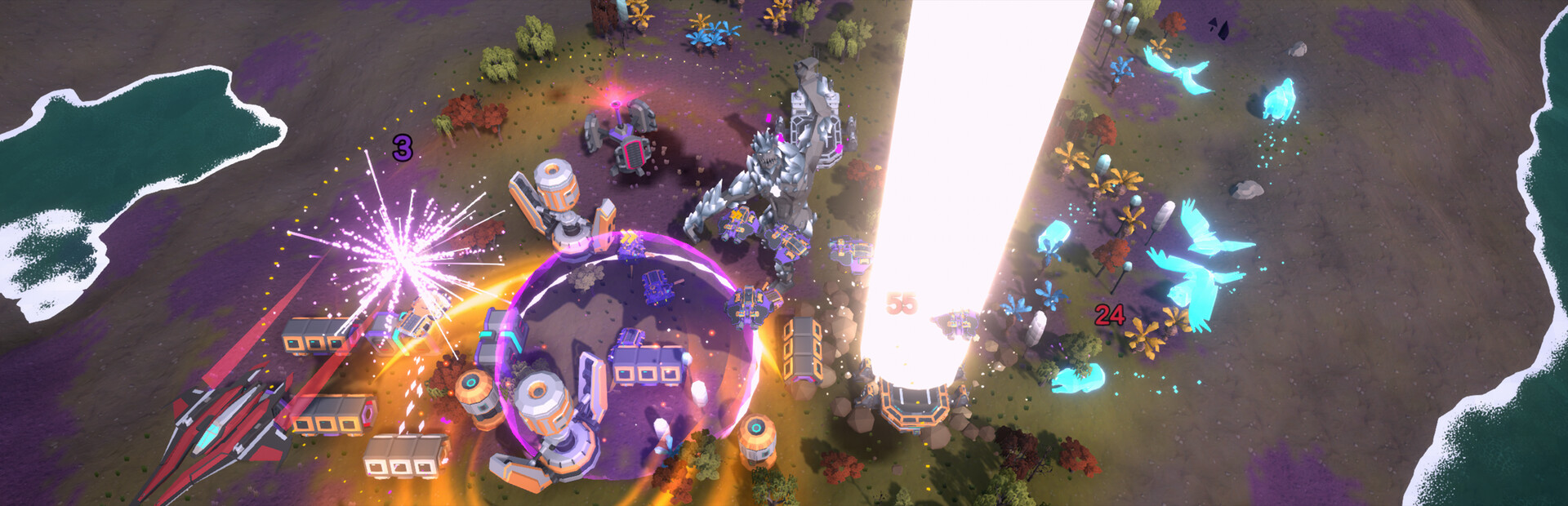
I went into Gods Against Machines expecting a glorified tower-defence clone and came out genuinely surprised by how much decision-making Silver Eye Studios packed into such a small package. The core loop puts you in the divine shoes of one of four elemental gods - Azzinoth (Fire), Nadea (Water), Zafari (Wind), and Urus (Earth) - each with distinct mechanics that change how you approach every map. Azzinoth players lean on raw area damage like Meteor Storm and Volcano to flatten enemy outposts in a single cast, while Nadea's toolkit scales off mana expenditure, slowly raising sea levels to drown entire formations. That kind of asymmetric god design is exactly the sort of thing I look for in a roguelite: your god choice is effectively your build archetype, and it sets the strategic tone before you spend a single blessing. The session structure borrows deliberately from Slay the Spire and the old Starcraft Nexus Wars mod. You move across a procedurally generated campaign map, choosing which enemy-held regions to attack. Skipping nodes lets you progress faster but starves you of spell upgrades and blessings; grinding every fight slowly scales your power beyond what the machines can counter. That pacing dial is genuinely useful and means the game respects players who want a methodical build-up rather than forcing a speed-run cadence. Mana crystals scattered across each map serve as your resource anchor - protect them, and optionally ring them with summoned structures like mini-volcanoes or spirit dwellings that spawn allied sprites. Corruption is the secondary pressure: let the machines' terraformers run unchecked and your post-mission rewards shrink. It is a lightweight but real resource management problem, and keeping track of it while casting offensive spells and positioning is where the interesting moments live. Meta-progression runs through Gaia, the Mother of Nature, whose powers carry between runs and accumulate over time. Picking which Gaia powers to activate each run adds a meaningful synergy layer - some combinations only become possible with specific god/spell pairings, and discovering those cross-synergies is the game's best content. Over 60 spells across the four gods, each upgradeable in branching ways, means the build space is wider than the game's modest review count might suggest. The Void Realm endless mode extends that experimentation past the main campaign for players who want to stress-test an overpowered build. That said, the AI is predictable by the developer's own admission - once you map out the machine threat patterns you are largely optimising rather than reacting, which will bore players who need dynamic opposition. Some community feedback flags repetition as a concern in longer sessions, and that is a fair read: the strategic variety is front-loaded into the pre-mission choices rather than spread through the combat itself. For newcomers to the action-RTS space, Gods Against Machines is a surprisingly accessible entry point. The tutorial covers mana management, spell targeting, and corruption control without drowning you in icons, and the difficulty dial - slow methodical runs versus fast aggressive ones - means you can learn at your own pace. It is a small-studio production from a Czech family team, and the low-poly art style reflects that budget honestly without looking bad. Controller support is solid. The session length is short enough for a lunch break run. If you are a genre veteran hunting a deep AI sandbox or complex faction diplomacy, look elsewhere. But if you want a tightly designed little god-game where a well-chosen Gaia power plus a Nadea flood build melts an entire enemy command structure, this earns its place.

Strategy & simulation
Tags
System Requirements
Minimum
- OS
- Windows 7 (SP1+) or higher
- Memory
- 4096 MB RAM
- Storage
- 2 GB available space
- Graphics
- NVIDIA GTX 760 or better, 2 GB RAM, DX11 capable
- Processor
- x64 architecture with SSE2 instruction set support
- Sound Card
- Yes
Recommended
- OS
- Windows 7 (SP1+) or higher
- Memory
- 8192 MB RAM
- Storage
- 2 GB available space
- Graphics
- NVIDIA GTX 960 or better, 3 GB RAM, DX11 capable
- Processor
- x64 architecture with SSE2 instruction set support
- Sound Card
- Yes
Keep exploring
Community Discussion
Be the first to comment on Gods Against Machines.
Reviews & Ratings
No ratings available
Game Info
- Developer
- Silver Eye Studios
- Publisher
- Silver Eye Studios
- Release Date
- Feb 26, 2024