
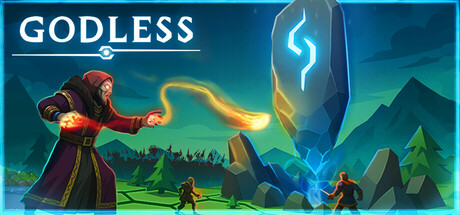
Godless
Playing the villain has never felt this methodical: a hex-grid auto-battler roguelite where terraform, summon, and spell decisions compound run after run into genuinely satisfying build variety.
GamerScout Verdict
Best for tactics players who want a compact, puzzle-minded roguelite and can tolerate minor solo-dev UI roughness.
Compare Prices(4 stores)
Every store in this table quotes us in euros, so the EUR figure is the price the seller actually set, not our arithmetic — which is why EUR is also the currency we rank in. We only list an offer here when the store gives us its price in euros, so nothing in this table is a number we invented.
Pick USD, PLN, GBP, CAD or AUD in the header and we convert from EUR at the European Central Bank reference rate — converted amounts are prefixed with ~. Your bank or the store may apply a different rate at checkout. We never hide offers based on where you are: everyone sees this whole table.
We may earn a commission when you buy games through links on this page — at no extra cost to you. It never affects our rankings or verdicts.
Price History
Screenshots & Media
About Godless
I went into Godless expecting a breezy auto-battler, and it took about three failed runs to recalibrate my expectations upward. This is a turn-based roguelite where you play as the last surviving deity, defending your shrine against waves of mortal heroes across procedurally generated hex maps. The pitch sounds chaotic, but the actual decision-making is disciplined and surprisingly puzzle-like once you understand the system. Your units fight autonomously, but how you position them, what terrain you terraform around them, and which spells you sequence each turn determines whether your shrine survives the onslaught or gets overrun. The indirect control model is not a shortcut for the developer; it is the core design choice. Because your minions always target the nearest enemy threat and enemies always march toward your shrine, every tile placement and unit summon has a predictable downstream effect. That predictability is what turns the chaos of an auto-battler into something a strategy player can actually solve. The build variety is where Godless earns its replay hours. Each run you accumulate spells, summon types, and passive talents that can be combined in ways the tutorial will not spell out for you. Resurrect abilities layered onto poisoned units, buffing spells timed to a counterattack wave, terrain reshaping to funnel enemies into a killbox: the combinations are numerous enough that two experienced players will rarely describe their winning run the same way. That said, the talent overflow UI bug spotted in community discussions is a real nuisance; if you stack enough passive abilities, some simply fall off-screen and become unreadable. It is the kind of rough edge that a solo developer polish pass could fix, and it is worth flagging before you sink deep into a particularly ambitious build. For newcomers to the auto-battler or roguelite space, Godless is more accessible than its difficulty tag suggests. The rules governing unit behavior are simple and consistent: your servants destroy enemies, enemies destroy your shrine, and the hex grid dictates who reaches what first. Learning those movement patterns is the entire tutorial, and once that clicks, the learning curve becomes about build theory rather than mechanical confusion. Difficulty settings give players room to ease in, and runs are short enough that a loss does not feel punishing. This is the kind of game where a one-hour session is entirely possible without feeling incomplete, which matters if you are deciding between this and a bigger time commitment. The community reception sits at 91 percent positive on Steam across a modest but meaningful review count, which tracks with the experience: this is a tight, well-conceived indie that does not overpromise. There is no mod ecosystem to speak of and no multiplayer, so longevity depends entirely on how much the run variety holds your attention. If you are the type who chases optimal build synergies and tolerates a few UI rough edges in exchange for a genuinely novel strategic angle, the value-to-price ratio here is strong. If you need a sprawling campaign or deep lore to stay engaged, Godless will run dry faster than you'd like.

Strategy & simulation
Tags
System Requirements
Minimum
- OS
- Windows 10
- Memory
- 6 GB RAM
- Storage
- 2 GB available space
- Graphics
- Intel HD Graphics 4000 or better
- Processor
- Intel Core i5
Recommended
- OS
- Windows 10
- Memory
- 8 GB RAM
- Storage
- 2 GB available space
- Graphics
- Intel HD Graphics 4000 or better
- Processor
- Intel Core i5
Keep exploring
Community Discussion
Be the first to comment on Godless.
Reviews & Ratings
No ratings available
Game Info
- Developer
- Danil Kalyupa
- Publisher
- Danil Kalyupa
- Release Date
- Jun 3, 2024