Getting Over It with Bennett Foddy
Foddy built this to punish a specific type of player, and the honesty of that is almost charming. Whether you're that player is the only question that matters before you click buy.
GamerScout Verdict
Built for players who find meaning in repetition and recovery; actively hostile to everyone else, by design.
Compare Prices(5 stores)
Every store in this table quotes us in euros, so the EUR figure is the price the seller actually set, not our arithmetic — which is why EUR is also the currency we rank in. We only list an offer here when the store gives us its price in euros, so nothing in this table is a number we invented.
Pick USD, PLN, GBP, CAD or AUD in the header and we convert from EUR at the European Central Bank reference rate — converted amounts are prefixed with ~. Your bank or the store may apply a different rate at checkout. We never hide offers based on where you are: everyone sees this whole table.
We may earn a commission when you buy games through links on this page — at no extra cost to you. It never affects our rankings or verdicts.
Price History
Screenshots & Media
About Getting Over It with Bennett Foddy
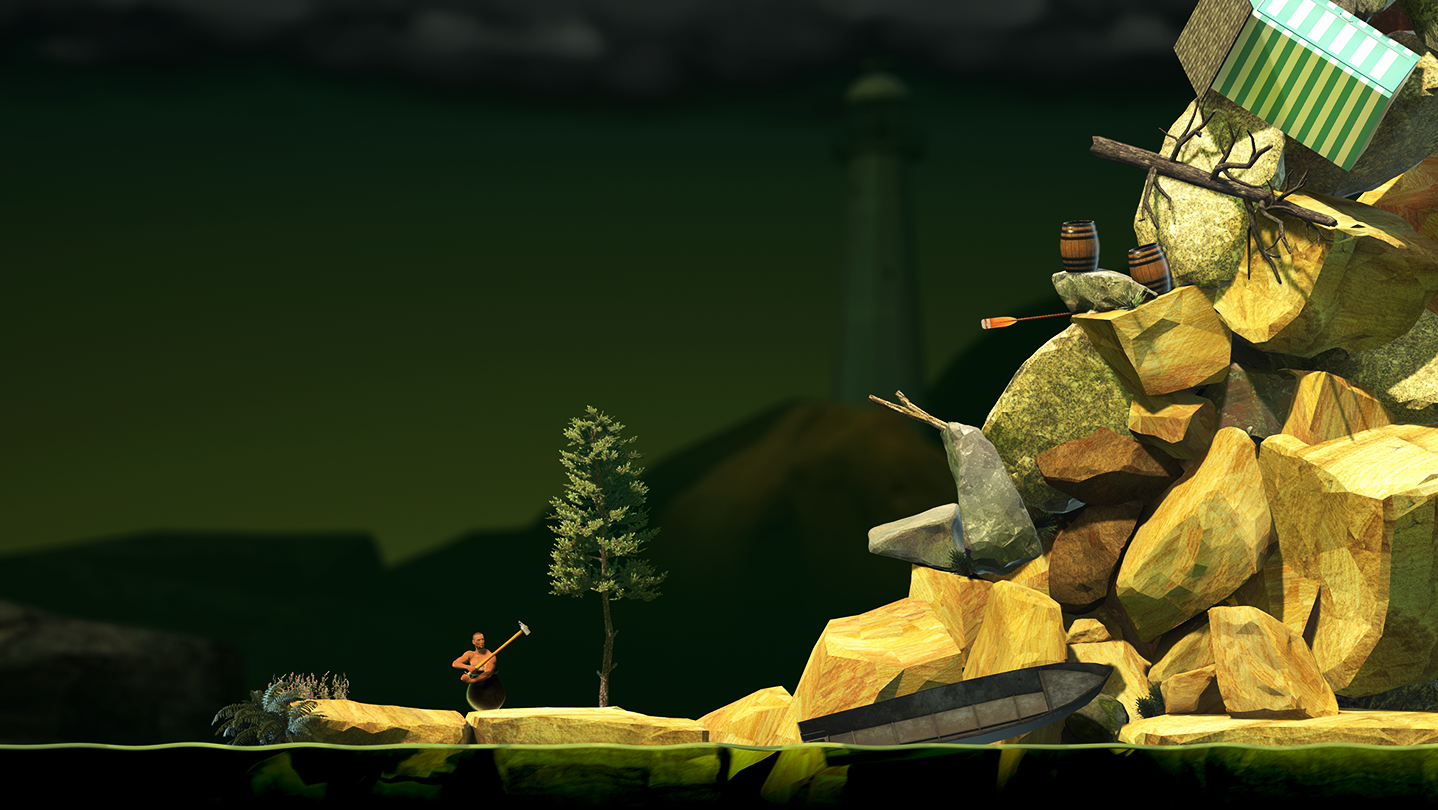
I went in knowing the reputation and still wasn't ready. You control Diogenes, a man sitting in a cauldron, using nothing but a sledgehammer controlled entirely by mouse movement to haul yourself up an enormous, chaotic mountain assembled from mismatched free-use assets. That single mechanic, moving only the hammer, is the whole game. No inventory, no upgrades, no alternate routes. Mouse moves hammer, hammer moves man in pot, man in pot either climbs or plummets. That is the entire loop from minute one to whenever you finally finish, or quit, or fling your mouse across the room. What separates this from other precision-punishment games is the voice layer. Bennett Foddy narrates throughout, delivering calm philosophical observations about failure, perseverance, and the nature of difficulty in games. The commentary kicks in specifically when you suffer significant setbacks, quoting writers, philosophers, and the occasional rapper with the dry composure of someone watching you suffer from a comfortable armchair. Whether that reads as genuinely thoughtful or patronizing depends entirely on your mood and how far you just fell. The audio design leans into the contrast, sometimes cutting to old public-domain songs at exactly the wrong moment, which is either hilarious or maddening depending on your temperament. The physics-based control scheme is the core argument the game makes. Early on it feels broken because it is sensitive and fidgety, but that fiddliness is intentional. With practice, the same hammer that felt impossibly unruly becomes a tool you can use to push, pull, pogo, swing, and fling yourself up terrain at speed. There are no permanent checkpoints, and certain sections are positioned to send you tumbling back through large chunks of progress you spent real time on. Speedrunners complete the whole mountain in under two minutes. First-time players can spend ten-plus hours and still not see the end. That gap is not a bug; it is the entire point. The game is a direct argument that mastery and repetition are worth something, and it structures every obstacle to reinforce that argument, whether you agree with the philosophy or not. The honest downside is that the game's premise and its execution are the same thing, and they do not get more varied. The mountain gets harder, the falls get longer, and Foddy keeps talking. If the core loop does not click for you in the first hour, nothing downstream will change your mind. The visuals are deliberately scrappy, the single level is the only level, and the three achievements (climb the mountain once, twice, fifty times) tell you exactly where the game's ambitions sit. Critics who call it unfair are not wrong; critics who call it shallow are not entirely wrong either. But the contingent of players who find meaning in the repetition, who feel the gap between a ten-hour first run and a two-minute mastery run as genuine growth, those players tend to hold onto this one for years. Getting Over It spawned an entire subgenre now loosely called Foddian games, including Jump King and A Difficult Game About Climbing, which is a reasonable measure of how much its design idea resonated. If you want something that treats frustration and recovery as the actual content rather than an obstacle between content, this is the most direct version of that idea anyone has made. If you want variety, checkpoints, or any sense that the game is working with you, look elsewhere.

Catch-all
Tags
System Requirements
Minimum
- Processor
- 2 GHz Dual Core CPU
- Memory
- 2 GB RAM
- Graphics
- Intel HD Graphics 4000 or better
- DirectX
- Version 11
- Network
- Broadband Internet connection
- Storage
- 2 GB available space
Recommended
- OS
- Windows 10
- Processor
- 2.5 GHz Dual Core CPU
- Memory
- 4 GB RAM
- Graphics
- Geforce GTX 970/Radeon RX470 or better
- DirectX
- Version 11
- Network
- Broadban…
Keep exploring
Community Discussion
Be the first to comment on Getting Over It with Bennett Foddy.
Reviews & Ratings
Game Info
- Developer
- Bennett Foddy
- Publisher
- Bennett Foddy
- Release Date
- Dec 6, 2017