Geneforge Saga
Five old-school RPGs, one brutal faction-driven world, and more hours of creature-commanding turn-based strategy than most modern trilogies can manage. Patience required; depth rewarded.
GamerScout Verdict
Best for patient CRPG fans who want faction-driven moral weight and creature tactics, and won't quit after the rough first entry.
Compare Prices(4 stores)
Every store in this table quotes us in euros, so the EUR figure is the price the seller actually set, not our arithmetic — which is why EUR is also the currency we rank in. We only list an offer here when the store gives us its price in euros, so nothing in this table is a number we invented.
Pick USD, PLN, GBP, CAD or AUD in the header and we convert from EUR at the European Central Bank reference rate — converted amounts are prefixed with ~. Your bank or the store may apply a different rate at checkout. We never hide offers based on where you are: everyone sees this whole table.
We may earn a commission when you buy games through links on this page — at no extra cost to you. It never affects our rankings or verdicts.
Price History
Screenshots & Media
About Geneforge Saga
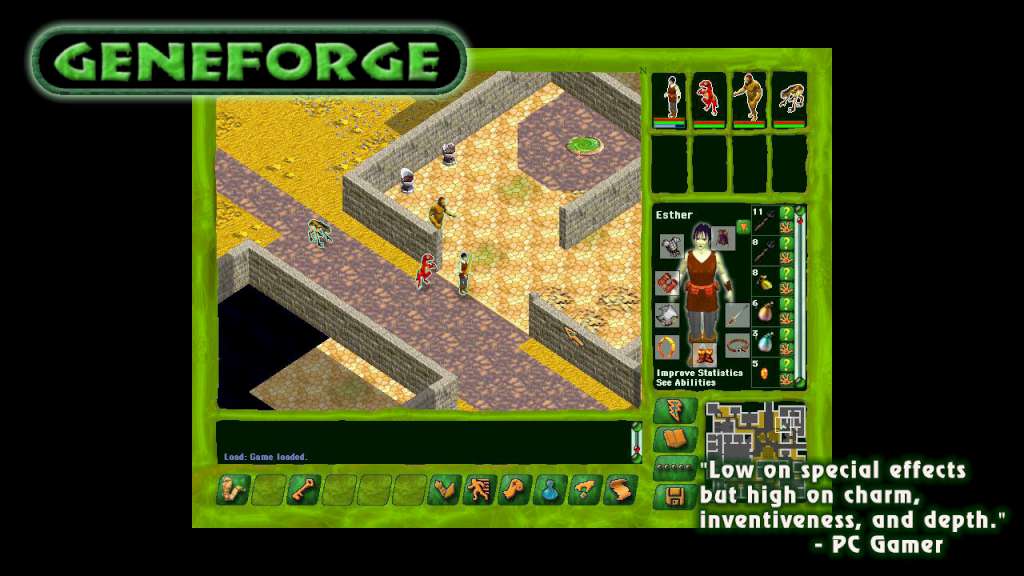
I went in expecting a dusty shareware curiosity. What I got instead was a series that quietly refuses to let you play hero, makes every faction choice feel like a compromise, and hands you an army of mutant creatures you built yourself. The Geneforge Saga bundles all five games from Spiderweb Software into a single package, spanning a continuous civil war between the Shapers (a secretive guild of mages who literally create life) and the creatures and rebels who want that power broken. The setting blends medieval structure with biological science fiction in a way that still feels distinctive, and the overarching moral question of who should control the power to shape living things runs through every entry. The core loop is a turn-based tactical RPG viewed from a classic 45-degree axonometric perspective. You pick one of three starting classes: Shaper, Guardian, or Agent. Shapers command squads of grown creatures ranging from basic Fyoras to high-tier battle creations, spending essence to field and maintain them. Guardians front-line with melee weapons and physical skills like parry and quick action. Agents run as fragile solo spellcasters, leaning on battle magic, mental magic to crowd-control groups, and the Leadership and Mechanics skills to bypass fights entirely. Each class plays genuinely differently, and the series rewards replaying individual entries with a different build. Beyond combat, the canister system is the saga's signature wrinkle: absorbing canisters grants new abilities and stronger creations, but using too many triggers corruption that costs you dialogue control in later games. The question of whether to trade humanity for power is baked into the stat screen. The five games are not equal. The original Geneforge is the leanest and most atmospheric, with a tight isolated-island mystery and only 18 possible creations to work with. Geneforge 2 opens the world and adds teachers to replace canister-only skill learning. Geneforge 3 introduces equipment crafting and two NPC companions, though the boat-based travel between islands slows things down noticeably. Geneforge 4 flips the script entirely: you start as a rebel, the class roster expands with options like the Infiltrator and Servile, and the shaping pool grows to 30 creatures. Geneforge 5 closes the arc with five factions to navigate, over 40 spells, artifact combination crafting, and the strongest encounter variety in the series. The quality curve genuinely trends upward; players who bounce off the first game's dated resolution and basic UI might find the fourth or fifth a much smoother entry point. What the Saga gets criticized for is consistency of a different kind. The visual presentation is rough across the board, though it improves meaningfully between entries. The audio is minimal and the music is largely not original. The first three games share enough structural DNA that pacing fatigue is a real risk if you try to marathon them. Build mistakes are punishing, especially for Guardian and Agent runs, and the game does not warn you loudly when you are wasting stat points. Community consensus is that spreading points too thin or ignoring Leadership and Mechanics will create real walls in the mid-game regardless of class. For the right player, none of that outweighs what the saga delivers: well over 100 hours of reactive, faction-driven RPG content where your alignment genuinely shifts the world state, NPC reactions, and ending options. Players who cleared Baldur's Gate or Icewind Dale looking for something with moral weight and tactical depth will find more here than the box art suggests. Newcomers to Spiderweb's style should start with Geneforge 1 for context, but know that the series gets better the further in you go.

Catch-all
Tags
System Requirements
Minimum
- Processor
- 1.6 GHz CPU
- Memory
- 512 MB Hard disk space: 300MB Video: OpenGL compliant graphics card Sound: Sound card
Keep exploring
Community Discussion
Be the first to comment on Geneforge Saga.
Reviews & Ratings
No ratings available
Game Info
- Developer
- Spiderweb Software
- Publisher
- Spiderweb Software
- Release Date
- Feb 11, 2011