
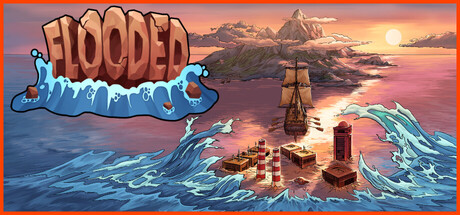
Flooded
City-builder instincts will kill you here. Flooded puts your production chain under a literal ticking tide, shrinking your island every few minutes until you either escape or drown your workforce.
GamerScout Verdict
Best for city-builder fans who want a tight, pressure-cooker puzzle loop and can accept a relatively short campaign ceiling.
Compare Prices(8 stores)
Every store in this table quotes us in euros, so the EUR figure is the price the seller actually set, not our arithmetic — which is why EUR is also the currency we rank in. We only list an offer here when the store gives us its price in euros, so nothing in this table is a number we invented.
Pick USD, PLN, GBP, CAD or AUD in the header and we convert from EUR at the European Central Bank reference rate — converted amounts are prefixed with ~. Your bank or the store may apply a different rate at checkout. We never hide offers based on where you are: everyone sees this whole table.
We may earn a commission when you buy games through links on this page — at no extra cost to you. It never affects our rankings or verdicts.
Price History
Screenshots & Media
About Flooded
My first instinct when loading Flooded was to slow down and plan carefully, the way you would in Anno or Tropico. That instinct is wrong, and the game wastes no time punishing it. The flood timer ticks down constantly, and when it hits zero the outer ring of your island disappears. Anything sitting on those tiles, mines, warehouses, housing blocks, all of it goes straight to the sea floor. Once you accept that the map is always contracting and your job is to retreat gracefully while extracting every last unit of iron, copper, and lead you can, a surprisingly tight decision loop clicks into place. The production chain logic will be familiar to anyone who has touched a city-builder in the last decade: you need mines to pull raw materials, housing to staff them, water infrastructure to keep everything running, warehouses to buffer surplus, and electricity via solar panels to unlock building upgrades. What Flooded adds is a brutal spatial constraint. Every building placement is a gamble on how many tidal cycles it will survive. You can construct bulwarks and artificial land tiles to buy time, but the materials those require come from the same finite island you are desperately trying to preserve. The tension between spending resources to delay the flood versus hoarding them to advance an era and build your ark is where the real strategic meat lives. Advancing through eras gates you into offshore drilling platforms that can pull resources from the seabed after your land mines are gone, and eventually into shipbuilding, which is the only actual exit from each island. The rogue-lite layer adds some staying power. Islands are procedurally generated, so rocky terrain configurations, mountain tiles that block construction, and coastal shapes all vary each run. Commanders each bring a passive skill and a starting bonus, functioning like a light operator system, and relics accumulated through campaign progress let you bend the rules in small but meaningful ways. There are three modes: a story-driven campaign that drip-feeds new mechanics chapter by chapter, a Quickplay mode where you dial in your own parameters on a random island, and an Endless mode where the water level partially retreats every four eras, giving you just enough breathing room to see how long a well-optimized economy can survive. A Nightmare difficulty update released post-launch tightens resource availability and reduces error tolerance for players who find the standard campaign too forgiving. One legitimate frustration: Quickplay is locked behind campaign progress, which forces a tutorial-first structure even on players who would rather learn by doing. The presentation is minimal pixel art with a clean top-down grid, and that works in the game's favor during the frantic mid-game when you need to read tile states at a glance. Tiles about to be swallowed are clearly marked, the UI stays out of the way, and the isometric camera causes no readability issues. The audio is understated, ambient rather than dramatic, which actually suits the slow-burn dread of watching your coastline shrink. Critics and players flag the same ceiling: once you have internalized the build order and the era progression, campaigns stop generating genuinely new puzzles, and the total playtime to see everything sits somewhere around ten to fifteen hours. For a budget-tier release that is a reasonable proposition, but players expecting the systemic depth of a Paradox title or the build variety of a mid-tier colony sim will find the late game thin.

Strategy & simulation
Tags
System Requirements
Minimum
- OS
- 64-bit Windows 7 SP1
- Memory
- 4 GB RAM
- DirectX
- Version 11
- Storage
- 1 GB available space
- Graphics
- GeForce GTX 660, Radeon R7 370 or equivalent with 2 GB VRAM
- Processor
- 2.8 GHz Dual Core CPU
- Sound Card
- DirectX compatible
Recommended
- OS
- 64-bit Windows 7 SP1 / 8.1 / 10 / 11
- Memory
- 8 GB RAM
- DirectX
- Version 11
- Storage
- 1 GB available space
- Graphics
- GeForce 960, Radeon RX 570 or equivalent with 4GB VRAM
- Processor
- 3.2 GHz Quad Core Processor
- Sound Card
- DirectX compatible
Keep exploring
Community Discussion
Be the first to comment on Flooded.
Reviews & Ratings
No ratings available
Game Info
- Developer
- Artificial Disasters
- Publisher
- Artificial Disasters
- Release Date
- Apr 12, 2023