Enigma of Fear
A paranormal detective puzzler that asks you to think like a real investigator, then punishes you when you don't write things down. Gorgeous 2D-in-3D art and a genuinely unsettling soundscape carry it far.
GamerScout Verdict
Built for players who want a genuine investigation challenge wrapped in handcrafted atmosphere - just keep a notepad open beside you.
Compare Prices(8 stores)
Every store in this table quotes us in euros, so the EUR figure is the price the seller actually set, not our arithmetic — which is why EUR is also the currency we rank in. We only list an offer here when the store gives us its price in euros, so nothing in this table is a number we invented.
Pick USD, PLN, GBP, CAD or AUD in the header and we convert from EUR at the European Central Bank reference rate — converted amounts are prefixed with ~. Your bank or the store may apply a different rate at checkout. We never hide offers based on where you are: everyone sees this whole table.
We may earn a commission when you buy games through links on this page — at no extra cost to you. It never affects our rankings or verdicts.
Price History
Screenshots & Media
About Enigma of Fear
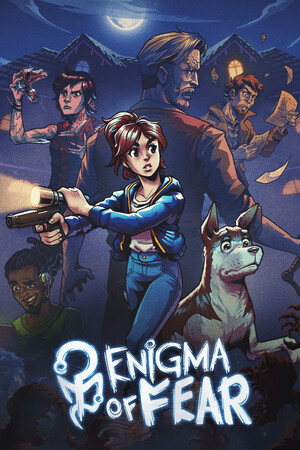
My first hour with Enigma of Fear felt like being handed a corkboard, a box of pushpins, and absolutely no string. The game drops you into the Perimeter - a place that, by its own lore, does not exist - and largely trusts you to figure out why. That trust is earned by the atmosphere long before the mechanics fully click. Pixel-art character sprites move through fully three-dimensional environments, and the visual trick of watching a flat 2D sprite cast real shadows in a volumetric fog is the kind of handcrafted choice that tells you immediately this team cared. The soundtrack does something rarer: it sits under everything like a low hum of wrongness, not screaming horror at you, just making you feel that something in the air is off. That sustained discomfort is worth more than any jump scare. The investigation loop is where Enigma of Fear earns most of its goodwill. You play as Mia, a young paranormal detective searching for her missing father across five open, non-linear regions including a creepy mansion, a cathedral, and a graveyard, each packed with found audio recordings, scattered documents, mechanical symbol locks, and environmental clues. Your toolkit grows as you progress: a UV flashlight that reveals invisible ink on documents, radio equipment that lets you check in with support characters Samuel and Agatha for hints, and later a paranormal flashlight and a time-slow ability. The clue density is high and deliberately overwhelming at first. The game ships with two difficulty modes - the standard path uses a mind map to track unexplored areas, while Detective Mode strips the mini-map entirely and asks you to keep physical notes. If you choose Detective Mode and then put the game down for three days, you will feel it. Treat it like a single long session and it rewards you generously. Mia also has a dog companion, Lupi, and switching to his perspective is one of the game's quietest pleasures. He sniffs out clues, squeezes into spaces Mia cannot reach, and exists as a warm presence against an otherwise cold and hostile world. The bond between them gives the investigation an emotional anchor that the broader story sometimes struggles to provide. A few reviewers noted that the relationship between Mia and her father never fully develops on screen, and the pacing of character revelations leans more toward mystery-first than emotional depth. That is a real trade-off worth knowing before you sit down. Combat is the soft underbelly. You carry a pistol with limited ammo, a crowbar for close-range encounters, and the option to stealth-kill blood zombies by approaching from behind while they track sound. The stealth angle actually suits the game's DNA well - direct confrontation feels clunky, aiming locks to eight cardinal directions, and boss encounters have a reputation for inconsistent hitboxes and a few unavoidable one-shot mechanics. The game nudges you toward avoidance, and when you accept that framing the combat friction becomes less annoying. Post-launch patches have addressed a fair number of bugs including loading-screen freezes and enemies failing to deal damage, and the developers have been active about responding to feedback. The game that exists today is meaningfully more stable than what launched in November 2024. What stays with me is the soundscape and the puzzle craft. Logical, environmental, and cipher-based puzzles cycle through the runtime without feeling repetitive, and the few that hit hardest - rhythm-matching, UV-revealed symbol sequences, multi-room deductions - feel like they were placed by someone who genuinely loves the genre. For a studio working inside an established TTRPG universe (the Paranormal Order / Ordem Paranormal world created by streamer Cellbit), the game is also surprisingly accessible to players with no prior lore knowledge. The Perimeter tells its own story through the evidence you find. Around fifteen to twenty hours for a thorough playthrough, which for an indie of this ambition is exactly the right length - it knows when to end.

Indie & narrative
Tags
System Requirements
Minimum
- OS
- Windows 10 +
- Memory
- 8 GB RAM
- DirectX
- Version 9.0c
- Storage
- 25 GB available space
- Graphics
- Geforce 9600GT+ | AMD HD 6570+
- Processor
- Intel Core i3-530 | AMD A6-3650+
Recommended
- OS
- Windows 11 64Bits +
- Memory
- 12 GB RAM
- DirectX
- Version 12
- Storage
- 25 GB available space
- Graphics
- Geforce 560+ | AMD Radeon HD 6950+
- Processor
- Intel Core i5-3300 | AMD Ryzen 3 1200
Keep exploring
Community Discussion
Be the first to comment on Enigma of Fear.
Reviews & Ratings
Game Info
- Developer
- Dumativa
- Publisher
- Dumativa
- Release Date
- Nov 28, 2024