Compare Empires of the Undergrowth prices across trusted key stores and find the best deal. Developed by Slug Disco. Published by Hooded Horse, Slug Disco. Released on 6/7/2024. Available on PC. Genres: Simulation, Strategy.

Ninety-four percent positive across 18,000+ Steam reviews for an ant colony RTS. Either Slug Disco figured out something most strategy studios miss, or the genre bar is on the floor. It's the former.

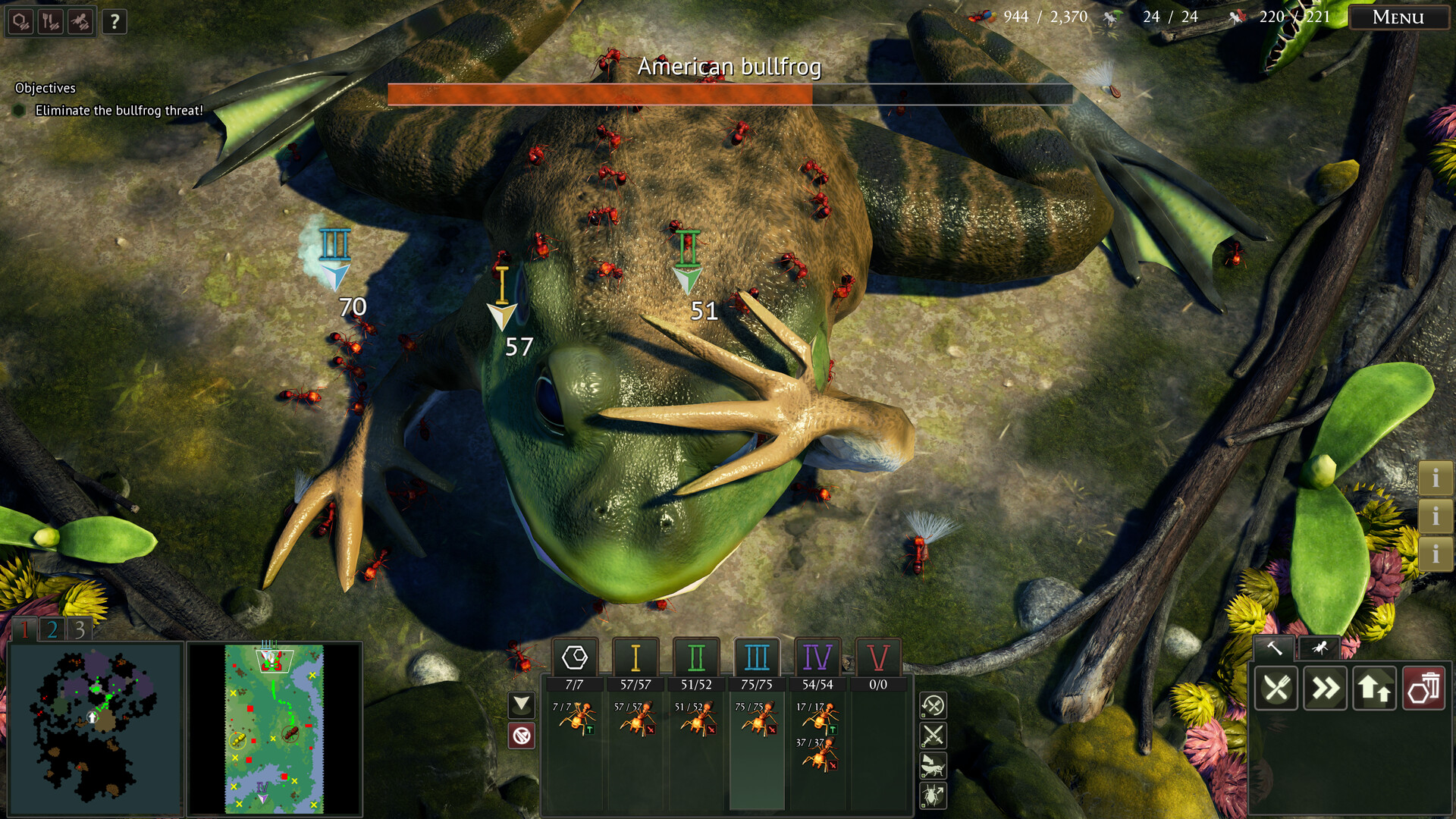
I've tracked a lot of strategy releases through early access cycles that stumbled on arrival, so when Empires of the Undergrowth finally hit full release in June 2024 after seven years of development, I went in calibrated for disappointment. That disappointment never came. What Slug Disco shipped is a dual-layer RTS-plus-base-builder that splits your attention between an underground nest you excavate tile by tile and a surface battlefield where your ant swarms claim territory, harvest food, and pick fights with spiders, dragonflies, frogs, and rival colonies. Managing both simultaneously is where the actual strategy lives, and it is genuinely demanding. The Formicarium campaign is the smartest structural choice in the game. Your core colony is a fictional species called Formica ereptor, a gene-thief ant that absorbs traits from defeated enemies via royal jelly. Side missions drop you into different species entirely, including black ants in an English woodland, wood ants on a French beach, leafcutter ants in an Ecuadorian rainforest, fire ants in a Florida swamp, and Matabele ants in West Africa, with each environment teaching different mechanics. Each mission is narrated in a documentary style, with an in-game voice providing context that doubles as a tutorial without feeling like one. It respects your intelligence while still walking you through the systems. For newcomers to the RTS genre, that framing does a lot of heavy lifting. I would recommend starting with the campaign over free play precisely because it paces the complexity well. The species variety is where the depth accumulates. Fire ants overwhelm with numbers and rapid hatching, Matabele ants bring an Anesthetist-or-Fast-Responder binary that shapes your entire tactical posture, and the Exploding Ants DLC adds autothysis units capable of voluntary detonation as a last-ditch defensive option. Brood chamber geometry matters, too: hexagonal layouts with at least 19 tiles let you push units to tier three upgrades, which is the kind of optimization detail that will keep build-order obsessives busy for dozens of hours. Beyond the campaign you get extra missions, a Freeplay skirmish mode, and Battle Arena, a sandbox for spawning creature matchups that has no strategic value but is genuinely compelling to watch. The criticisms are real and worth flagging. There is no multiplayer, which some reviewers found hard to forgive given how well the faction asymmetry could translate to head-to-head play. Pathfinding has visible glitches, particularly on busy surface maps where large groups of ants occasionally lose coherence. Some early-game unit types feel similar before upgrades differentiate them. And players who come in expecting wall-building or static tower-defense mechanics will bounce off the design philosophy immediately: this game is about pheromone-direction, reactive swarm management, and knowing when to commit your major units, not about placing turrets. If your instinct is to turtle, the difficulty spikes in later missions will correct that quickly. What Slug Disco built across seven years of early access is a game that takes an RTS concept most studios would treat as a gimmick and treats it as a serious systemic exercise instead. The tutorial respects newcomers, the campaign scales cleanly, and the species roster gives experienced players enough distinct tools to keep optimizing well past the credits. The 94% positive rating across a large sample is not marketing noise. It earned that. Diego, Scout Team

Empires of the Undergrowth

Empires of the Undergrowth

Jun 7, 2024Slug DiscoHooded Horse, Slug Disco
GamerScout Says

Ninety-four percent positive across 18,000+ Steam reviews for an ant colony RTS. Either Slug Disco figured out something most strategy studios miss, or the genre bar is on the floor. It's the former.

PC
Best Price Available
€0.00
at N/A

GamerScout Verdict

Best for strategy players who want RTS depth wrapped in a concept that sounds cute but plays with genuine mechanical teeth.

Compare Prices(0 stores)

Loading prices...

We may earn a commission when you buy games through links on this page — at no extra cost to you. It never affects our rankings or verdicts.

Screenshots & Media
Screenshot

About Empires of the Undergrowth

I've tracked a lot of strategy releases through early access cycles that stumbled on arrival, so when Empires of the Undergrowth finally hit full release in June 2024 after seven years of development, I went in calibrated for disappointment. That disappointment never came. What Slug Disco shipped is a dual-layer RTS-plus-base-builder that splits your attention between an underground nest you excavate tile by tile and a surface battlefield where your ant swarms claim territory, harvest food, and pick fights with spiders, dragonflies, frogs, and rival colonies. Managing both simultaneously is where the actual strategy lives, and it is genuinely demanding. The Formicarium campaign is the smartest structural choice in the game. Your core colony is a fictional species called Formica ereptor, a gene-thief ant that absorbs traits from defeated enemies via royal jelly. Side missions drop you into different species entirely, including black ants in an English woodland, wood ants on a French beach, leafcutter ants in an Ecuadorian rainforest, fire ants in a Florida swamp, and Matabele ants in West Africa, with each environment teaching different mechanics. Each mission is narrated in a documentary style, with an in-game voice providing context that doubles as a tutorial without feeling like one. It respects your intelligence while still walking you through the systems. For newcomers to the RTS genre, that framing does a lot of heavy lifting. I would recommend starting with the campaign over free play precisely because it paces the complexity well. The species variety is where the depth accumulates. Fire ants overwhelm with numbers and rapid hatching, Matabele ants bring an Anesthetist-or-Fast-Responder binary that shapes your entire tactical posture, and the Exploding Ants DLC adds autothysis units capable of voluntary detonation as a last-ditch defensive option. Brood chamber geometry matters, too: hexagonal layouts with at least 19 tiles let you push units to tier three upgrades, which is the kind of optimization detail that will keep build-order obsessives busy for dozens of hours. Beyond the campaign you get extra missions, a Freeplay skirmish mode, and Battle Arena, a sandbox for spawning creature matchups that has no strategic value but is genuinely compelling to watch. The criticisms are real and worth flagging. There is no multiplayer, which some reviewers found hard to forgive given how well the faction asymmetry could translate to head-to-head play. Pathfinding has visible glitches, particularly on busy surface maps where large groups of ants occasionally lose coherence. Some early-game unit types feel similar before upgrades differentiate them. And players who come in expecting wall-building or static tower-defense mechanics will bounce off the design philosophy immediately: this game is about pheromone-direction, reactive swarm management, and knowing when to commit your major units, not about placing turrets. If your instinct is to turtle, the difficulty spikes in later missions will correct that quickly. What Slug Disco built across seven years of early access is a game that takes an RTS concept most studios would treat as a gimmick and treats it as a serious systemic exercise instead. The tutorial respects newcomers, the campaign scales cleanly, and the species roster gives experienced players enough distinct tools to keep optimizing well past the credits. The 94% positive rating across a large sample is not marketing noise. It earned that.

Diego
Diego · Scout Team

Strategy & simulation

Tags

auto-admittedPheromone TacticsDual-Layer MapSpecies AsymmetryDocumentary NarrativeSwarm ManagementNest OptimizationChallenge ModeGene-Thief ProgressionFreeplay Skirmish

System Requirements

System requirements for Empires of the Undergrowth aren't listed yet. Check the store page for the latest specs.

Keep exploring

Community Discussion

Be the first to comment on Empires of the Undergrowth.

Reviews & Ratings

Steam
94%(18,510)

Game Info

Developer
Slug Disco
Publisher
Hooded Horse, Slug Disco
Release Date
Jun 7, 2024

Features

Single-playerSteam AchievementsFull controller supportSteam Trading CardsSteam CloudFamily Sharing

Price Alert

Get notified when the price drops below your target!

Create Alert

No card? Pay another way

Top up your Steam Wallet or buy crypto with any card — instant delivery, no bank account needed.

More from Slug Disco

Buy smarter: helpful guides

Looking for more? See games like Empires of the Undergrowth →

Frequently asked questions about Empires of the Undergrowth

How much does Empires of the Undergrowth cost?

Empires of the Undergrowth pricing changes often and varies by store, edition and region. The live price table on this page compares the cheapest in-stock offers from trusted key stores like Eneba and Kinguin, so you always see the current lowest price before you buy.

Where can I buy Empires of the Undergrowth cheapest?

Compare Empires of the Undergrowth prices across every verified store in the price table on this page. We list the cheapest in-stock key and store offers, updated regularly, so you always see the best current deal before you buy.

What platforms is Empires of the Undergrowth available on?

Empires of the Undergrowth is available on PC.

When was Empires of the Undergrowth released?

Empires of the Undergrowth was released on 7 June 2024.

Who developed Empires of the Undergrowth?

Empires of the Undergrowth was developed by Slug Disco and published by Hooded Horse, Slug Disco.