
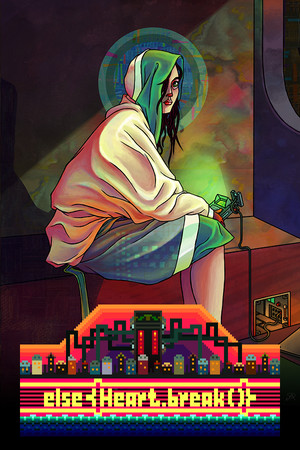
Else Heart.Break()
Probably the only game that'll teach you to write actual loops and conditionals while breaking your heart about a girl named Pixie in a city where everything runs on hackable code.
GamerScout Verdict
Essential for patient players who want to genuinely learn to code inside a melancholy, handcrafted world, frustrating for everyone else.
Compare Prices(4 stores)
Every store in this table quotes us in euros, so the EUR figure is the price the seller actually set, not our arithmetic — which is why EUR is also the currency we rank in. We only list an offer here when the store gives us its price in euros, so nothing in this table is a number we invented.
Pick USD, PLN, GBP, CAD or AUD in the header and we convert from EUR at the European Central Bank reference rate — converted amounts are prefixed with ~. Your bank or the store may apply a different rate at checkout. We never hide offers based on where you are: everyone sees this whole table.
We may earn a commission when you buy games through links on this page — at no extra cost to you. It never affects our rankings or verdicts.
Price History
Screenshots & Media
About Else Heart.Break()
I keep thinking about Dorisburg the way you think about a city you visited once and never fully understood. You arrive as Sebastian, a soda salesman with a ferry ticket and no plan, and the game drops you into a living isometric town with its own clocks, its own parties, its own rhythms. NPCs wake up, go to work, drift to bars, and fall asleep without waiting for you. That simulation has a warmth to it, something close to the Majora's Mask clockwork but without the loop, without the reset. Days pass and they don't come back. That detail alone does more emotional work than most games manage with hours of cutscenes. The hacking is the real reason you're here, though, and it's unlike anything else in the genre. Once you get your hands on a modifier, almost every object in the world opens up: hover over a beer can and you'll see the actual Språk code governing how tired it makes you. Change a positive sleepiness value to a negative one and you've got an energy drink. Want through a locked door? Hack a key's code to loop through combinations, or connect to the door over the city's internal internet from a terminal across town. Språk is a custom language built on BASIC principles, with if-else conditionals, looping, and syntax that matters, but the game is gentle enough about it that people with zero coding background consistently find themselves writing working scripts and feeling genuinely surprised by themselves. The modifier interface shows you the available functions in its bottom panel, so you're never guessing at thin air. When your code is wrong, objects emit a little puff of smoke. It's a forgiving metaphor for a real technical system, and that balance is the game's quiet achievement. Here is where honesty matters: the first several hours are genuinely hard to love. The open-world structure is aimless by design, and if you miss the social cues that pull the plot forward, you'll spend real time wandering a harbor town waiting for a party to start. The story doesn't hold your hand, which is mostly good, but in the early stretch it can feel like the game is withholding rather than trusting you. Some players never push through, and that's a fair outcome. The camera also has a habit of burying your view behind walls at inconvenient moments, and the writing, while charming and idiosyncratic, is sometimes stiff in ways that feel less stylized and more unpolished. Bugs have been present since launch and the community still exchanges workarounds a decade on. But if you do push through, what the game becomes is genuinely singular. The community of players who made it past the opening hasn't shrunk down to silence. They write SPRAK manuals, catalog every floppy disk in Dorisburg, build scripts that let you teleport anything to anywhere. The game quietly spawned people who learned to think like programmers inside a world that treated code as something close to magic, a colorful halo appearing around Sebastian's head when the modifier is active, hacking framed as a kind of secular sainthood. That's a specific and unusual thing to pull off. The soundtrack, credited partly to El Huervo and Oscar Rydelius, carries the whole atmosphere on its back in the way only small, intentional games manage. Else Heart.Break() is not for players who need a clear objective every fifteen minutes. It's for people who want to sit inside a city that feels real, learn a scripting language by necessity, and find out whose heart actually breaks at the end. Go in with a notebook, talk to everyone twice, and don't look up walkthroughs for at least the first few hours. The payoff, when it arrives, earns all the wandering.

Indie & narrative
Tags
System Requirements
Minimum
- OS
- 7
- Memory
- 2 GB RAM
- DirectX
- Version 9.0
- Storage
- 1500 MB available space
- Graphics
- Dedicated graphics card
- Processor
- Core 2 Duo 2.4 GHz
Recommended
- OS
- 7
- Memory
- 4 GB RAM
- DirectX
- Version 9.0
- Storage
- 1500 MB available space
- Graphics
- NVIDIA GeForce GT 650M or equivalent
- Processor
- Intel Core i3 2.4 GHz
Keep exploring
Community Discussion
Be the first to comment on Else Heart.Break().
Reviews & Ratings
Game Info
- Developer
- Erik Svedäng
- Publisher
- Erik Svedäng AB
- Release Date
- Sep 24, 2015
