Electrician Simulator VR
Satisfying if you set your expectations correctly: this VR job sim nails hands-on tactility but runs dry on depth within about 10 hours. Know what you're buying.
GamerScout Verdict
Best for casual VR players who want a relaxing hands-on loop; too shallow and too short for anyone expecting sim depth.
Compare Prices(2 stores)
Every store in this table quotes us in euros, so the EUR figure is the price the seller actually set, not our arithmetic — which is why EUR is also the currency we rank in. We only list an offer here when the store gives us its price in euros, so nothing in this table is a number we invented.
Pick USD, PLN, GBP, CAD or AUD in the header and we convert from EUR at the European Central Bank reference rate — converted amounts are prefixed with ~. Your bank or the store may apply a different rate at checkout. We never hide offers based on where you are: everyone sees this whole table.
We may earn a commission when you buy games through links on this page — at no extra cost to you. It never affects our rankings or verdicts.
Price History
Screenshots & Media
About Electrician Simulator VR
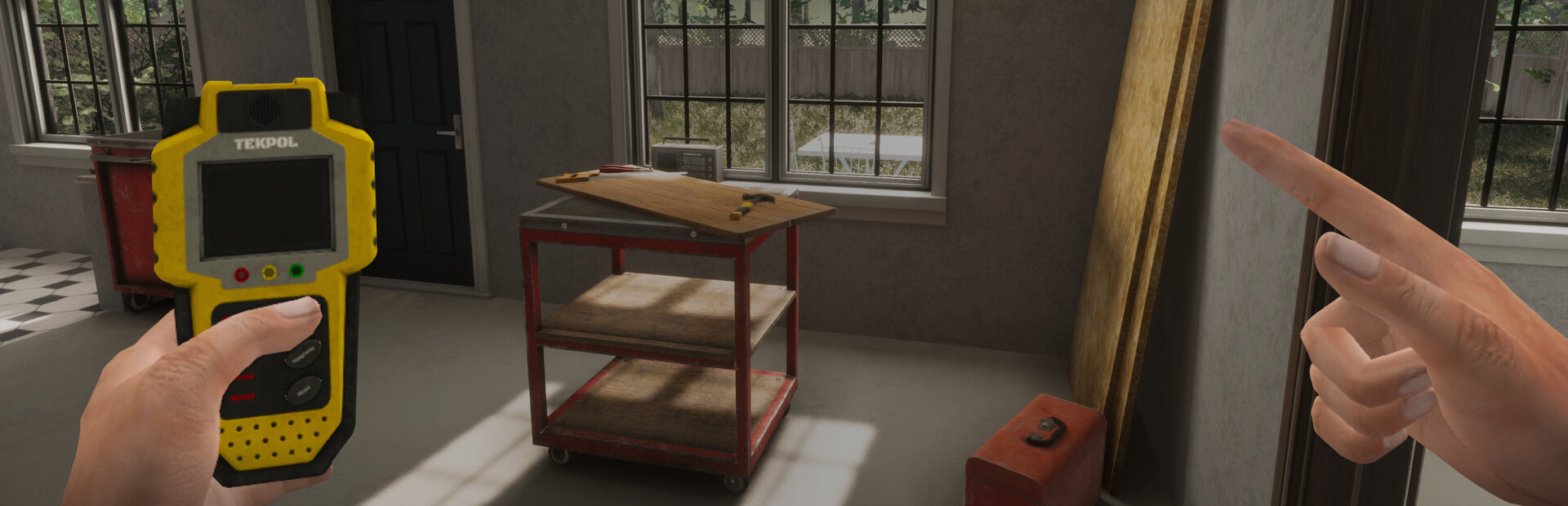
I've put enough time into VR simulators to know the ones that genuinely leverage the medium versus those that could have been a flatscreen game with a camera rig bolted on. Electrician Simulator VR lands somewhere in the middle, and that gap matters depending on which side of it you land on. The core loop is apprentice-style mission work: you start in your father's garage learning the basics, then move out to client homes where you repair outlets and switches, run cables in walls, install lamps, replace bulbs, wire up fuse boxes, and diagnose faulty sockets. There is a real-time in-mission shop so you can order parts without leaving the job, and breaking something comes out of your own in-game budget. Those small friction points add a light resource-management layer that keeps you honest. The physical interaction model is where Take IT Studio earns its money. Grabbing tools is responsive, physics-based drawer and cabinet interactions feel deliberate rather than floaty, and a wrist-mounted smartwatch plus a hip-attached clipboard replace menu screens with in-world UI. That clipboard mechanic specifically is the kind of decision that shows a studio thinking in VR-native terms rather than porting habits. Controller haptics register the pulse of connecting live wires, and the game correctly punishes you with visual disruption and headset feedback if you touch a live circuit without killing the breaker first. Safety-check loops as an actual gameplay verb is a neat touch. Comfort options are generous: smooth or snap turning, variable movement speeds, and adjustable vignette are all present, which matters for longer sessions. Where the wheels wobble is repetition and scope. The task variety is real at first, ranging from straightforward bulb swaps to soldering, to reconstructing gadgets in workshop-style bonus stages. Each mission also includes three optional side challenges, things like tracking down hidden items or repairing a sculpture, which break the rhythm. But reviewers across platforms consistently flag that the core electrical work starts to feel samey after a few hours, and at roughly 10 hours of content if you chase every optional objective, the game runs out of road faster than the indie asking price might lead you to expect. The DLC adds Smart Devices and Toys Repair categories, which help, but they are separate purchases. Steam's mixed user rating at launch reflects a player base split between people who found the tactile loop meditative and those who bounced off the repetition. Technical rough edges show up in reports across both PCVR and PSVR2: wire connection tasks occasionally fail to register and require a restart, and hand collision with environmental objects can push your virtual hands into geometry. Neither is a progress-killer in most cases, but in a game where precision screwdriving and soldering tiny components are central mechanics, a finicky physics edge case lands harder than it would in a looser action title. Visuals are functional rather than impressive, with textures that read as indie-tier up close. The audio design is appropriately understated, layering in ambient environmental sounds and soft background music rather than overproducing the soundscape. For whom does this actually work? Casual VR players who enjoy the satisfying loop of tactile task completion, think PowerWash Simulator or car repair sims, will find the first few sessions genuinely enjoyable. The on-boarding is clear, the difficulty curve is gentle, and sessions can be short without penalty. Strategy and sim players hoping for business management depth or a branching job progression system will find it too thin. This one is not going to stress your decision-making circuits. Treat it as a zen-mode hands-on experience with a finite run, and it mostly delivers what it promises.

Strategy & simulation
Tags
System Requirements
Minimum
- OS
- Windows 11 64bit
- Memory
- 8 GB RAM
- Storage
- 15 GB available space
- Graphics
- GeForce GTX 1060 / AMD Radeon RX 580
- Processor
- Intel Core i5-8400 / AMD Ryzen 5 1600
- Sound Card
- DirectX compatible
- VR Support
- OpenXR, requires Valve Index, PlayStationVR or Meta Quest headset
Recommended
- OS
- Windows 11 64bit
- Memory
- 8 GB RAM
- Storage
- 15 GB available space
- Graphics
- GeForce RTX 3060 6GB / AMD RX 6600 XT
- Processor
- Intel Core i5-11400 / AMD Ryzen 5 3600
- Sound Card
- DirectX compatible
- VR Support
- OpenXR, requires Valve Index, PlayStationVR or Meta Quest headset
Keep exploring
Community Discussion
Be the first to comment on Electrician Simulator VR.
Reviews & Ratings
No ratings available
Game Info
- Developer
- Take IT Studio!
- Publisher
- Take IT Studio!
- Release Date
- Mar 21, 2025