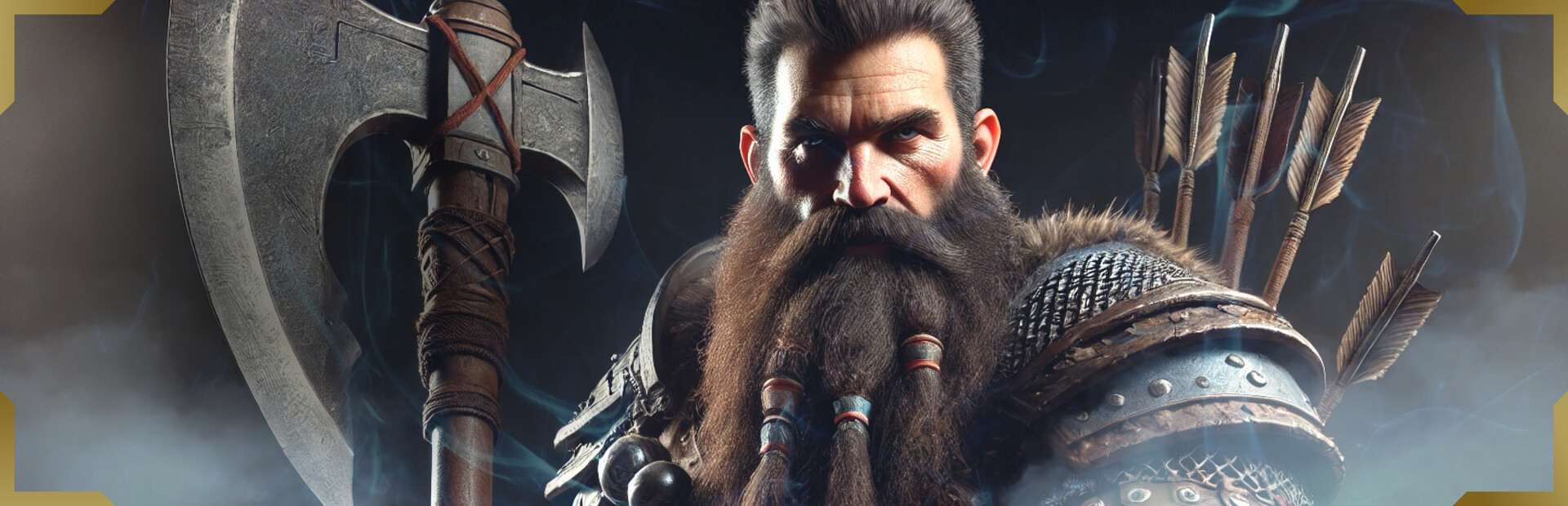
Dwarven Realms
Built by two people and carrying a Very Positive Steam rating, Dwarven Realms earns its place on the shelf by doing one thing spectacularly well: drowning you in enemies and making you feel unstoppable for doing it.
GamerScout Verdict
Best for ARPG fans who want screen-filling horde chaos with genuine build depth at a budget-friendly entry point.
Compare Prices(7 stores)
Every store in this table quotes us in euros, so the EUR figure is the price the seller actually set, not our arithmetic — which is why EUR is also the currency we rank in. We only list an offer here when the store gives us its price in euros, so nothing in this table is a number we invented.
Pick USD, PLN, GBP, CAD or AUD in the header and we convert from EUR at the European Central Bank reference rate — converted amounts are prefixed with ~. Your bank or the store may apply a different rate at checkout. We never hide offers based on where you are: everyone sees this whole table.
We may earn a commission when you buy games through links on this page — at no extra cost to you. It never affects our rankings or verdicts.
Price History
Screenshots & Media
About Dwarven Realms
I went in expecting a budget ARPG curiosity and came out genuinely surprised by how much is working here. Dwarven Realms is the product of a two-person indie studio that clearly studied the genre's heavyweights, the mob density philosophy of survivor games like Vampire Survivors, the sprawling skill trees of Path of Exile, the loot feedback loop of Diablo, and then crammed all three ambitions into a single low-price package. The result is rough in places, but it has a distinct identity, and that counts for a lot in a crowded space. The core loop is straightforward: you level through a campaign that functions mostly as a warm-up, unlock the Home Fort, and then spend the bulk of your time running Ruptures, procedurally modified endgame zones you craft maps for and portal into. Inside, enemies arrive in quantities that would make most ARPGs stutter, and the moment abilities start connecting against a packed screen, the game hits a particular kind of chaotic satisfaction that very few titles manage in 3D. Combat is built around weapon specializations, mauls and staves, two-handers, spears, one-handers, bows and throwing weapons, or elemental caster builds, and each specialization carries two unique combat abilities tied to the Q and R slots. You gain two skill points per level, feeding a branching tree that covers offensive output, defense, luck and magic find, and crafting. A respec stand in the Home Fort means committing to a build isn't permanent, which keeps experimentation low-friction once you've cleared Rupture level 10. Where the game earns its Very Positive Steam rating is in the breadth of updates Crater Studios has shipped since September 2024 launch. Multiple full seasons have introduced new stances (including a Necromancer that commands skeletal warriors and spectral beasts rather than dealing direct damage), playable races with racial bonuses, a Forsaken Path endgame mode that scales into deep Rupture tiers, seasonal leaderboards, a Hardcore race mode, and a boss-mastery system where every ten boss kills lets you forge a custom weapon with deterministic affixes. The most recent season even split player damage into Physical and Elemental categories to widen build variety, a sign the team is actively responding to what early critics flagged as shallow late-game differentiation. The pace of updates for a two-person operation is genuinely notable. That said, the weaknesses from launch haven't all been solved. Visuals sit firmly in the passable category: functional, nothing more. The UI has been criticised for small text and cluttered layout, and while patches have addressed some of this, first-time players will feel the roughness. Early critics noted the grind can creep in sooner than expected, and build diversity in the first few seasons was thin enough that the community was struggling to find documented builds outside of a handful of mage variations. The good news is each subsequent season has chipped at these problems. If you jumped off the game at launch, the version on offer now is meaningfully different. The audience this fits best: players who want that brain-off horde-slaying rhythm of a survivor game but want actual ARPG depth underneath it, crafting, item affixes, skill trees, seasonal progression, without committing to the hundreds of hours Path of Exile demands before it opens up. It is a focused, low-price game doing one thing exceptionally well, surrounded by systems that are getting better each season. The rough edges are real, but so is the fun.

Catch-all
Tags
System Requirements
Minimum
- OS
- 64-bit Windows
- Memory
- 16 GB RAM
- Network
- Broadband Internet connection
- Storage
- 10 GB available space
- Graphics
- Nvidia GeForce GTX 760 (2 GB) / AMD Radeon HD 7850 (2 GB)
- Processor
- Intel CPU Core i3-2120 (3.3 GHz) / AMD CPU FX-6300 (3.5 GHz)
Recommended
Requires a 64-bit processor and operating system
Keep exploring
Community Discussion
Be the first to comment on Dwarven Realms.
Reviews & Ratings
No ratings available
Game Info
- Developer
- Crater Studios
- Publisher
- Crater Studios
- Release Date
- Sep 27, 2024