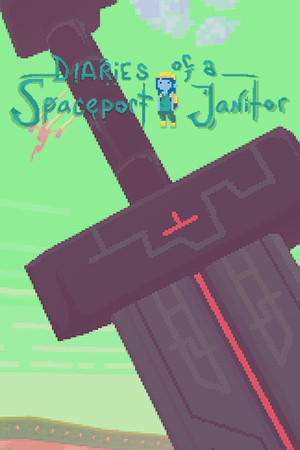
Compare Diaries of a Spaceport Janitor prices across 50+ stores and find the best deal. Developed by Sundae Month. Published by Sundae Month. Released on 9/16/2016. Available on PC, Mac. Genres: Adventure, Casual, Indie, RPG, Simulation. Metacritic score: 69/100.

Intentionally tedious, surprisingly resonant: a lo-fi anti-RPG that weaponises mundane routine to say something real about poverty and powerlessness - if you can stomach the grind.

I came to this one expecting a quirky walking sim with a sci-fi skin. What I got was something genuinely harder to categorise: a slow, deliberate provocation dressed up as a casual game. You play as a low-wage alien girlbeast on Xabran's Rock, and your job - your only job - is to pick up trash, burn it in your incinerator, survive another day, and repeat. There is no build order. There is no levelling system. The decision-making here is of a far grimmer kind: which items do you incinerate for the daily wage, which do you try to sell to a merchant who only buys what they happen to be stocking today, and how do you scrape together enough coin for food without accidentally eating something that makes you vomit across the street. The economy is deliberately opaque by design - the developers have confirmed this - keeping the player in a constant state of low-level uncertainty about whether any of their effort is actually adding up to anything. As a strategy guy who likes transparent resource loops and clear feedback, that friction initially put me off. Then I realised that friction IS the point. Mechanically, the daily loop breaks down like this: wake up, wander the four colour-coded districts of the bazaar (Portside Shantytown, Riverwalk, Covered Market, and the red quarter near the spaceport), pick up whatever junk the world has dropped, incinerate what you can, eat something that hopefully does not cause nausea, pray at one of nine deity shrines to nudge a luck stat that may or may not be doing anything, spin the lottoshrines for free since they cost nothing, write in your journal, sleep. The map is a looping square that intentionally disorients you - it wraps at 90-degree turns rather than straight across, so the Ziggurat and the sewerdungeon entrances appear in multiple apparent locations. It feels larger and more labyrinthine than it actually is, and that disorientation is part of the experience. You also carry a floating skull from an early dungeon run gone wrong, and removing it requires collecting fetishes for all nine gods, which means learning the vendor rotation across districts. That is the closest thing to a proper quest this game has. Where the game genuinely earns its Metacritic 69 rather than scoring lower is in its atmosphere. The chunky low-poly 3D environment with flat 2D pixel sprites for characters produces something that looks like nothing else - reviewers reached for Rick and Morty comparisons and they are not wrong. Street bands play strange tunes, ships career overhead, party cars roll past while you crouch over a pile of litter. The sound design communicates the world's indifference to your situation more effectively than any cutscene could. The graphics settings are literally labelled 'Bad' and 'Worse', and the game is in on the joke. The whole thing runs about ten hours, which is the right length for a concept this narrow. The honest downsides are real and worth flagging before you spend money. The merchant selling system requires that a vendor be actively selling a category of item before you can sell one back to them - a friction mechanic that critics called out as more frustrating than thematic. The luck stat is intentionally obscure to the point where player guides have done code analysis to understand it. Hand-holding is nonexistent, and the first two to three hours are genuinely disorienting enough that some players bounce off entirely. RNG affects item spawns, merchant stock, daily pay, and food outcomes, so a bad streak of dice rolls can feel punishing rather than meaningful. There is no mod ecosystem to speak of, and no post-launch content updates have materially changed the core loop. Who is this for? Fans of games like Cart Life or Pathologic who value atmosphere and thematic coherence over mechanical reward. Players who want a sub-ten-hour experience with a clear artistic intent and are comfortable with deliberate obscurity. It is emphatically not for anyone who needs a visible progress bar or a tutorial that explains the rules. If the pitch of 'intentional drudgery as social commentary' makes you roll your eyes, this one will confirm every suspicion. If it makes you curious, there is something genuine here worth finding. Diego, Scout Team

Diaries of a Spaceport Janitor
AdventureCasualIndieRPGSimulation

Diaries of a Spaceport Janitor

Sep 16, 2016Sundae Month
GamerScout Says

Intentionally tedious, surprisingly resonant: a lo-fi anti-RPG that weaponises mundane routine to say something real about poverty and powerlessness - if you can stomach the grind.

PCMac
Best Price Available
0.00
at N/A
Historical low: $0.68

Compare Prices(0 stores)

Loading prices...

We may earn a commission when you buy games through links on this page — at no extra cost to you. It never affects our rankings or verdicts.

Screenshots & Media

Screenshot

About Diaries of a Spaceport Janitor

I came to this one expecting a quirky walking sim with a sci-fi skin. What I got was something genuinely harder to categorise: a slow, deliberate provocation dressed up as a casual game. You play as a low-wage alien girlbeast on Xabran's Rock, and your job - your only job - is to pick up trash, burn it in your incinerator, survive another day, and repeat. There is no build order. There is no levelling system. The decision-making here is of a far grimmer kind: which items do you incinerate for the daily wage, which do you try to sell to a merchant who only buys what they happen to be stocking today, and how do you scrape together enough coin for food without accidentally eating something that makes you vomit across the street. The economy is deliberately opaque by design - the developers have confirmed this - keeping the player in a constant state of low-level uncertainty about whether any of their effort is actually adding up to anything. As a strategy guy who likes transparent resource loops and clear feedback, that friction initially put me off. Then I realised that friction IS the point. Mechanically, the daily loop breaks down like this: wake up, wander the four colour-coded districts of the bazaar (Portside Shantytown, Riverwalk, Covered Market, and the red quarter near the spaceport), pick up whatever junk the world has dropped, incinerate what you can, eat something that hopefully does not cause nausea, pray at one of nine deity shrines to nudge a luck stat that may or may not be doing anything, spin the lottoshrines for free since they cost nothing, write in your journal, sleep. The map is a looping square that intentionally disorients you - it wraps at 90-degree turns rather than straight across, so the Ziggurat and the sewerdungeon entrances appear in multiple apparent locations. It feels larger and more labyrinthine than it actually is, and that disorientation is part of the experience. You also carry a floating skull from an early dungeon run gone wrong, and removing it requires collecting fetishes for all nine gods, which means learning the vendor rotation across districts. That is the closest thing to a proper quest this game has. Where the game genuinely earns its Metacritic 69 rather than scoring lower is in its atmosphere. The chunky low-poly 3D environment with flat 2D pixel sprites for characters produces something that looks like nothing else - reviewers reached for Rick and Morty comparisons and they are not wrong. Street bands play strange tunes, ships career overhead, party cars roll past while you crouch over a pile of litter. The sound design communicates the world's indifference to your situation more effectively than any cutscene could. The graphics settings are literally labelled 'Bad' and 'Worse', and the game is in on the joke. The whole thing runs about ten hours, which is the right length for a concept this narrow. The honest downsides are real and worth flagging before you spend money. The merchant selling system requires that a vendor be actively selling a category of item before you can sell one back to them - a friction mechanic that critics called out as more frustrating than thematic. The luck stat is intentionally obscure to the point where player guides have done code analysis to understand it. Hand-holding is nonexistent, and the first two to three hours are genuinely disorienting enough that some players bounce off entirely. RNG affects item spawns, merchant stock, daily pay, and food outcomes, so a bad streak of dice rolls can feel punishing rather than meaningful. There is no mod ecosystem to speak of, and no post-launch content updates have materially changed the core loop. Who is this for? Fans of games like Cart Life or Pathologic who value atmosphere and thematic coherence over mechanical reward. Players who want a sub-ten-hour experience with a clear artistic intent and are comfortable with deliberate obscurity. It is emphatically not for anyone who needs a visible progress bar or a tutorial that explains the rules. If the pitch of 'intentional drudgery as social commentary' makes you roll your eyes, this one will confirm every suspicion. If it makes you curious, there is something genuine here worth finding. Diego, Scout Team

Tags

singleplayerachievementstrading-cardstier:sub-5Anti-AdventureIntentional GrindBlue-Collar SimOpaque EconomyNo TutorialAtmospheric World-BuildingRNG-HeavyShort Playthrough

Steam Deck & Linux

ProtonDB Platinum

Runs flawlessly on Linux out of the box. Based on 11 ProtonDB community reports.

System Requirements

Minimum

OS
Windows 7/8/8.1/10
Memory
512 MB RAM
Storage
512 MB available space
Graphics
NVIDIA GeForce 550 GTX / AMD Radeon 5770 HD series card
Processor
Dual-Core Intel or AMD processor
Sound Card
100% DirectX9.0c compatible sound card and drivers

Community Discussion

Be the first to comment on Diaries of a Spaceport Janitor.

Reviews & Ratings

Metacritic
69

Game Info

Developer
Sundae Month
Publisher
Sundae Month
Release Date
Sep 16, 2016

Price Alert

Get notified when the price drops below your target!

Create Alert

Price History

2026-06-100.68(lowest)

More from Sundae Month

Buy smarter: helpful guides

Looking for more? See games like Diaries of a Spaceport Janitor

Frequently asked questions about Diaries of a Spaceport Janitor

How much does Diaries of a Spaceport Janitor cost?

Diaries of a Spaceport Janitor pricing changes often and varies by store, edition and region. The live price table on this page compares the cheapest in-stock key and store offers across 50+ verified shops, so you always see the current lowest price before you buy.

Where can I buy Diaries of a Spaceport Janitor cheapest?

Compare Diaries of a Spaceport Janitor prices across every verified store in the price table on this page. We list the cheapest in-stock key and store offers, updated regularly, so you always see the best current deal before you buy.

What platforms is Diaries of a Spaceport Janitor available on?

Diaries of a Spaceport Janitor is available on PC, Mac.

When was Diaries of a Spaceport Janitor released?

Diaries of a Spaceport Janitor was released on 16 September 2016.

Who developed Diaries of a Spaceport Janitor?

Diaries of a Spaceport Janitor was developed by Sundae Month.

Is Diaries of a Spaceport Janitor worth buying?

Diaries of a Spaceport Janitor holds a Metacritic score of 69/100, making it one of the standout Adventure titles. See the full reviews, ratings and how-long-to-beat times on this page to decide.