Desktop Dungeons
Puzzle-roguelike that tricks you into thinking it's casual, then quietly demands you track tile counts, god favors, and level-gap math all at once. Mechanically dense in the best way.
GamerScout Verdict
Best for players who want puzzle-depth in short sessions and don't mind losing a few runs before the regen-tile economy finally clicks.
Compare Prices(2 stores)
Every store in this table quotes us in euros, so the EUR figure is the price the seller actually set, not our arithmetic — which is why EUR is also the currency we rank in. We only list an offer here when the store gives us its price in euros, so nothing in this table is a number we invented.
Pick USD, PLN, GBP, CAD or AUD in the header and we convert from EUR at the European Central Bank reference rate — converted amounts are prefixed with ~. Your bank or the store may apply a different rate at checkout. We never hide offers based on where you are: everyone sees this whole table.
We may earn a commission when you buy games through links on this page — at no extra cost to you. It never affects our rankings or verdicts.
Price History
Screenshots & Media
About Desktop Dungeons
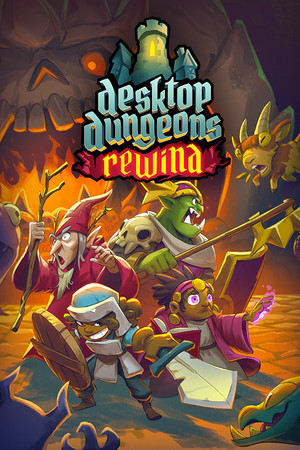
My first instinct when loading Desktop Dungeons: Rewind was to treat it like a commute game, something to half-watch while a podcast plays in the background. That instinct will get you killed inside three minutes, and the game will be entirely correct to punish you for it. Underneath the cartoonish art and self-referential humor sits one of the most elegantly compressed tactical puzzles in the genre, a game that fits a full decision tree into a single dungeon floor and roughly ten minutes of real time. The core loop is genuinely clever and worth understanding before you write it off as shallow. You enter a fog-of-war grid, and every tile you uncover passively restores health and mana. That sounds generous until you realize those tiles are also your only healing resource for the entire run. Reveal too many too fast, and you will walk into the level-ten boss with no recovery left, dead on arrival. The correct play is to sequence your reveals deliberately: attack an enemy slightly above your level, step back into unexplored tiles to regen, push back in, and repeat. It is a resource-depletion puzzle masquerading as an action RPG, and once that clicks, the game opens up considerably. Spells like BURNDAYRAZ for fireballs or WEYTWUT for slowing enemies become timing tools rather than panic buttons, and god worship adds another conversion economy layer where dumping unwanted items into a deity's favor bank can unlock temporary combat bonuses at exactly the right moment. The class and kin system is where replay value actually lives. There are up to 21 classes to unlock, ranging from fighters and berserkers to thieves, assassins, wizards, sorcerers, and more unusual picks like the vampire with its life-steal mechanic that creates passive health regeneration at the cost of strategic flexibility. Each of the seven kin types carries distinct passive bonuses, so a dwarven berserker plays nothing like an elven blood mage, and that combination space keeps individual runs feeling meaningfully different. The kingdom layer sits between dungeon runs: you spend boss-trophy gold on buildings that unlock new classes, items, and dungeon access. It is not a deep city-builder, and some reviewers have noted that upgrade costs feel slightly steep, but it provides just enough meta-progression to give each run a purpose beyond the immediate floor. The friction points are real and worth naming. The UI, redesigned from the original 2013 release, spreads key information across the screen perimeter in a way that feels disorienting for the first several hours, especially if you remember the tighter original layout. There are no custom keybindings, which is a legitimate accessibility gap for a 2023 release. The writing leans heavily on a self-aware, Dungeon Keeper-style comedy tone that lands well in small doses but can grate if you are not predisposed to that register. Veterans of the 2013 version have noted that the 3D art direction of Rewind loses some of the original pixel work's charm, a fair criticism with no clean resolution. Steam user sentiment sits at roughly 75 percent positive, suggesting the game wins over most newcomers while leaving a slice of returning players mildly disappointed by the visual trade-offs. For someone new to the puzzle-roguelike space, Rewind is actually an excellent entry point precisely because runs are short. Failing a dungeon costs you maybe twelve minutes, not two hours. The challenge mode scenarios, which drop you into pre-configured situations and demand specific solutions, function as structured tutorials for the deeper mechanics without ever labeling themselves as such. If you are willing to sit with the system long enough to internalize the regen-tile economy, the god conversion combos, and the level-gap targeting, there is a game here that will quietly occupy your evenings for weeks.

Strategy & simulation
Tags
System Requirements
Minimum
- OS
- Windows XP
- Memory
- 1 GB RAM
- DirectX
- Version 9.0c
- Storage
- 350 MB available space
- Graphics
- any Direct3D 9 card
- Processor
- 1.2GHz
Keep exploring
Community Discussion
Be the first to comment on Desktop Dungeons.
Reviews & Ratings
Game Info
- Developer
- QCF Design
- Publisher
- QCF Design
- Release Date
- Apr 18, 2023