
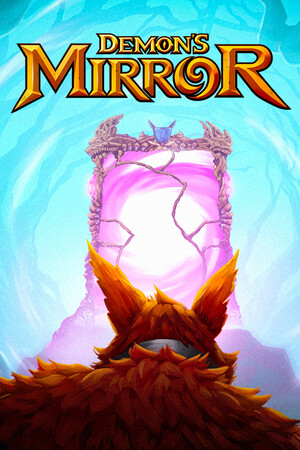
Demon's Mirror
Two resource systems running in parallel, zero wasted turns, and a branching map that punishes greedy routing, Demon's Mirror is the deckbuilder that actually respects your decision-making bandwidth.
GamerScout Verdict
Solid pick for deckbuilder veterans who want a second resource system to optimize, lighter on content depth than the best in the genre, but mechanically distinct enough to earn its place in the rotation.
Compare Prices(8 stores)
Every store in this table quotes us in euros, so the EUR figure is the price the seller actually set, not our arithmetic — which is why EUR is also the currency we rank in. We only list an offer here when the store gives us its price in euros, so nothing in this table is a number we invented.
Pick USD, PLN, GBP, CAD or AUD in the header and we convert from EUR at the European Central Bank reference rate — converted amounts are prefixed with ~. Your bank or the store may apply a different rate at checkout. We never hide offers based on where you are: everyone sees this whole table.
We may earn a commission when you buy games through links on this page — at no extra cost to you. It never affects our rankings or verdicts.
Price History
Screenshots & Media
About Demon's Mirror
My first instinct when I saw a match-3 grid sharing screen space with a card hand was mild suspicion, that combination has a long history of collapsing into one mechanic cannibalizing the other. Demon's Mirror is one of the rare cases where the concern evaporates within a handful of fights. The core tension is this: you have three energy per turn, and spending two of it on a chain pull from the 6x6 gem board is expensive but often correct. Wulf, the starting character, gets his first chain free each turn, which keeps newcomers from feeling locked out of the board entirely. Draga and Axo, unlocked through accumulated run-score points, shift the calculus differently and demand you rebuild your board-vs-cards mental model from scratch. That character-to-character variation is exactly the kind of design decision I want to see in this genre. The combat loop has real mechanical density. Tile matches attack enemies, generate shields, or produce temporary energy. Cards can directly damage or defend, but the more interesting ones manipulate the board itself, setting up longer chains that would otherwise be geometrically impossible. Enemies place hostile tiles on the grid with countdown timers, clear them via matching before the timer hits zero or absorb a heavy hit. That creates a constant triage problem: optimize your own turn or neutralize the incoming threat. Good roguelikes live or die on the quality of that moment-to-moment dilemma, and Demon's Mirror mostly gets it right. The forced full-hand discard at the end of each turn is a deliberate friction point that rewards tight deck construction over hoarding powerful one-offs. The run structure follows the Slay the Spire branching-path blueprint across three maps, each with twelve node encounters before a boss. Nodes mix battles, shops, campfires for healing or crafting single-use scrolls, and random narrative events with binary choices that affect your run state. The path decisions matter more than they might first appear, ducking battles to rush campfires when your health is low versus chasing shops to hit a key trinket before a boss is the kind of routing logic that separates early runs from polished ones. The modification system deserves a specific callout for newcomers: you can dial down enemy health and damage without a penalty flag on most achievements, which is a sensible difficulty ramp that more roguelikes should copy. Difficulty 10 exists for the people who want a real ceiling to grind toward. Where Demon's Mirror stumbles is consistency. The randomization, while standard for the genre, can feel punishing in ways that even veteran deckbuilder players will recognize as unfair rather than instructive. If your preferred synergy depends on a specific card showing up, the pool of over 200 cards means you can go multiple full runs without seeing it. The story is thin to the point of being decorative, and enemy variety thins out noticeably in repeat sessions. Runs are also on the shorter side, which cuts both ways, sessions are approachable in length, but the content ceiling arrives faster than you might want from a genre where you expect a slow unraveling of build space. Critics noted the game sits around an 81 average across a modest review pool, with the split coming predictably from players who wanted deeper card complexity versus those who found the hybrid format freshly demanding. For strategy players specifically, the value proposition is clear. This is a game about optimizing two resource streams simultaneously, reading enemy intent telegraphed one turn ahead, and routing a map with incomplete information about what's coming. That is a genuinely satisfying decision space even if the narrative scaffolding around it is forgettable. New players should start with Wulf, keep decks lean, and treat the board as a primary weapon rather than a fallback. The modification system is there for a reason, use it, learn the synergies, then strip the training wheels off.

Strategy & simulation
Tags
System Requirements
Minimum
- OS
- Windows 10 x64 Bit
- Memory
- 8 GB RAM
- DirectX
- Version 11
- Storage
- 2 GB available space
- Graphics
- GeForce GTX 660 (2048 MB) Radeon HD 7850 (2048 MB) HD Graphics 630
- Processor
- Intel Core i5-4570T (2 * 2900), or equivalent. AMD A10-5800K APU (4 * 3800), or equivalent.
Recommended
- OS
- Windows 11 x64 Bit
- Memory
- 8 GB RAM
- DirectX
- Version 12
- Storage
- 2 GB available space
- Graphics
- GeForce GTX 1050 Ti (4096 MB) Radeon RX 470 (4096 MB) Iris Pro Graphics 580
- Processor
- Intel Core i5-8600K (6 * 3600), or equivalent. AMD Ryzen 5 1500X (4 * 3500, or equivalent.)
Keep exploring
Community Discussion
Be the first to comment on Demon's Mirror.
Reviews & Ratings
No ratings available
Game Info
- Developer
- Be-Rad Entertainment
- Publisher
- Good Shepherd Entertainment
- Release Date
- Sep 5, 2024